
HUMAN RIGHTS
WATCH Americas FrenchSpanishRussianKoreanArabicHebrewspacer
RSSPortugueseGermanChinesePersianMore Languagesspacer
   
Bolivia

U.S.: Ecuador’s Labor Abuses Violate Trade Act
The United States should suspend Ecuador’s trade benefits due to the country’s failure to comply with the labor rights requirements of the Andean Trade Preferences Act, Human Rights Watch said today in a petition filed with the U.S. Trade Representative. Human Rights Watch called for suspension of Ecuador’s trade benefits because of the country’s poor record on workers’ right to freedom of association and harmful child labor.
September 19, 2005    Press Release
Also available in  spanish 
Printer friendly version

Ecuador: Petition Regarding Ecuador's Eligibility for ATPA Designation
September 2005
In September 2003 and September 2004, Human Rights Watch argued for partial or total suspension of tariff benefits when we submitted Andean Trade Preferences Act (ATPA) petitions to the Office of the U.S. Trade Representative (USTR). In those petitions, we detailed Ecuador’s failure to meet the ATPA and ATPDEA workers’ rights criteria. However, USTR has yet to rule on these petitions, and Ecuador has made little progress in addressing the violations of workers’ rights that we identified. This petition serves to reinforce and update our prior petitions, particularly our September 2004 submission.
September 19, 2005    Background Briefing

Bolivia: Ruling Holds Military Accountable for Rights Abuses
Bolivian military personnel implicated in human rights violations must be tried in civilian rather than military courts, Human Rights Watch said today after the Constitutional Court upheld civilian court jurisdiction in a case involving alleged killings by army troops.
May 7, 2004    Press Release
Printer friendly version

Bolivia: Strengthen Investigation into Protest Deaths
The Bolivian military’s lack of cooperation threatens an investigation into the armed forces’ shooting of scores of civilians during anti-government protests in September and October, Human Rights Watch said today in a letter to Bolivian President Carlos Mesa.
December 22, 2003    Press Release
Also available in  spanish 
Printer friendly version

Bolivia: Letter to President Carlos Mesa Gisbert
Dear President Mesa: I write respectfully to draw your attention to serious obstacles to the ongoing investigation of the killings of more than fifty Bolivians in protests that took place in September and October of this year. Human Rights Watch is deeply concerned that if these problems are not resolved in an expeditious way the investigation will end unsuccessfully.
December 22, 2003    Letter
Printer friendly version

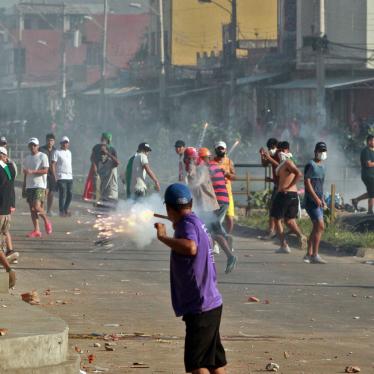
Bolivia: Exercise Restraint in Response to Protests
Bolivian President Gonzalo Sánchez de Lozada must bar troops from using lethal force against protesters unless its use is absolutely necessary to protect life, Human Rights Watch said today.
October 15, 2003    Press Release
Printer friendly version

Bolivia: Investigate Killings During Clashes
Following the violent clashes between protesters and security forces, Human Rights Watch said today that the incident must be thoroughly investigated, and that the Bolivian government must ensure that restraints on the use of lethal force were followed.
February 14, 2003    Press Release
Printer friendly version

Bolivia: Child Soldier Global Report 2001
From the Coalition to Stop the Use of Child Soldiers
Almost half of Bolivia’s armed forces are under 18, including some children as young as 14. Poor adolescents are targeted for conscription.
June 12, 2001    Multi Country Report

Bolivia: Landmine Monitor Report 2000
Bolivia signed the Mine Ban Treaty on 3 December 1997 and was the first country of South America to deposit its instrument of ratification with the UN on 9 June 1998. Bolivia has not enacted national implementation legislation.29 Bolivia participated in the First Meeting of State Parties (FMSP) in Maputo in May 1999. In her statement to the plenary, Barbara Canedo Patiño, Director General of Multilateral Issues of the Ministry of Foreign Affairs, called on the countries which had not signed or ratified the treaty to do so as soon as possible, protested against new deployments of AP mines, encouraged states parties to correctly implement the treaty and described her government's support for the contribution of the ICBL and the ICRC. She went on to note, "Bolivia gives priority to the Ottawa Convention and confirms its commitment to fulfilling the terms of the Convention.
August 1, 2000    Multi Country Report

Bolivia Under Pressure
Human Rights Violations and Coca Eradication
In 1995, under strong pressure from the U.S., the Bolivian government began an aggressive coca eradication effort that was strongly resisted by coca growers. Periods of negotiation alternated with outbursts of violence in the Chapare, the sub-tropical region in which thousands of poor farmers produce most of the Bolivian coca. In its efforts to quell their opposition to eradication and to meet its eradication goals, the Bolivian government has engaged in serious human rights abuses such as excessive use of force, arbitrary detention, and the suppression of peaceful demonstrations. The primary agents of this abuse are troops of the Mobil Rural Patrol Unit, the rural antinarcotics police controlled by the Ministry of Government.
HRW Index No.: B804
May 1, 1996    Report

Human Rights Violations and the War on Drugs
Bolivia, one of the world’s leading producers of coca leaf and refined cocaine, is also the largest recipient of U.S. counter-narcotics aid. The aid has led to new legislation, institutions and antinarcotics strategies in Bolivia that are shaped by U.S. concerns and dependent on U.S. funding. But this aid has also supported programs and policies deeply flawed by human rights abuses, including prolonged detention of suspects even after their acquittal, due process violations by antinarcotics police, alleged torture, and impunity for law enforcement personnel accused of violations among both the Bolivian and U.S. forces.
HRW Index No.: B708
July 1, 1995    Report

The Trial of Responsibilities
The Garcia Meza Tejada Trial
On April 21, 1993, the Bolivian Supreme Court delivered a historic verdict, sentencing a former military dictator and forty-seven collaborators to lengthy prison terms for human rights violations, the disruption of a democratic government, and other offenses. This report reviews the verdict of the Bolivian Supreme Court.
HRW Index No.: B506
September 1, 1993    Report


Display only
> Briefing Papers and Publications


Overview of Human Rights Developments

2003


XML/RSS: Americas


HRW Logo Contribute to Human Rights Watch

Home | About Us | News Releases | Publications | About HRW | Info by Country | Global Issues | Campaigns | Free Mailing Lists | Community | Store | Film Festival | Search | Site Map | Contact Us | Press Contacts | Privacy Policy

© Copyright 2006, Human Rights Watch    350 Fifth Avenue, 34th Floor    New York, NY 10118-3299    USA