HUMAN RIGHTS
WATCH Americas FrenchSpanishRussianKoreanArabicHebrewspacer
RSSPortugueseGermanChinesePersianMore Languagesspacer
   
Dominican Republic

DR-CAFTA Falls Short on Workers’ Rights
By Carol Pier (*)
The U.S. House of Representatives will likely vote before the end of this week on the U.S.-Dominican Republic-Central America Free Trade Agreement (DR-CAFTA). The House should reject the accord for falling short on workers' human rights because it does not require countries to protect women workers from discrimination or to have laws that meet international labor standards.
July 27, 2005    Commentary
Printer friendly version

The United States-Dominican Republic-Central America Free Trade Agreement Falls Short on Workers' Rights
Written Testimony Submitted to the U.S. House of Representatives Committee on Ways and Means
Human Rights Watch welcomes the opportunity to testify regarding workers’ human rights under the proposed United States-Dominican Republic-Central America Free Trade Agreement (D.R.-CAFTA). Human Rights Watch takes no position on free trade per se, but we take an active interest in workers’ human rights. We believe that trade agreements can provide leverage to promote workers’ rights, but only when meaningful, enforceable labor rights protections are built into the fabric of the accords. Unfortunately, D.R.-CAFTA does not contain such protections.
April 21, 2005    Testimony
Printer friendly version

Dominican Republic: Women with HIV Doubly Abused
HIV-Positive Women Denied Work, Medical Treatment
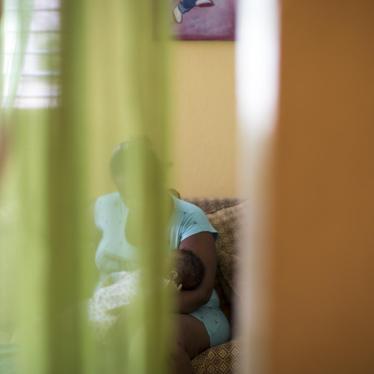
Women in the Dominican Republic are routinely subjected to involuntary HIV testing, and those who test positive are fired and denied adequate healthcare, Human Rights Watch said in a report released today.
July 13, 2004    Press Release
Also available in  spanish 
Printer friendly version

A Test of Inequality
Discrimination against Women Living with HIV in the Dominican Republic
Women in the Dominican Republic are routinely subjected to involuntary HIV testing, and those who test positive are fired and denied adequate healthcare. This 50-page report documents the human rights violations women living with HIV suffer in the public health system as well as in the workplace. Women receive grossly inadequate information about HIV from the public health system, preventing them from giving their informed consent to testing and treatment. Public health professionals routinely reveal HIV test results to women’s families without the tested individuals knowledge or consent, exposing them to violence and abuse. In addition, women living with HIV are frequently denied adequate and equal healthcare.
HRW Index No.: B1604
July 13, 2004    Report
Also available in  spanish 
Download PDF, 331 KB, 50 pgs
Purchase online

CAFTA: A Topic for Women
By Marianne Mollmann. Originally published in Peru.21, Lima, Peru, June 13, 2004
It is not necessary to be an anti-globalization activist to worry about the trade negotiations between Peru and the United States. You just have to be a woman. All trade agreements negotiated by the Bush administration have ignored the internationally recognized right to nondiscrimination in the workplace, and none has included adequate labor rights protections. The result? Peru might benefit from a trade agreement with the United States that does not condemn potential labor rights violations. Women, on the other hand, might enter the workplace in greater numbers, but at a high cost: discrimination in the workplace could rest in impunity. This is unacceptable.
June 16, 2004    Commentary
Also available in  spanish 
Printer friendly version

Dominican Republic Discriminates Against Women with HIV
Letter to CEDAW Committee Members
In January 2004, Human Rights Watch conducted research in the Dominican Republic on human rights violations suffered by women living with HIV. We documented violations of the rights to bodily integrity, nondiscrimination, the highest attainable standard of health, work, information on health, and privacy.
May 25, 2004    Letter
Also available in  spanish 
Printer friendly version

Dominican Republic: U.S. Trade Pact Fails Pregnant Women
CAFTA Fails to Protect Pregnant Workers Against Rampant Job Discrimination
Women who become pregnant are routinely fired from jobs and shut out of employment in the Dominican Republic’s export-processing sector, Human Rights Watch said in a briefing paper released today. The proposed U.S.-Central America Free Trade Agreement (CAFTA), which ignores workplace discrimination, will allow these abuses to persist.
April 22, 2004    Press Release
Also available in  spanish 
Printer friendly version

Deported Because of Skin Color in The Dominican Republic
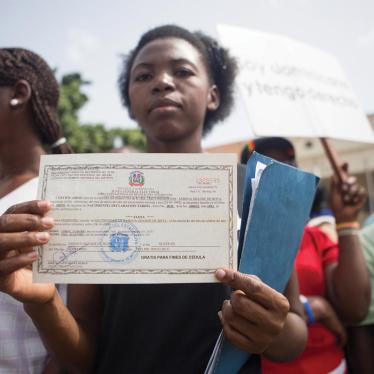
Targeted because their skin color is often darker, "Haitian-looking" people are frequently deported to Haiti within hours of their detention, causing families to be separated and children to be left behind. Suspected undocumented Haitians - including Dominicans of Haitian descent - have no fair opportunity to challenge their expulsion. Released on April 4, "'Illegal People': Haitians and Dominico-Haitians in the Dominican Republic," calls on the Dominican Republic to revise its deportation policies to ensure due process and to avoid race-based discrimination, to recognize the citizenship of Dominicans of Haitian descent, and to allow Haitian children to attend Dominican schools.
May 1, 2002    Advocacy Impact

Dominican Republic: Deportations Conducted Unfairly
The Dominican Republic should revise its deportation policies to ensure due process and to avoid race-based discrimination, Human Rights Watch urged in a new report released today. Human Rights Watch also called on the government to protect Dominicans of Haitian descent from deportation, consistent with the constitution's rule of citizenship by birth.
April 4, 2002    Press Release
Printer friendly version

"Illegal People"
Haitians And Dominico-Haitians In The Dominican Republic
Over the past decade, the Dominican government has deported hundreds of thousands of Haitians to Haiti, as well as an unknown number of Dominicans of Haitian descent. On several occasions, most recently in November 1999, the Dominican authorities have conducted mass expulsions of Haitians and Dominico-Haitians, rounding up thousands of people in a period of weeks or months and forcibly expelling them from the country.
HRW Index No.: B1401
April 4, 2002    Report
Also available in  spanish 
Download PDF
Purchase online

"Illegal People"
Haitians and Dominico-Haitians in the Dominican Republic
Over the past decade, the Dominican government has deported hundreds of thousands of Haitians to Haiti, as well as an unknown number of Dominicans of Haitian descent. On several occasions, most recently in November 1999, the Dominican authorities have conducted mass expulsions of Haitians and Dominico-Haitians, rounding up thousands of people in a period of weeks or months and forcibly expelling them from the country. Snatched off the street, dragged from their homes, or picked up from their workplaces, “Haitian-looking” people are rarely given a fair opportunity to challe nge their expulsion during these wholesale sweeps. The arbitrary nature of such actions, which myriad international human rights bodies have condemned, is glaringly obvious.The country’s daily flow of deportations follows a similar pattern. Suspected Haitians are targeted for deportation based on the color of their skin, and are given little opportunity to prove their legal status or their claim to citizenship. As a rule, people facing deportation from the Dominican Republic have no chance to contact their families, to collect their belongings, or to prepare for departure in any way. They are frequently dropped off at the Haitian border within a matter of hours after their initial detention, sometimes with nothing more than the clothes on their back.The summary procedures in use during these deportations fall far short of the due process requirements of international law, specifically those outlined in the International Covenant on Civil and Political Rights, and the American Convention on Human Rights. The race-based selection of deportees violates international prohibitions on racial discrimination.
April 1, 2002    Report
Download PDF, 139 KB, 32 pgs
Purchase online
Printer friendly version

Dominican Republic: Child Soldier Global Report 2001
From the Coalition to Stop the Use of Child Soldiers
There are no indications of under-18s in government armed forces. National legislation provides for the special protection of children at times of war.
June 12, 2001    Multi Country Report

Haitian Immigrants in the Dominican Republic
Thousands of Haitians participate in the Dominican sugar harvest every year, contracted by the State Sugar Council (CEA: Consejo Estatal de Azúcar) for the harvest. Historically, the conditions of the migrant laborers and the treatment accorded them have given rise to several complaints.
January 1, 2001    Graphic

Dominican Republic: Landmine Monitor Report 2000
The Dominican Republic signed the Mine Ban Treaty on 3 December 1997 and ratified on 30 June 2000. It is not believed to have enacted domestic implementing legislation. The Dominican Republic was not present at the First Meeting of States Parties to the Mine Ban Treaty in Maputo in May 1999 and has not participated in the intersessional meetings of the ban treaty. It voted in favor of the December 1999 UN General Assembly resolution supporting the Mine Ban Treaty. The Dominican Republic is not believed to have ever produced, transferred, stockpiled or used AP mines. It is not mine-affected.
August 1, 2000    Multi Country Report

Political Unrest in the Dominican Republic
Human Rights Watch condemned police shootings in the Dominican Republic and called on President Leonel Fernández to order immediate investigations of the violence in the capital.
January 27, 1999    Press Release
Printer friendly version

A Troubled Year
Haitians in the Dominican Republic
The Dominican government's human rights practices on its state-owned sugarcane plantations in 1992 were shaped by two events in the Dominican Republic and Haiti in 1991. One, between the months of June and September 1991, was the Dominican authorities' summary expulsion from the country of as many as 6,000 Haitians and Dominicans of Haitian origin, and the flight to Haiti of tens of thousands of others who sought to avoid forced deportation. The other was the bloody September 30, 1991 military coup in Haiti, which ousted the first democratically elected Haitian president, Jean-Bertrand Aristide; resulted in the mass killing of civilians; systematically trampled basic civil and political rights; and provoked a hemisphere-wide trade embargo. The military takeover in Haiti led thousands of Haitians and Dominico-Haitians to cross the border once again, to return to the country that only months earlier had grievously mistreated them. Once more, many were compelled to cut sugarcane on government plantations.
October 1, 1992    Report
Download PDF, 299 KB, 51 pgs
Printer friendly version

Dominican Authorities Ban Creole Radio Program and Crack Down on Protesters
In February, the Dominican Republic's telecommunications chief suspended the Creole-language news program of a popular Dominican radio station based in the southwest region of the country, near the Haitian border. After receiving complaints from Haiti's de facto military rulers, the Dominican authorities barred Radio Enriquillo from transmitting its news program in Creole, the Haitian language. The program is widely heard in Haiti. Since the ruthless supression of the Haitian press, which began on the first day of the September 30, 1991 military coup in Haiti, Radio Enriquillo has been a main source of information for Haitians on developments in their own country -- including human rights abuses by the army -- as well as on the progress of international negotiations for the restoration of ousted President Jean-Bertrand Aristide. By seeking to silence Radio Enriquillo's Creole broadcasts to Haiti, Dominican authorities have become a party to the Haitian military's efforts to impose a blackout on all independent sources of information reaching the Haitian people. The banning of the Creole program also marked the beginning of a crackdown on local Dominican popular organizations that have sought peacefully to demonstrate their support for Radio Enriquillo.
April 10, 1992    Report
Download PDF, 94 KB, 7 pgs
Printer friendly version

Personas Ilegales
Haitianos Y Domínico-Haitianos En La República Dominicana
Durante la última década, el gobierno dominicano ha deportado a cientos de miles de haitianos a Haití, así como a un número desconocido de dominicanos de ascendencia haitiana. En varias ocasiones, la más reciente en octubre de 1999, las autoridades dominicanas han realizado expulsiones masivas de haitianos y dominico- haitianos, deteniendo a miles de personas en un período de semanas o meses y expulsándolas a la fuerza del país. Capturados en la calle, arrancados de sus casas o detenidos en sus lugares de trabajo, las personas con apariencia haitiana” reciben rara vez la justa oportunidad de cuestionar su expulsión durante estas redadas masivas. El carácter arbitrario de dichas acciones, que han sido condenadas por toda una gama de organismos internacionales de derechos humanos, es manifiestamente obvio.
April 1, 1992    Report
Download PDF, 342 KB, 34 pgs
Printer friendly version


Display only
> Briefing Papers and Publications


Overview of Human Rights Developments

1998
1997
1996
1992
1991
1990
1989


XML/RSS: Americas


Related Material

Films
screened in the HRW International Film Festival

2000: My American Girls: A Dominican Story


HRW Logo Contribute to Human Rights Watch

Home | About Us | News Releases | Publications | About HRW | Info by Country | Global Issues | Campaigns | Free Mailing Lists | Community | Store | Film Festival | Search | Site Map | Contact Us | Press Contacts | Privacy Policy

© Copyright 2006, Human Rights Watch    350 Fifth Avenue, 34th Floor    New York, NY 10118-3299    USA