![]() | ![]() ![]() | |
|
| ||
|
|
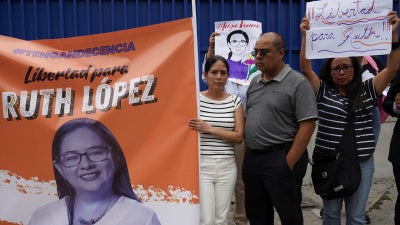
El Salvador El Salvador: Terrorism Law Misused Against Protesters Salvadoran Legislature Should Amend Overbroad Law Against Terrorism The government of El Salvador should dismiss terrorism charges brought against protesters who allegedly blocked roads and threw stones at a July 2 demonstration, Human Rights Watch said today. July 31, 2007 Press Release Also available in
Printer friendly version Domestic Workers Abused Worldwide Report Spotlights Violence and Slavelike Conditions in 12 Countries Domestic workers face a wide range of grave abuses and labor exploitation, including physical and sexual abuse, forced confinement, non-payment of wages, denial of food and health care and excessive working hours with no rest days, Human Rights Watch said in a new report today. July 26, 2006 Press Release Also available in
Printer friendly version Swept Under the Rug Abuses against Domestic Workers Around the World
HRW Index No.: C1807 July 26, 2006 Report Download PDF, 470 KB, 95 pgs Purchase online Read Press Release DR-CAFTA Falls Short on Workers’ Rights By Carol Pier (*) The U.S. House of Representatives will likely vote before the end of this week on the U.S.-Dominican Republic-Central America Free Trade Agreement (DR-CAFTA). The House should reject the accord for falling short on workers' human rights because it does not require countries to protect women workers from discrimination or to have laws that meet international labor standards. July 27, 2005 Commentary Printer friendly version The United States-Dominican Republic-Central America Free Trade Agreement Falls Short on Workers' Rights Written Testimony Submitted to the U.S. House of Representatives Committee on Ways and Means Human Rights Watch welcomes the opportunity to testify regarding workers’ human rights under the proposed United States-Dominican Republic-Central America Free Trade Agreement (D.R.-CAFTA). Human Rights Watch takes no position on free trade per se, but we take an active interest in workers’ human rights. We believe that trade agreements can provide leverage to promote workers’ rights, but only when meaningful, enforceable labor rights protections are built into the fabric of the accords. Unfortunately, D.R.-CAFTA does not contain such protections. April 21, 2005 Testimony Printer friendly version El Salvador: Investigate Trade Unionist Assassination Letter to Salvadoran president Elías Antonio Saca We write to express deep concern regarding the assassination of trade unionist Gilberto Soto. November 23, 2004 Letter Also available in
Printer friendly version El Salvador: Child Labor on Sugar Plantations Foreign Firms Use End Product of Children’s Hazardous Work Businesses purchasing sugar from El Salvador, including The Coca-Cola Company, are using the product of child labor that is both hazardous and widespread, Human Rights Watch said in a report released today. June 10, 2004 Press Release Also available in
Printer friendly version Turning a Blind Eye Hazardous Child Labor in El Salvador’s Sugarcane Cultivation Businesses purchasing sugar from El Salvador, including The Coca-Cola Company, are using the product of child labor that is both hazardous and widespread. Harvesting cane requires children to use machetes and other sharp knives to cut sugarcane and strip the leaves off the stalks, work they perform for up to nine hours each day in the hot sun. Nearly every child interviewed by Human Rights Watch for its 139-page report said that he or she had suffered machete gashes on the hands or legs while cutting cane. These risks led one former labor inspector to characterize sugarcane as the most dangerous of all forms of agricultural work. HRW Index No.: B1602 June 10, 2004 Report Also available in
Download PDF, 500 KB, 73 pgs Purchase online CAFTA's Weak Labor Rights Protections: Why the Present Accord Should be Opposed A Human Rights Watch Briefing Paper, March 2004 On February 20, 2004, President George W. Bush notified Congress of his intent to sign the U.S.-Central America Free Trade Agreement (CAFTA)-an accord that the United States recently negotiated with Costa Rica, El Salvador, Guatemala, Honduras, and Nicaragua. According to U.S. law, the president must wait ninety days from the date of notification before signing the agreement and can send it to Congress for a vote any time thereafter. March 10, 2004 Background Briefing Also available in
Printer friendly version El Salvador: Girls Working as Domestics Face Abuses Tens of thousands of girls in El Salvador work as domestics, a form of labor that makes them particularly vulnerable to physical abuse and sexual harassment, Human Rights Watch charged in a report released today. January 15, 2004 Press Release Also available in
Printer friendly version Voices of El Salvador Girl Domestic Workers Testimonies from "No Rest: Abuses Against Child Domestics in El Salvador" “When I was ten, I went to work in the first house. I would wash the dishes, make the beds . . . . I slept there. This was in San Salvador. They didn’t pay me because they left and went to their mother’s house and didn’t give me the address. I worked there for four months without being paid. I worked from 6 a.m. to 9 p.m. In the morning I would do the cleaning and then make lunch. I took care of the three-year-old child. I would cook [and] wash clothes.” January 15, 2004 Testimony Printer friendly version No Rest Abuses Against Child Domestics in El Salvador Tens of thousands of girls in El Salvador work as domestics, a form of labor that makes them particularly vulnerable to physical abuse and sexual harassment. This 35-page report calls on the Salvadoran government to include domestic workers, who are almost exclusively girls and young women, in its program to address hazardous child labor. Girls as young as nine work as domestics in El Salvador and may labor 12 hours or more, up to six days a week, for wages of $40 to $100 a month. They are particularly vulnerable to physical abuse and sexual harassment from members of the household in which they work. HRW Index No.: B1601 January 15, 2004 Report Also available in
Download PDF, 558 KB, 38 pgs Purchase online El Salvador: Government Ignores Widespread Labor Abuse CAFTA Must Include Strong Protection for Workers' Rights Workers' human rights in El Salvador are systematically violated by employers while the government disregards or even facilitates the abuses, Human Rights Watch said in a report released today. From December 8-12, El Salvador will be participating in the final round of negotiations for the U.S.-Central America Free Trade Agreement (CAFTA), a proposed trade pact with profound implications for labor rights. December 4, 2003 Press Release Also available in
Printer friendly version Deliberate Indifference El Salvador's Failure to Protect Workers' Rights This 110-page report documents serious violations of workers' human rights and examines the role of the government. It features case studies in the private and public sectors, in manufacturing and service industries, and concludes that workers face an uphill battle to exercise their rights, regardless of the sector. Three of the highlighted companies supplied internationally known, U.S.-based apparel corporations. Human Rights Watch found that employers delay salary payments, fail to pay overtime due, deny mandatory bonuses and vacation payments, and pocket workers' social security contributions, preventing them from receiving free public health care. Most pervasively, employers use myriad tactics to violate workers' right to freedom of association. The report calls on El Salvador to strengthen its labor laws by requiring reinstatement for workers illegally fired or suspended for legitimate trade union activity, banning anti-union hiring discrimination, and streamlining union registration requirements according to ILO recommendations. Human Rights Watch urges the Ministry of Labor to uphold workers' human rights by following legally mandated inspection procedures, facilitating rather than obstructing union registration, and refraining from participating with employers in illegal anti-union conduct. HRW Index No.: B1505 December 4, 2003 Report Also available in
Download PDF Purchase online Labor Rights Protections in CAFTA In January 2003, U.S.-Central America Free Trade Agreement (CAFTA) negotiations began among the United States, Costa Rica, El Salvador, Guatemala, Honduras, and Nicaragua. The final negotiating round is scheduled for early December 2003. CAFTA presents an important opportunity to raise labor standards throughout Central America. Free trade alone, however, cannot guarantee greater respect for workers’ rights. Instead, meaningful protections for workers’ human rights should be built into CAFTA. October 14, 2003 Background Briefing Printer friendly version The Right Way to Trade This week the United States and Costa Rica, El Salvador, Guatemala, Honduras and Nicaragua have been conducting the sixth of nine negotiating rounds for a U.S.-Central America Free Trade Agreement (CAFTA). The United States has already proposed labor rights provisions for CAFTA similar to those in the U.S free trade agreements with Chile and Singapore. But those are the wrong models. August 1, 2003 Commentary The Right Way to Trade By Carol Pier, Expert for Labor Rights and Trade Issues at Human Rights Watch Published in The Washington Post The Bush administration is quietly carrying on a major new trade negotiation with Central America that could show -- contrary to the notion that globalization hurts workers -- how international trade deals can increase respect for labor rights. But the Bush team must get the right formula into its briefing books. August 1, 2003 Commentary Printer friendly version El Salvador: Child Soldiers Global Report 2001 From the Coalition to Stop the Use of Child Soldiers There are indications of under-18s in government armed forces since voluntary recruitment can take place from the age of sixteen. During the civil war, some 80 per cent of government and 20 per cent of opposition forces were estimated to be children. June 12, 2001 Multi Country Report El Salvador: Landmine Monitor Report 2000 El Salvador signed the Mine Ban Treaty on 4 December 1997 and ratified on 27 January 1999. Thus, the treaty entered into force for El Salvador on 1 July 1999. El Salvador has not yet passed any legislation implementing the ban treaty. It has also not yet submitted its Article 7 transparency report, due by 27 December 1999, even though Vice-Minister of External Relations Rene Eduardo Dominguez has said, "We consider it necessary that transparency exist with respect to complete communication with the United Nations as Depository of the Convention, with the intent of advancing Article 7 reporting." August 1, 2000 Multi Country Report Children in Combat Throughout the world, thousands of children are used as soldiers in armed conflicts.1 Although international law forbids recruiting children under fifteen as soldiers, such young children may be found in government armies and, more commonly, in armed rebel groups. Armed forces, both governmental and non-governmental, often claim that the children in their camps are there for their own protection and welfare. In fact, however, the involvement of the children in the conflict puts them in grave danger and is detrimental to their physical and mental health and development. This report concerns the ways in which children are recruited, the possible reasons for their recruitment and participation, the roles children play in combat and in violence against civilians, and their treatment by the groups that recruit them. It does not deal with all of the countries in which child soldiers are used, but only with countries in which Human Rights Watch has investigated the practice. Legal standards for the prevention of the recruitment of children and problems in applying and enforcing them are covered as well. January 1, 1996 Report Download PDF, 219 KB, 26 pgs Printer friendly version |
![]() ![]()
| |||||||||||||||
|
Contribute to Human Rights Watch
Home | About Us | News Releases | Publications | About HRW | Info by Country | Global Issues | Campaigns | Free Mailing Lists | Community | Bookstore | Film Festival | Search | Site Map | Contact Us | Press Contacts | Privacy Policy © Copyright 2006, Human Rights Watch 350 Fifth Avenue, 34th Floor New York, NY 10118-3299 USA |