

HUMAN RIGHTS
WATCH Americas PortuguesFrancaisRussianGerman
EspanolChineseArabicOther Languages
   
Peru Confronts a Violent Past:
The Truth Commission Hearings in Ayacucho


Accomarca massacre

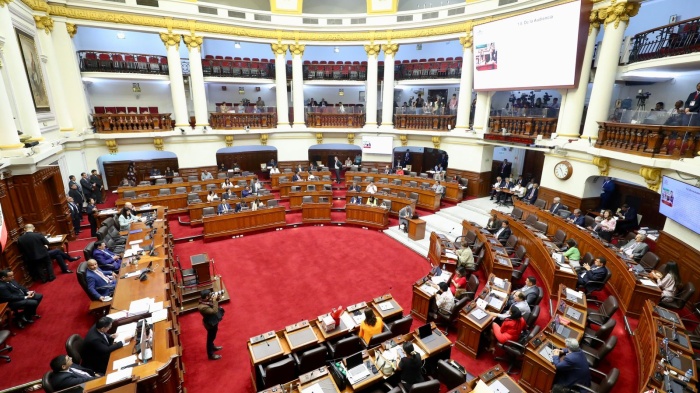
From April 8 to 12, Peru's Truth and Reconciliation Commission held its first public hearings in the cities of Huamanga and Huanta, in the rural department of Ayacucho. Sebastian Brett of the Americas division of Human Rights Watch attended some of the hearings as an international observer. This is his report.

The Right to be Happy

Liz Rojas Valdez was barely a teenager when her mother Marcela, a school teacher and single parent, went out one afternoon to buy a sack of potatoes and never returned. Shining Path guerrillas had organized a strike in Huamanga that day and the town was without electricity, adding to the girl's anxiety when dusk fell and Marcela did not reappear. With her baby brother Paul in tow, Liz set off in the dark to search for her mother. A family friend told Liz that her mother had been arrested and taken to the headquarters of the investigations police, but the police denied holding her. Liz was unable to sleep that night.

After days of pleading for information, Liz was finally able to get an officer to speak to her secretly. He told her that Marcela had been taken to an army base for torture, and that she might have been raped, killed, and her body incinerated. Up to now, Liz has been unable to find out what really happened to her mother and to see those responsible for her mother's "disappearance" brought to justice. But she told the audience at the Truth and Reconciliation Commission's April 8 hearing that she knew exactly who they were.

Liz last saw her mother on May 17, 1991, but the emotional impact of her account, the depth and precision of its detail, made the events seem much more immediate.


  "I need to see my mother's bones so that I can bury her."

"It's been like a shadow over my life. There is not a single moment in which I can feel happy. I had my first child when I was fifteen. I was on my own and there was no one to help me. I need to see my mother's bones so that I can bury her. Everyone has somewhere to go to say farewell to their dead. I have a right to be happy, too," sobbed 23-year-old Liz, as long suppressed rage about her stolen childhood burst to the surface.

Several of the commissioners listening to Liz's story seemed to be concentrating hard to hold back the tears. It was a scene that was to repeat itself over and over during the next few days.

A Healing Process

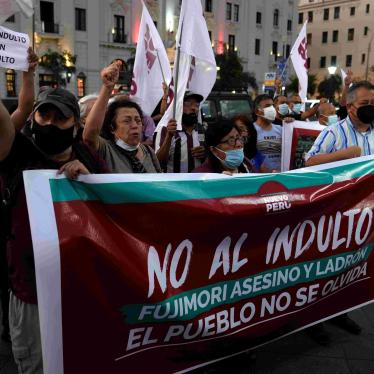
Ayacucho was the birthplace of the Shining Path, a Maoist guerrilla force that brought terror to Peru's cities and countryside in the early 1980s. By the mid-1990s the worst of the war was over, but the human cost was enormous: at least 30,000 had perished at the hands of the insurgents and the government's security forces. Police and army units are believed responsible for more than 6,000 "disappearances," for notorious massacres of civilians, and for the systematic torture of thousands picked up as guerrilla suspects, often on the basis of rumor and hearsay. In 1995 President Alberto Fujimori passed an amnesty law intended to ensure permanent impunity for the military and police officials responsible for these abuses.

After Fujimori left office in November 2000, disgraced by corruption scandals, interim president Valentín Paniagua set up a seven-member commission to investigate the violations of human rights and international humanitarian law that took place during the twenty-year conflict. Following a long campaign by the local human rights community, all of Peru's political parties expressed support for the commission. Current president Alejandro Toledo enlarged it to twelve members. They include anthropologists and social scientists, jurists, members of the Catholic and evangelical churches, a retired air-force general, and a prominent member of the human rights community. Bishop Luis Bambarén, president of the Peruvian Episcopal Conference, acts as an official observer. The commission has only two women members, however, and, regrettably, does not include anyone from Peru's indigenous communities, although certain of the commission's members are fluent in Quechua.

The commission's tasks are to discover the root causes of the political violence; to aid the courts in clarifying crimes involving human rights abuse and determining criminal responsibility; to elaborate proposals for reparation for the victims and their families; to make recommendations for improving human rights protection; and to establish mechanisms to follow up implementation of its recommendations.

The Huamanga proceedings were the first public hearings ever held by a truth commission in the Americas. In Argentina, Chile, and other countries in the region that have held truth commissions to document past atrocities, such commissions interviewed witnesses behind closed doors, and distilled their testimonies into book-length reports. In Peru, even prior to the release of the commission's planned report, the public is able to see and hear the witnesses direct. In this respect, the Peruvian hearings are like those of the South African Truth and Reconciliation Commission.

These hearings, which will be held in each of the remote regions affected by the armed conflict, are not meant to serve an investigative or judicial purpose (the testimonies have been previously documented). Rather, they serve, in the commission's words, "as an act of dignifying and healing for the victims and those who can identify with the cases brought up." The commission also sees the hearings as a way of "overcoming discriminatory acts which permanently victimize large groups of the population." Peru's rural indigenous population has suffered from discrimination and neglect for centuries, and its voice is seldom heard in politics or in the press.

Many of the witnesses at the hearings testified in Quechua with simultaneous translation. The proceedings were televised live by a cable channel, Canal N , and excerpts were broadcast on the state television channel. Appropriately, the hearings took place in an auditorium at Huamanga University, the school where then-Professor Abimael Guzmán, who is now serving a life sentence for his leadership of Shining Path, gained his first recruits, and where several of the victims were once students or teachers.


  "We found corpses with their eyes hanging out, with no ears, women whose breasts had been cut off."

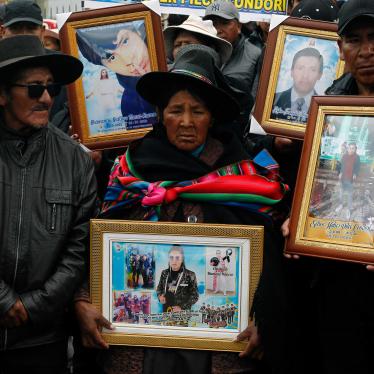
Dressed in a traditional shawl and woven hat and speaking in Quechua, Angélica Mendoza de Ascarza waved a yellowing scrap of paper on which her son had scribbled: "mom, I'm inside the (army) base. Find a lawyer, some money, and please get me out of here, I'm desperate." Arquímedes Ascarza, a student, was arrested by thirty hooded men at Mendoza's home in Ayacucho on July 3, 1983. They took him to the army base of Los Cabitos, from where he managed to smuggle out his call for help. But Arquímedes could not be traced. Litigation, public denunciations, and even bribery all proved fruitless. Nor could Angélica Mendoza find Arquímides' body at any of the sites where corpses were dumped. "We found corpses with their eyes hanging out, with no ears, women whose breasts had been cut off. The soldiers guarded the bodies until the animals devoured them and only the bones were left."

Massacres

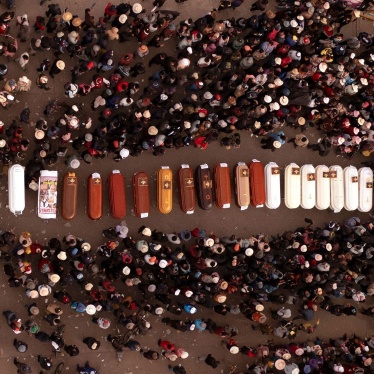
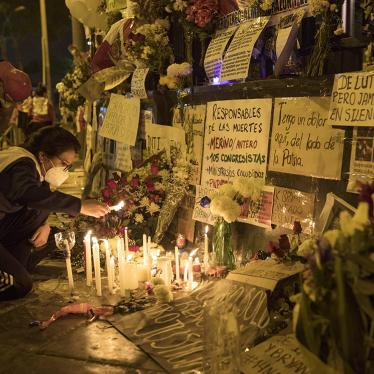
Survivors and relatives recalled some of the most barbaric massacres of the armed conflict, such as those of Socco (1983), Pucayacu (1984), Rosario (1984), and Accomarca (1985), in which dozens of men, women, and children were gunned down by police and army troops, and their bodies mutilated, burned, or cast down ravines. Impunity for these atrocities was almost complete. The few officers convicted were given short sentences (most were thought to have been imprisoned only for a brief period). Some, like Lt-Col. Telmo Hurtado Hurtado, sentenced by a military court to six years of imprisonment for the Accomarca massacre, were even promoted.

The Shining Path, whose fighters were also Quechua-speaking Indians, was responsible for similar atrocities. Paulina Abarca, an indigenous woman in her forties with button eyes and missing teeth, read out a list of twenty-three ronderos (members of civil defense patrols), stabbed and beaten to death by the Shining Path during an incursion by a 250-strong rebel force into the community of Paqcha in 1989. "They grabbed my husband (Esteban Chumbes, a community leader) and cut his throat in front of me," she described, reliving the attack with the movement of her hands. "They hit me over the head with a stick and they made us lie down in the square without looking while they looted the houses and the community clinic." Having opened the floodgates on these traumatic memories, Paulina Abarca was unable to stop. As happened with so many of the speakers, the memories seemed to catch up with her words and overpower her. Dr. Salomón Lerner, the commission's president, and the human rights workers accompanying her, gently coaxed her away from the microphone.

Peru now faces the daunting task of identifying the victims of these mass killings and building up forensic evidence for use in future court proceedings. Dr. Lerner told Human Rights Watch that more than 150 burial sites are thought to exist across the country. In January 2002 the commission completed its first exhumation at Chuschi, in Ayacucho, successfully identifying eight victims of extrajudicial executions by the army in May 1983. It hopes to carry out a further ten exhumations during the rest of the year. Legal responsibility for these criminal investigations, however, falls to the Attorney General's (AG) office. The nongovernmental Peruvian Forensic Anthropology Team, whose members have carried out exhumations in Rwanda and former Yugoslavia, has played a key operational role. The careful methodology they follow, however, requires a much longer time period than the commission's mandate, which expires in July 2003. The Attorney General's office has appointed advisors to coordinate the exhumations and a special prosecutor is expected to be appointed soon to take overall charge of the cases.

"All my family wants is justice"

Those testifying at the hearings included people from all strata of Peruvian provincial society, from illiterate campesinos from remote rural communities to entrepreneurs, teachers and intellectuals. Among the unsung heroes of the armed conflict in Peru were the mayors who stuck to their posts despite repeated death threats. Typical was Jorge Jaúregui Montero, a prominent member of Popular Action (the party of Fernando Belaúnde, president from 1980-1985). He owned the main electrical and domestic goods store in Huamanga and was elected mayor in 1980. Shining Path, then in its infancy, quickly singled out him out as a target and tried to force him from office. His home was bombed three times, and his warehouse burned to the ground. The death threats became so frequent that he was given police protection. Despite all this, Jaúregui firmly refused to quit.


  "All my family wants is justice."

On December 11, 1982, Jaúregui was inaugurating a health clinic when two youths on a motorbike shot him three times in the head. A surgeon saved his life and he recovered, but his injuries left him disabled for life. After six months spent recovering in Lima, Jaúregui insisted on returning to Huamanga to complete his term. "If I have to die, I will die, but I won't leave my people," he insisted. But in 1987 his store was robbed, and he was too ill to save his business from ruin. "All my family wants is justice," said Gustavo Jaúregui, pointing out his father among the audience. "We love you, dad." Juarégui got unsteadily to his feet to a stirring round of applause.

Justice - A Pending Task

According to the government decree (No. 065-2001-PCM of June 4, 2001) on which the commission's mandate is based, the commission must "contribute to the clarification of crimes and human rights violations by the respective organs of justice by seeking to establish the whereabouts and situation of the victims and by identifying as far as possible those responsible." Apart from cooperating with the Attorney General's office on exhumations and forensic investigations, the commission will turn over its findings to state prosecutors who may initiate criminal prosecutions.

The sweeping amnesty law passed by the Fujimori government in 1995 should not be an obstacle to such prosecutions. In March 2001, the Inter-American Court of Human Rights, ruling on the case of the 1991 Barrios Altos massacre, declared the law null and void and later interpreted that ruling as applicable to all similar cases. Already, a special prosecutor responsible for investigating human rights crimes committed under the Fujjimori government has filed charges against members of the La Colina group, a government death squad responsible for Barrios Altos and the notorious kidnapping and execution of nine students and a professor from La Cantuta university in 1992.

The Attorney General's office recently appointed another independent special prosecutor, Felipe Villavicencio, to coordinate investigations into cases from the 1980s. The decision to do so followed an accord reached between Peru and the Inter-American Commission on Human Rights in February 2001, by which the government agreed to investigate and determine criminal responsibility in some 165 cases the Inter-American Commission still has on its books.

HRW Logo Contribute to Human Rights Watch

Home | About Us | News Releases | Publications | About HRW | Info by Country | Global Issues | Campaigns | Campaigns | Free Mailing Lists | Community | Bookstore | Film Festival | Search | Site Map | Contact Us | Press Contacts | Privacy Policy

© Copyright 2006, Human Rights Watch    350 Fifth Avenue, 34th Floor    New York, NY 10118-3299    USA