
![]() | ![]() ![]() | |
|
| ||
|
|
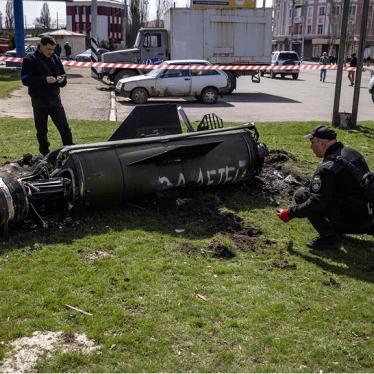
Recent Releases Georgia: Civilians Killed by Russian Cluster Bomb ‘Duds’ More Attacks Confirmed; Unexploded Ordnance Threatens Many Georgian and Russian authorities should take urgent measures to protect the civilian population in Georgian villages from unexploded ordnance left by Russian attacks, Human Rights Watch said today. Human Rights Watch researchers documented additional Russian cluster munitions attacks during the conflict in Georgia, refuting Russia’s earlier denials that it used the weapon. August 20, 2008 Press Release Also available in
Printer friendly version Russian Attacks in Georgia Show Need for Convention on Cluster Munitions By Bonnie Docherty, Researcher Published in JURIST Russia has not only caused civilian casualties with its use of cluster munitions in Georgia, but it has also blatantly disregarded the international decision to ban the weapons. In the process, Russia has demonstrated that states around the world cannot become complacent about the Convention on Cluster Munitions, which 107 of them adopted in May. They must sign and ratify the treaty as soon as possible so that its obligations enter into force and its stigmatization power grows. August 19, 2008 Commentary Printer friendly version Georgia: Russian Cluster Bombs Kill Civilians Stop Using Weapon Banned by 107 Nations Human Rights Watch researchers have uncovered evidence that Russian aircraft dropped cluster bombs in populated areas in Georgia, killing at least 11 civilians and injuring dozens. August 15, 2008 Video Background on Russia and Cluster Munitions The Russian Federation was not part of the Oslo Process launched in February 2007 to develop a new international treaty banning cluster munitions. In May 2008, 107 nations adopted the Convention on Cluster Munitions, which comprehensively bans the use, production, trade and stockpiling of the weapon. It will be open for signature in Oslo on December 3, 2008. August 14, 2008 Background Briefing Printer friendly version Georgia: Russian Cluster Bombs Kill Civilians Stop Using Weapon Banned by 107 Nations Human Rights Watch researchers have uncovered evidence that Russian aircraft dropped cluster bombs in populated areas in Georgia, killing at least 11 civilians and injuring dozens, Human Rights Watch said today. Human Rights Watch called upon Russia to immediately stop using cluster bombs, weapons so dangerous to civilians that more than 100 nations have agreed to ban their use. August 14, 2008 Press Release Also available in
Printer friendly version US: Pentagon’s ‘New’ Cluster Bomb Policy Treads Water US Campaign to Ban Landmines Press Release The Pentagon announced Monday that the US military would continue to use and export even the most unreliable cluster bombs over the next decade. This policy decision comes shortly after 111 countries, including major NATO allies, agreed to a global treaty banning cluster bombs. The new policy states that the United States will not impose restrictions on the use or export of cluster bombs, including those with high failure rates, until 2018. The announcement drew heavy criticism from human rights groups because of the danger that unexploded cluster munitions pose to civilians. July 8, 2008 Web Site US Out of Step with Allies with Hollow 'New' Cluster Bomb Policy: Unrestricted Use for another Decade Cluster Munition Coalition Press Release A month after 111 nations including major US allies agreed to ban cluster bombs, the United States says it will continue to use its huge stockpile for another decade. According to the new policy memorandum signed by Secretary of Defense Robert Gates, the US will also seek to ship cluster bombs to other countries, despite US law prohibiting transfers. After 2018, the US will still use cluster munitions with a claimed failure rate of less than 1 percent, despite wide recognition that a failure rate approach will not prevent unacceptable harm to civilians.The policy puts the US squarely at odds with the 111 nations-including nearly all major US allies-that agreed to a new international treaty in May that comprehensively bans the use, production, trade and stockpiling of cluster munitions, no matter what the failure rate. The United States has been the leading known user, producer, stockpiler, and exporter of cluster bombs. July 8, 2008 Web Site Cluster Bomb Treaty Breaks New Ground The new cluster munitions treaty adopted in Dublin on May 30, 2008, will save thousands of lives for decades to come, with key treaty provisions stronger than even some of its staunchest supporters had expected, Human Rights Watch said today. The treaty immediately bans all types of cluster munitions, rejecting initial attempts by some nations to negotiate exceptions for their own arsenals, as well as calls for a transition that would delay the ban for a decade or more. May 30, 2008 Press Release Also available in
Printer friendly version Opening Remarks in the Closing Press Conference of the Dublin Diplomatic Conference on Cluster Munitions Delivered by Steve Goose, director of the Human Rights Watch Arms Division and co-chair of the Cluster Munition Coalition This convention is a gift to the world. The real beneficiaries are the thousands of civilians who will not lose their lives or limbs to cluster munitions—cluster munitions that will never be produced and never be used. This is an all too rare example of governments responding to the call of civil society—a call to deal urgently and comprehensively with a humanitarian imperative. May 30, 2008 Oral Statement Printer friendly version US: Defeat at Clusters Parley US efforts to undermine a new treaty banning cluster munitions met with significant defeat today at the final negotiations in Dublin, Human Rights Watch said. May 28, 2008 Press Release Also available in
Printer friendly version Cluster Munition Coalition Statement to the Committee of the Whole on the Agreement to Adopt the Cluster Munitions Convention Delivered by Steve Goose, director of the Arms Division at Human Rights Watch and co-chair of the Cluster Munition Coalition This convention is a comprehensive ban on cluster munitions as a class of weapons. In many ways it is more comprehensive than the 1997 Mine Ban Treaty. It bans not just some cluster munitions, but all cluster munitions. It does not try to differentiate between good cluster munitions and bad cluster munitions, it bans them all. The weapons that are covered in the Article 2(C) exclusion cannot have the indiscriminate wide area effect and excessive unexploded ordnance effect of cluster munitions, and thus should not be considered cluster munitions. May 28, 2008 Oral Statement Printer friendly version NYT - Working Toward Safer Bombs: 2 Tracks May 27, 2008 Media A cluster of excuses Britain, pushed by the US, is trying to insert a massive loophole in the treaty banning cluster weapons By Marc Garlasco, Senior Military Analyst Published in Guardian Online Before it is too late, the UK needs to start showing some humanitarian principles and some political backbone. As a close ally of the US and a major military player on the global stage, it is important that the UK remains on board the Oslo process. But it is also essential that the UK follow up on Brown's helpful statement this week and start standing for the interests of the victims - past, present and future - of these horrible weapons. May 23, 2008 Commentary Printer friendly version US: Efforts to Weaken Cluster Ban Treaty Threat to US Humanitarian Aid Overblown The US government is trying to win dangerous loopholes in a new treaty on cluster munitions even though it is not participating in the international conference to hammer out a final text, Human Rights Watch said today. May 22, 2008 Press Release Also available in
Printer friendly version UK must stop clinging to cluster bombs By Marc Garlasco, Senior Military Analyst Published in The Independent, Open House Blogs We’ve gathered at the home of the Gaelic Games to write a major new piece of international law. Here in the massive Croke Park Stadium in Dublin, nearly 1,000 diplomats and campaigners are thronging the chilly halls to hammer out the final text of a treaty banning cluster munitions. The United Kingdom is one of the lynchpin nations here, but they are clinging to their last cluster munitions and have thoroughly isolated themselves. May 22, 2008 Commentary Printer friendly version Types of Cluster Munitions in Global Stockpiles Cluster munitions are stockpiled by at least 76 states and have been used in at least 31 countries and disputed territories. A total of 34 states are known to have produced over 210 different types of air-dropped, surface-launched, or submarine-launched cluster munitions including projectiles, bombs, rockets, missiles, and dispensers. This reference chart is organized by type of cluster munition and indicates which states stockpile them. It is not intended to be a complete accounting of stockpiles, and Human Rights Watch welcomes any clarifications, corrections, or updates from state representatives. May 19, 2008 Campaign Document Printer friendly version Interoperability and the Prohibition on Assistance Memorandum to Delegates of the Dublin Diplomatic Conference on Cluster Munitions A provision obliging states parties not to assist with prohibited acts is an accepted and essential part of a modern weapons treaty. The draft cluster munitions convention includes such a provision in Article 1(c). Article 1(c) is based on extensive precedent from past weapons treaties and is indispensable to the humanitarian goal of the convention. Because it prevents states parties from contributing even indirectly to the use of cluster munitions, it promotes the object and purpose of the treaty, which is to minimize civilian harm from the weapons. It also stigmatizes cluster munitions by declaring that states parties will not tolerate their use by anyone and contributes to deterring use by non-states parties. May 19, 2008 Background Briefing Printer friendly version Cluster Munition Coalition Statement to the Opening Plenary of the Dublin Diplomatic Conference on Cluster Munitions Delivered by Steve Goose, director of the Human Rights Watch Arms Division and co-chair of the Cluster Munition Coalition Government delegates should be entering these negotiations with a great sense of excitement at the prospect of what you may be about to accomplish, and a great sense of responsibility. If you are successful in concluding a strong treaty banning cluster munitions, this will be hailed as one of the most important measures that governments have ever taken to protect civilians from the ravages of war, both during and after armed conflict. May 19, 2008 Oral Statement Printer friendly version Statement to the Dublin Diplomatic Conference on Cluster Munitions: Intervention to the Committee of the Whole on Interoperability Delivered by Steve Goose, director of the Human Rights Watch Arms Division and co-chair of the Cluster Munition Coalition The most important thing is that states do not delete or undercut the prohibition on assisting non-signatories with the use of cluster munitions. This is a core prohibition that is essential to the strength of the treaty and to the promotion of the norm against the weapon. We understand that states want to ensure legal protections to their soldiers for any unintentional assistance that could occur during joint military operations. And we do not believe that mere participation in joint military operations is prohibited. May 19, 2008 Oral Statement Printer friendly version Statement to the Dublin Diplomatic Conference on Cluster Munitions: Intervention to the Committee of the Whole on Stockpile Destruction and Retention Delivered by Steve Goose, director of the Human Rights Watch Arms Division and co-chair of the Cluster Munition Coalition It is still not clear why the proposed stockpile destruction deadline of six years is appropriate, as opposed to a shorter period. We have never seen the rationale for that particular number. The Mine Ban Treaty experience has shown us that difficulties in meeting deadlines have come not from too little time, or technical issues, or financial issues, but rather the political will and prioritizatoin to start early enough to finish on time. May 19, 2008 Oral Statement Printer friendly version |
Related Material Films screened in the HRW International Film Festival 2002: Stealing the Fire 2001: Unfinished Symphony 2000: A Greek Tragedy 1999: Zyklon Portrait 1999: Harmed Forces 1999: The Job 1998: Spotlights on a Massacre: 10 Films against Landmines | ||||||||||||||||||||||
|
Contribute to Human Rights Watch
Home | About Us | News Releases | Publications | About HRW | Info by Country | Global Issues | Campaigns | Free Mailing Lists | Community | Store | Film Festival | Search | Site Map | Contact Us | Press Contacts | Privacy Policy © Copyright 2006, Human Rights Watch 350 Fifth Avenue, 34th Floor New York, NY 10118-3299 USA |