|
Frequently Asked Questions
Myths and Realities
Related Links
Key Facts About Cluster Munitions
- Cluster munitions pose an immediate danger to civilians during attacks due to their inaccuracy and wide dispersal pattern.
- After conflict, cluster munitions pose a lasting hazard due to the high number of landmine-like submunition duds that litter the landscape.
- The shapes and small size of cluster munitions are appealing to children, who can mistake them for toys. Children accounted for 60 percent of cluster munition victims in Iraq after the US dropped 61,000 cluster bombs containing some 20 million submunitions between January 17 and February 28, 1991.
- Cluster munitions left behind after conflict kill and injure civilians rebuilding their lives after war.
- Cluster submunitions litter towns, farms, and fields, preventing people from harvesting their crops or using their land for decades after a conflict has ended.
- Cluster munitions have been used and caused civilian harm in Afghanistan, Albania, Bosnia and Herzegovina, Cambodia, Chad, Chechnya, Croatia, Eritrea, Ethiopia, Georgia, Iraq, Kosovo, Kuwait, Laos, Lebanon, Montenegro, Pakistan, Serbia, Sudan, Syria, Vietnam and Western Sahara.
- Billions of submunitions are stockpiled by over 75 countries worldwide.
Key Facts About the Convention on Cluster Munitions
- The Convention on Cluster Munitions is a legally binding international treaty that prohibits the use, production, stockpiling, and transfer of cluster munitions. It was adopted by 107 countries on May 30, 2008 in Dublin, Ireland.
- A key strength of the Convention on Cluster Munitions is its prohibition of cluster munitions as an entire category of weapon. The convention applies to all cluster munitions, putting forth a detailed and comprehensive definition of the weapon.
- The Convention requires that States Parties destroy their stockpiles of cluster munitions within 8 years and clear land contaminated by cluster duds within 10 years. Until clearance is completed, affected states must provide risk reduction education to alert local populations about the dangers of cluster munitions.
- The Convention includes groundbreaking provisions to help victims of cluster munitions. States parties must provide assistance to victims, including medical care, rehabilitation, psychological support, and measures to promote social and economic inclusion.
- The Convention will enter into force six months after the 30th state has ratified it. States parties are obligated to submit an annual transparency report detailing their implementation of the treaty.
States that adopted the Convention on Cluster Munitions on May, 30 2008
Argentina |
Ghana |
Niger |
Australia |
Guatemala |
Nigeria |
Austria |
Guinea |
Norway |
Bahrain |
Guinea-Bissau |
Palau |
Belgium |
Holy See |
Panama |
Belize |
Honduras |
Papua New Guinea |
Benin |
Hungary |
Paraguay |
Bolivia |
Iceland |
Peru |
Bosnia and Herzegovina |
Indonesia |
Philippines |
Botswana |
Ireland |
Portugal |
Brunei Darussalam |
Italy |
Qatar |
Bulgaria |
Jamaica |
Samoa |
Burkina Faso |
Japan |
San Marino |
Burundi |
Kenya |
Sao Tome and Principe |
Cambodia |
Kyrgyzstan |
Senegal |
Cameroon |
Lao PDR |
Serbia |
Canada |
Lebanon |
Seychelles |
Chad |
Lesotho |
Sierra Leone |
Chile |
Lithuania |
Slovakia |
Comoros |
Luxembourg |
Slovenia |
Republic of Congo |
Macedonia (FYR) |
South Africa |
Cook Islands |
Madagascar |
Spain |
Costa Rica |
Malawi |
Sudan |
Côte d’Ivoire |
Malaysia |
Swaziland |
Croatia |
Mali |
Sweden |
Czech Republic |
Malta |
Switzerland |
Democratic Republic of
Congo |
Mauritania |
Tanzania |
Denmark |
Mexico |
Timor-Leste |
Dominican Republic |
Moldova |
Togo |
Ecuador |
Montenegro |
Uganda |
El Salvador |
Morocco |
United Kingdom |
Estonia |
Mozambique |
Uruguay |
Fiji |
The Netherlands |
Vanuatu |
Finland |
New Zealand |
Venezuela |
Germany |
Nicaragua |
Zambia |
|
|
|
|
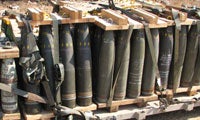 Pallets of 155mm artillery projectiles including DPICM cluster munitions (center and right with yellow diamonds) in the arsenal of an IDF artillery unit on July 23 in northern Israel. Each DPICM shell contains 88 sub-munitions, which have a dud rate of up to 14 percent. © Human Rights Watch 2006
 |
|