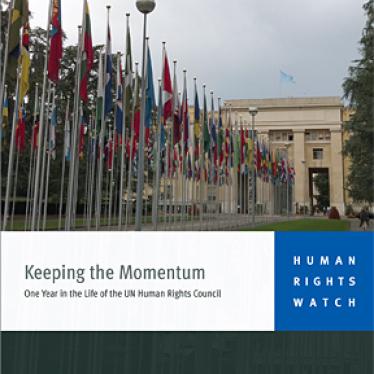
In a letter to the President of the U.N. General Assembly and the Co-Chairs of Negotiations for the U.N. Human Rights Council, two HRW Directors reviewed the options available for the Council. The letter offers the Directors' recommendations for many important issues, including the Council's status, mandate, membership, and transitional arrangements.
Thank you for the opportunity to review the Options Paper on the Human Rights Council (HRC). We appreciate the effort you have made to compile the positions put forward by member states during the informal consultations of the plenary. We would also like to express our gratitude for the open nature of those discussions. Along with other non-governmental organizations (NGOs), Human Rights Watch was pleased to be able to attend those sessions.
We would like to submit our comments on the Options Paper in advance of your elaboration of a compilation text. Rather than address all of the issues raised by the Options Paper, this submission focuses on those issues that we believe are of greatest concern to human rights victims and to NGOs such as Human Rights Watch.
Status
We support creation of the HRC as a principal organ of the General Assembly as soon as possible. Accordingly, we prefer option II.1(a), and would agree with option II.1(c) in the alternative.
With regard to the standing nature of the Council, we believe that the compilation text must include a firm guarantee that current meeting practices of the Commission on Human Rights will be substantially improved, and that the Council will have adequate resources for an enhanced meeting schedule. We support a combination of all three of the options listed in II.2, including that it be a standing body that meets throughout the year and have the ability to call additional meetings as suggested in II.2(c), with additional text that makes clear that regular meetings should occur at least monthly, that the Council should hold at least two extended sessions as part of its regular meetings, and that the Council should have sufficient resources to meet these needs.
Under this formula, the HRC would be able to give sustained attention throughout the year to human rights matters, as well as to convene quickly and easily in response to crisis situations. Regular meetings would provide the opportunity for a more effective approach to fulfilling the Council’s mandate. These meetings would enable the HRC to receive updates, facilitate capacity building, hear reports from U.N. experts in a timely manner, and create a framework for graduated responses to human rights situations. The extended sessions could include a high-level segment, thematic debates, and interactive and focused discussion with Special Procedures. They could also allow for worldwide civil society input into the work of the Council.
Mandate and Functions
We believe that points III.2.(g) and III.2(h) should be part of the HRC’s mandate (section III.1). In addition, we strongly support inclusion of III.2(l) in the HRC’s mandate or functions. The compilation text should also include III.2(i), slightly revised to read “maintain the system of special procedures.” The HRC’s mandate and functions should be broadly written and include these key elements; agreement on more detailed issues could well be left to the HRC itself.
Composition
Human Rights Watch supports option IV.2(a) and believes that it should be combined with option IV.2(c) in the compilation text.
Membership
We strongly support the inclusion of options IV.3(c), (d), and (e), in the compilation text. We would also emphasize that each of these options is fully consistent with option IV.3(a), which states that all member states should have the opportunity to serve on the Council.
Elections
Human Rights Watch supports election of the Council by two-thirds majority (option IV.4(A)(b)). We also strongly favor the inclusion of options IV.4(B)(a), (b), and (d) in the compilation text.
First Election Arrangements
On this point, we believe that there is only one option that is consistent with the basic precepts of this reform—the election of new members of the Council in accordance with option IV.6(a). We believe that that alternative presented by option IV.6(b) would drastically undermine the credibility of this reform.
Rules of Procedures
We believe that option V.1(d) on arrangements and practices for participation and access for NGOs must be included in the compilation text.
Transitional Arrangements
Human Rights Watch believes it is key that the timetable as laid out by the President of the General Assembly be sustained and that an agreement before the end of the year be reached so as to set in motion options VI (a), (b), (c), and (d).
We believe that all of the above elements are essential to the success of this reform. In the end, this effort will be judged by whether the new Human Rights Council is better able to protect and promote human rights than the existing Commission. Only such a Council will fulfill the mandate given to the General Assembly by world leaders in September and the expectations of human rights victims throughout the world.
We look forward to continuing to work with you and the Co-Chairs on the prompt establishment of a stronger and more responsive Human Rights Council.
Sincerely,
Peggy L. Hicks
Global Advocacy Director
Loubna Freih
Geneva Director