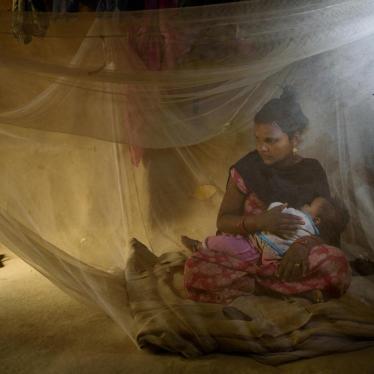
Middle East governments should follow Syria’s example in accepting refugees and asylum seekers fleeing violence in Iraq, Human Rights Watch said today. The Syrian government this week admitted 244 Palestinian refugees who had been stranded at the Jordanian border, as well as another group of around 40 who fled to Syria directly from Baghdad.
“Syria has stepped forward to protect a particularly vulnerable group of refugees,” said Bill Frelick, Refugee Policy director for Human Rights Watch, who visited the refugees in their makeshift camp on the Iraqi side of the Jordanian border on April 30. “Some of the refugees had seen their relatives and friends brutalized and murdered in Iraq.”
The first 89 refugees arrived at the Jordanian border on March 19, and were soon joined by others fleeing threats and violence directed against Palestinians in Baghdad. The refugees were stuck at a remote and inhospitable border post, living hand-to-mouth and in fear. On April 7, Human Rights Watch called upon the Jordanian authorities to admit them, to no avail.
On May 9, the International Organization for Migration transported the refugees in nine buses to the Syrian border. Armed men in Iraq reportedly attacked the convoy, but although they broke bus windows, they did not fire shots, according to refugee accounts of the incident.
The United Nations High Commissioner for Refugees (UNHCR), among others, has made efforts to ensure the safety of around 34,000 Palestinian refugees living in Baghdad. Grand Ayatollah Sayyid al-Sistani issued a statement on April 30 forbidding attacks on them, in response to a wave of attacks on Palestinians in the aftermath of the bombing of a Shia shrine, the al-`Askariyya Mosque, in Samarra on February 22. Despite these efforts, Palestinians at risk in Iraq have neither safe means of leaving the country nor places willing to take them should their evacuation be necessary, Human Rights Watch said.
“These Palestinians are refugees twice over. Israel denies them their right to return to their homeland, but Iraq has become a country where they are targeted for violence,” said Sarah Leah Whitson, director of Human Rights Watch’s Middle East and North Africa division. “Syria’s action in admitting them should be an example for other countries in the region.”
Many of the Palestinians in Iraq are the descendants of persons who were expelled from or fled the Haifa region during the 1948 Arab-Israeli war. Others emigrated to Iraq to take advantage of free education opportunities, or were expelled and fled from Kuwait at the time of the 1990-91 Gulf war.
Syria should not have to bear the asylum burden alone, Human Rights Watch said. The international community should help Syria financially and, where appropriate, provide resettlement for refugees who cannot remain in the region.
Syria already hosts 425,000 Palestinian refugees and at least as many Iraqis who have fled sanctions, war and persecution, the overwhelming majority of whom are not formally recognized as refugees.