
![]() | ![]() ![]() | |
|
| ||
|
|
Bosnia and Hercegovina EU: Tie Serbia’s Membership to Mladic’s Arrest EU Members Should Not Backtrack on Their Commitment to Justice The European Union’s (EU) signing of the Stabilization Association Agreement (SAA) with Serbia today despite Belgrade’s failure to arrest accused war criminal Ratko Mladic is a setback to those seeking justice for genocide in Srebrenica, Human Rights Watch said today. EU member states should refuse to allow Serbia to take additional steps toward EU membership without full cooperation with the International Criminal Tribunal for the former Yugoslavia (ICTY), including the surrender of Mladic. April 29, 2008 Press Release Printer friendly version Follow Up Letter to Bosnian Authorities on Treatment of Terror Suspects Thank you for your reply to our letter of January 25, 2008, in which we expressed concern at the expulsion of Attou Mimoun on December 9, 2007 from Bosnia and Herzegovina to Algeria and for the information you provided regarding the circumstances surrounding the case. We would like to follow-up on the case by asking whether Mr. Mimoun had access to a lawyer at any point prior to his transfer. Moreover, we request information about any communication with the Algerian authorities prior to Mr. Mimoun’s return and whether you are aware of what happened to Mr. Mimoun upon return (whether he was taken into custody) and his current situation in Algeria. March 26, 2008 Letter Also available in
Printer friendly version EU/Serbia: Don’t Compromise on Mladic EU Should Insist on Full Cooperation With Yugoslav Tribunal The European Commission’s decision to move ahead with an association agreement with Serbia despite Belgrade’s failure to arrest a key suspect could threaten efforts to bring war criminals to justice, Human Rights Watch said today. November 6, 2007 Press Release Printer friendly version Serbia Must Boost Support for War Crimes Chamber Council of Europe to Adopt Report on Balkans Prosecutions Today Serbia’s War Crimes Chamber has made significant progress in domestic prosecutions since its establishment in 2003, but the Serbian government must increase its support for the chamber if it is to end impunity for war crimes in Serbia, Human Rights Watch said in a briefing paper released today. June 28, 2007 Press Release Also available in
Printer friendly version Letter to the Bosnian Authorities on Forced Returns to Risk of Torture Amnesty International, the Helsinki Committee for Human Rights in Bosnia and Herzegovina and Human Rights Watch are writing to ask you to exercise your leadership to ensure that every person in Bosnia and Herzegovina subject to deportation, extradition or other removal is protected against return to countries where they would be at risk of serious human rights abuses, including torture or other cruel, inhuman or degrading treatment or punishment (refoulement). May 10, 2007 Letter Also available in
Printer friendly version Bosnia: Local Trials Key as Hague Tribunal Winds Down War Crimes Court Makes Progress in Struggle Against Impunity Bosnia’s War Crimes Chamber has made considerable progress in bringing perpetrators to justice, but to increase public confidence it must do more to explain its work to the people of Bosnia, Human Rights Watch said in a report issued today. February 12, 2007 Press Release Also available in
Printer friendly version Bosnia's War Crimes Chamber Timeline and Key Statistics February 12, 2007 Special Focus Printer friendly version Narrowing the Impunity Gap Trials before Bosnia’s War Crimes Chamber This 61-page report evaluates the chamber’s work in conducting trials. Although a relatively new institution, the chamber has made substantial headway in trying cases, including the trial of 11 defendants charged with genocide for their role in the Srebrenica massacre. Other important accomplishments include introducing support for witnesses in the pre-indictment phase and establishing an effective defense office committed to assisting defendants in trials before the chamber. HRW Index No.: D1901 February 12, 2007 Report Also available in
Download PDF, 406 KB, 58 pgs Purchase online Read Press Release European Parliament: Condemn Complicity in Illegal CIA Activity The European Parliament should condemn European complicity in the US Central Intelligence Agency (CIA) program of “extraordinary renditions” and secret detention of prisoners, Human Rights Watch said today. February 12, 2007 Press Release Printer friendly version Weighing the Evidence Lessons from the Slobodan Milosevic Trial This 76-page report examines key evidence introduced at trial, the most comprehensive account to date of the conflicts in Croatia, Bosnia and Kosovo. The report finds that the trial revealed how leaders in Belgrade and the Federal Republic of Yugoslavia financed the wars; how they provided material to Croatian and Bosnian Serbs; and how they created administrative and personnel structures to support the Croatian Serb and Bosnian Serb armies. The report traces the mechanisms, some of which were previously secret, by which Belgrade fueled the conflicts. HRW Index No.: D1810 December 14, 2006 Report Also available in
Download PDF, 339 KB, 80 pgs Purchase online Read Press Release Kosovo: Criminal Justice System Fails Victims Accountability Must Be Central to Status Talks The criminal justice system continues to fail victims in Kosovo, despite almost seven years of international administration, Human Rights Watch said in a new report released today. Kosovo’s future status is currently the subject of intense negotiations mediated by the international community. May 30, 2006 Press Release Also available in
Printer friendly version Balkan Impunity Outlives Milosevic By Param-Preet Singh Published in European Voice The furore over the death in prison of Slobodan Milosevic weeks before he was due to be sentenced should not obscure the debate about how criminals of the Balkans Wars are to be brought to justice. There is a huge 'impunity gap'. March 23, 2006 Commentary Printer friendly version Bosnian Serb Republic Takes First Steps to Justice Huge Challenges to Keep War Crimes Trials Going After 10 years of allowing suspected war criminals to go free, Bosnia’s Serb Republic is taking its first steps to bring them to justice, Human Rights Watch said in a report released today. But sustaining that progress depends on local commitment and international support. March 16, 2006 Press Release Also available in
Printer friendly version A Chance for Justice? War Crime Prosecutions in Bosnia’s Serb Republic This 42-page report describes the increased momentum towards war crimes trials at the end of 2005, and the opportunity created by the transfer of cases from the new War Crimes Chamber in Sarajevo. It also documents the obstacles to sustained progress on fair and effective prosecutions, including limited prosecutorial resources and insufficient assistance by Republika Srpska police. HRW Index No.: D1803 March 16, 2006 Report Also available in
Download PDF, 317 KB, 44 pgs Purchase online Read Press Release Milosevic Won't Escape History's Verdict Published in International Herald Tribune Slobodan Milosevic conducted his legal defense much as he did his political life: with bombast, bullying and belligerence. Observing Milosevic for weeks and weeks in The Hague in the first half of his four-year trial, it became quickly clear to me that he was undertaking a political offensive in the courtroom rather than presenting a rebuttal of the 66 charges he faced. March 13, 2006 Commentary Printer friendly version Human Rights Watch Memorandum on the Western Balkans Prepared for EU Foreign Ministers’ informal meeting Human Rights Watch welcomes the opportunity to highlight a number of pressing concerns pertaining to the Western Balkans in advance of the informal Gymnich meeting of EU foreign ministers in Salzburg on March 10-11, during which relations with the countries of the region will be discussed. Below we provide a summary overview of these concerns, structured along three broad themes – Kosovo, accountability for war crimes throughout the region, and concerns in areas other than war crimes accountability in two of the countries (Croatia and Serbia and Montenegro) – and offer a number of concrete suggestions for specific steps the EU should take to address them.1 March 7, 2006 Memorandum Printer friendly version Bosnia: Donors Must Ensure Justice for Atrocities New War Crimes Chamber Needs Sufficient International Funding and Support As the international tribunal in The Hague winds up its operations, the new War Crimes Chamber established in Sarajevo to handle remaining cases of serious war crimes will require sufficient international funding and support, Human Rights Watch said in a report released today. Bosnia’s donors are scheduled to meet in Brussels next month. February 8, 2006 Press Release Also available in
Printer friendly version Looking for Justice The War Crimes Chamber in Bosnia and Herzegovina In March 2005, the War Crimes Chamber began operations within Bosnia’s State Court to try cases of serious war crimes in Bosnia and Herzegovina that could not be prosecuted within the mandate or timeframe of the International Criminal Tribunal for the former Yugoslavia (ICTY). The chamber will also handle serious war crimes cases initiated locally. This 44-page report evaluates the initial phase of the chamber, identifies achievements, and makes recommendations on how to improve the chamber’s operations. HRW Index No.: D1801 February 8, 2006 Report Also available in
Download PDF, 309 KB, 46 pgs Purchase online Read Press Release Empty Words and Unmet Promises Dayton and human rights--ten years later By Bogdan Ivanisevic, Human Rights Watch researcher on the former Yugoslavia Published in El Mundo (in Spanish) If the Dayton Peace Agreement, which ended the Bosnian war in November 1995, had been fully implemented in the past ten years, Bosnia and Herzegovina would stand out globally for its superb record on human rights. The agreement proclaimed the right of all refugees and displaced persons to return to their homes, and the state obligation to investigate and prosecute war crimes. More than a dozen international human rights agreements were, quite uniquely, to be directly applicable before domestic courts. November 20, 2005 Commentary Also available in
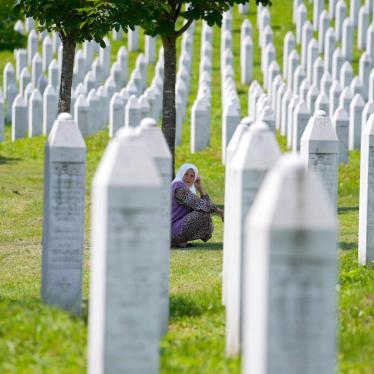
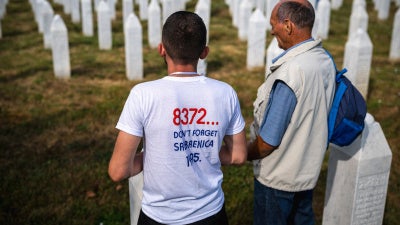
Printer friendly version The Legacy of Srebrenica By Bogdan Ivanisevic, Human Rights Watch researcher on the former Yugoslavia Published in El Mundo The 1995 massacre in Srebrenica occurred because Bosnian Serb leaders, intoxicated by hatred and an illusory sense of omnipotence, lashed out savagely against the country’s Muslim population. But the international community also bears responsibility for the worst crime in Europe since World War Two. After promising protection to the inhabitants of Srebrenica, the United Nations and NATO allowed the “safe area” to fall. That responsibility is compounded by the continuing failure to bring to justice Radovan Karadzic and Ratko Mladic, the two men indicted as the principal architects of the Srebrenica genocide. July 11, 2005 Commentary Printer friendly version |
Related Material Films screened in the HRW International Film Festival 2001: That the Women Live 2001: No Man's Land 2001: A Conversation with Haris | |||||||||||||
|
Contribute to Human Rights Watch
Home | About Us | News Releases | Publications | About HRW | Info by Country | Global Issues | Campaigns | Free Mailing Lists | Community | Store | Film Festival | Search | Site Map | Contact Us | Press Contacts | Privacy Policy © Copyright 2006, Human Rights Watch 350 Fifth Avenue, 34th Floor New York, NY 10118-3299 USA |