Internal Civil Rights Oversight
The Gramm-Miller amendment fails to include basic internal oversight mechanisms to address civil rights abuses by agents and officers of this new and powerful Department. Both the House-passed version of H.R. 5005 and Senator Lieberman's substitute recognize the need for such measures, and include limited provisions to address this issue. Accountability for rights violations is a central theme of Human Rights Watch's work around the world. In the United States, we have investigated abuses by Immigration and Naturalization Service (INS) personnel and found that these abuses persist because agents are not held accountable for violations of law and policy and because of structural flaws in the investigative and disciplinary process. We have made specific recommendations regarding the need to improve mechanisms to prevent, investigate, and punish such abuses.
Given that this massive new agency will exercise broad powers in the context of national security, it is especially important to establish strong civil rights oversight and accountability systems in the new Department. It is not enough merely to create an Office of Inspector General. Congress needs to ensure that the legislation mandates a dedicated system of civil rights oversight with the stature, resources, and expertise to handle civil rights matters. We urge you to support an amendment that fills this critical gap, including the establishment of an effective Assistant Inspector General for Civil Rights and Civil Liberties as well as a Civil Rights Officer with policy and oversight functions.
Protections for Unaccompanied Children
We are also concerned that the Gramm-Miller bill eliminates key provisions to protect unaccompanied immigrant children. Although the Lieberman substitute includes these provisions, they are not part of the Gramm-Miller bill. Gramm-Miller fails to include provisions on standards of detention for children and does not address critical legal needs in children's cases.
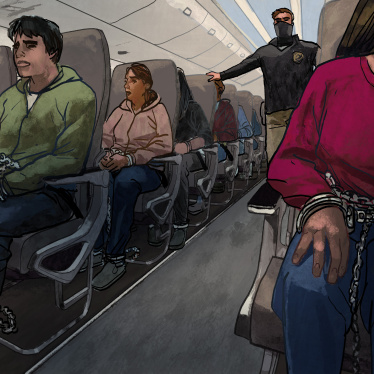
Human Rights Watch has investigated conditions for children detained by the INS in Arizona, California, and Pennsylvania. We have found that too many children are being unnecessarily detained in secure detention centers and for excessive periods of time in violation of international guidelines. Approximately one-third of the roughly 4,000 children detained by the INS each year are placed in secure detention centers, where they are subjected to harsh, punitive conditions and commingled with juveniles charged or adjudicated delinquent in violation of court orders binding on the INS.
In addition, the Gramm-Miller bill does not require that every unaccompanied minor have counsel and a legal guardian whose sole responsibility is to ensure the child's well-being. Absent such provisions, their rights will not be adequately protected. Our research has shown that, under existing standards, children do not receive adequate information about access to legal representation or their legal rights. Children are too often transferred without notification to their families or attorneys. In some cases, children are transferred to facilities thousands of miles from family members, creating unnecessary isolation and exacerbating problems related to family reunification and legal representation.
We urge you to ensure that any homeland security bill passed by the Senate contains protections for unaccompanied minors and strong internal civil rights oversight and accountability measures. Their inclusion in the legislation will demonstrate to the U.S. public and to others around the world that the United States is determined both to protect its national security and to defend fundamental rights.
Sincerely,
/s/
Wendy Patten
U.S. Advocacy Director