
<<previous | index | next>>
III. The Battle for Kabul: April 1992-March 1993
[Washington Post, May 3, 1992] Kabul today is anything but a city basking in triumph. . . . [R]ockets and shells continue to crash into residential neighborhoods, fired by the forces of fundamentalist guerrilla leader Gulbuddin Hekmatyar. . . . Hundreds of civilians lie in hospitals lacking electricity, water, and basic sterilization equipment. More arrive each day. . . . Heavily armed, ethnically divided guerrillas and militiamen prowl the city streets, defending patchwork blocks from their rivals, speaking in heated tones about their various enemies and sometimes looting homes and shops. . . .22
The small measure of calm restored after Hekmatyar’s retreat to the south was not to last. Many of the factions still in the city were openly hostile to one another, and Hekmatyar still wanted a major share of power in the new government.
After peace talks between Massoud and Hekmatyar on May 25, the government initially agreed to name Hekmatyar as prime minister, but the agreement collapsed in less than a week, when President Mujaddidi’s plane came under rocket fire as he returned from a trip to Islamabad on May 29. Mujaddidi claimed that both Hekmatyar’s forces and former agents from the Najibullah government had conducted the attack, and that Hekmatyar had earlier threated to shoot down his plane.23 Meanwhile, Hekmatyar continued to demand that Dostum’s Uzbek militias leave Kabul (which might then allow him to seize the city and expel Massoud’s forces).24 By May 30, Jamiat and Junbish forces were again fighting with Hetmatyar’s forces in the south of the city. Hekmatyar began shelling and rocketing Kabul in early June, hitting all areas of the city, and Junbish and Jamiat forces shelled areas to the south of the city. Meanwhile, Sunni Ittihad and Shi’a Wahdat factions in Kabul began fighting with one another in west Kabul.
As shown in sections below, the fighting between Jamiat and Hezb-e Islami, along with the clashes between Ittihad and Wahdat and later conflicts between Wahdat and Jamiat, led to tens of thousands civilian deaths and injuries, and caused hundreds of thousands to flee Kabul for safer areas.
A: April – December 1992
Ethnic fighting in West Kabul and the Hezb-e Islami attacks on Kabul
This section describes inter-factional hostilities in West Kabul and rocket and artillery attacks on Kabul by Hezb-e Islami forces to the south of the city. The section concludes with a section discussing the violations of international humanitarian law and human rights law which took place during these hostilities.
Wahdat, Ittihad and Jamiat in West Kabul
In May 1992, mere days after Hekmatyar was first driven from Kabul, the predominately Sunni-Pashtun Ittihad forces (under Abdul Rabb al-Rasul Sayyaf) and the predominately Shi’a-Hazara Wahdat forces (under Abdul Ali Mazari) began skirmishing in west Kabul, shooting rockets at each other and engaging in street battles. Each sought to dislodge the other from various neighborhoods or government buildings which each force occupied.
The battles, taking place in the midst of a dense civilian setting, predictably caused high numbers of casualties and lead to widespread destruction of civilian homes and infrastructure. The battles also became increasingly meaningless as the buildings each side occupied in the areas in dispute disintegrated into rubble. Much of west Kabul remains in ruins as of mid-2005, mostly because of fighting in 1992-1996.
There is no single explanation of which side started the fighting between Ittihad and Wahdat. Some observers believe the first problems arose over a relatively mundane issue: posters. Ittihad and Wahdat forces were reportedly tearing down posters of each other’s leaders—Mazari and Sayyaf—which in turn led to arguments between the two side’s troops, in turn leading to conflict between the forces.
A high-level Afghan military officer, General Mohammed Nabi Azimi, who served as a Soviet-era general and was cooperating at the time with the new government to create a national army, recounted in his 1998 memoirs the beginning of the fighting between Wahdat and Ittihad forces:
The first battle between Hazaras and Ittihad-e Islami began on 31 May 1992. First, four members of Hezb-e Wahdat’s leadership were assassinated in the area near the Kabul Silo—Karimi, Sayyid Isma’il Hosseini, Chaman Ali Abuzar, and Vaseegh—of whom the first three were members of the central committee of the party. Shura-e Nazar [i.e., government officials] informed Hezb-e Wahdat that Sayyaf’s men had assassinated them. Next, the car of Haji Shir Alam [a top Ittihad commander] was stopped by Hezb-e Wahdat near the Pol-e Sorkh area, and after releasing him, there was firing at the car which killed one of the passengers.25
Regardless of the proximate causes of the first clashes, the fact that conflict arose between Ittihad and Wahdat forces was not suprising. There was high tension between Wahdat, who were predominately Shi’a Muslims, and the Sunni Ittihad faction, whose members follow an ultra-conservative Islamic creed, Wahabbism, which views Shi’ism as heretical. A great deal of tension was also caused by the influence of foreign combatants and foreign military advisors and intelligence agents from Iran and possibly Saudi Arabia, who were working with some of the factions—Iranians with Wahdat and Saudis with Ittihad. Numerous Iranian agents were assisting Wahdat forces, as Iran was attempting to maximize Wahdat’s military power and influence in the new government. Saudi agents of some sort, private or governmental, were trying to strengthen Sayyaf and his Ittihad faction to the same end.
Rare ceasefires, usually negotiated by Jamiat commanders, representatives of Mujaddidi or Rabbani, or officials from the International Committee of the Red Cross (ICRC), commonly collapsed within days. Compounding the problem, some of the other parties in Kabul periodically joined the fighting at various times, serving to intensify the conflict. Harakat forces sometimes joined the fight with Wahdat against Ittihad. After Wahdat attacked Jamiat positions in July 1992, and hit civilian areas around them, Massoud’s troops launched retaliatory artillery attacks on west Kabul (which likewise killed numerous civilians).26
Human Rights Watch interviewed scores of witnesses and victims of the fighting in west Kabul in 1992 who described the violence and its effect on the civilian population.
S.K., a health worker in a hospital in west Kabul, described the horror of everyday life after fighting started in Kohte-e Sangi, a neighborhood in the west:
What can I say? What I saw in those days I can never forget. Hundreds of people were wounded when they fought—every time they fought. The hospital would be full of patients, overwhelmed; we couldn’t treat everyone who was brought there. People were dying in the halls. People would not get treatment. There were dead bodies everywhere, and blood. When the fighting was very bad, and we couldn’t transport anyone anywhere, there would be dead bodies in the hospital for weeks at a time. . . . Whenever the journalists came, they would ask the same questions: “How many rockets hit? How many were killed? How many were injured?” That’s all they were interested in. . . .
I saw dead bodies in the streets, and everywhere, all around west Kabul. In the hospital there were so many dead bodies, and because of the fighting, people could not come to take away the bodies.27
S.K. said that hospitals in west Kabul were repeatedly hit during the fighting between Ittihad/Jamiat and Wahdat. “One time, the children’s ward at the hospital was hit, and twice the operating theatre. Patients were killed, and staff.”28
A Kabul resident told Human Rights Watch about terrible scenes he encountered in west Kabul early in the summer of 1992:
My wife was delivering our first child. Because I was poor, we were in our home, we could not leave to go anywhere [i.e. to a hospital]. So my wife told me to bring her sister, to help. So I went to west Kabul, to Qargha [on the border of Paghman district], to get her. . . . [T]he fighting had started while I was there. So we took the road up through Afshar. So we were going on the road, my sister-in-law on the bicycle behind me.
From Qargha to Afshar, on the road, I saw many corpses—seventeen, eighteen, I don’t know—all civilians. They were commuters, people riding on the road [i.e., on bicycles], not fighters. Their bodies were swollen up. Also, I saw combatants, Hazaras, tied to trees, shot dead. I saw four fighters like this. My sister-in-law, of course, was very upset, and she started vomiting, so I had to stop. She was vomiting, and could not go on. Till this day, she does not eat meat. . . . So we turned back. We went back to Qargha, and then we went on another road. . . . When I got to my home, my wife had delivered my first child, and my first child was dead. To bury him was very difficult, with so much fighting going on, it was very difficult.29
An Afghan journalist who worked regularly in west Kabul through 1992 described how the fighting typically took place:
They were constantly shelling the civilian areas of west Kabul, and Afshar. . . . Shura-e Nazar would sometimes attack them from the zoo, and the silo [a grain warehouse in west Kabul]. Sayyaf’s forces would attack from the west: Dasht-e Barchi [to the southwest] and Kohte-e Sangi [central west Kabul]. West Kabul was destroyed by the fighting between Ittihad and Wahdat, and by the artillery and rockets fired by Shura-e Nazar off of Television Mountain and Mamorine [the two peaks in the center of Kabul city]. . . . I went to a lot of places where the rockets and shells would fall. I saw many bodies, terrible sights. 30
The first week of June 1992 was particularly bad, as Hekmatyar’s forces were also launching artillery attacks on the city from the south.31 (For more on Hekmatyar’s shelling of the city, see the following section). Jamilurrahman Kamgar, a resident of Kabul who later published his contemporaneous chronicle of events in this period, wrote of heavy clashes between Wahdat and Ittihad forces, including attacks on a government mediator attempting to stop the fighting (June 2); the abduction of dozens of civilians by Hazara and Ittihad forces (June 3); hundreds of injuries and deaths, the Red Cross hospital filled to capacity, and hundreds of families forced to leave destroyed houses (June 5).32
Sharon Herbaugh, a correspondent with Associated Press who died in a helicopter crash north of Kabul in 1993, filed a dispatch on June 5:
[Friday, June 5, 1992] -- [A]ttacks continued, and more shops, schools and homes were destroyed in the ravaged capital. At least 20 more people were killed and 100 others injured. . . . Rival forces pounded each other with rockets and mortars, destroying entire blocks of shops and houses, and knocking down power lines. In downtown Kabul, rockets slammed into three empty schools, killing four passers-by and setting fires. Missiles also fell on a house in northern Kabul, killing a family of six, witnesses said. Unidentified gunmen raked a row of shops near the Kabul zoo, killing or injuring 10 people, witnesses said. . . . Residents in predominantly Shiite neighborhoods also accused Sunni rebels of looting shops and houses, killing prisoners, gouging out the eyes of wounded guerrillas and burning dead bodies.33
A journalist from Agence France-Presse saw hundreds of civilians fleeing from the west the same week, and witnessed some being shot by random gunfire and wounded children being carted to hospitals in wheelbarrows.34
One civilian who lived near the large grain silo in west Kabul described fighting between Wahdat and Ittihad that he believes took place in June 1992, right after a brief ceasefire:
People were really hoping [the ceasefire] would last: they were moving about, doing things that they hadn’t been able to do until then. . . . It was around nine o’ clock in the morning.
Suddenly, there was an explosion and a lot of firing of weapons. Everything was bullets, it was very severe. Everyone was rushing to flee from the violence. Husbands forgot wives, brothers forgot sisters, mothers forgot children, uncles forgot nephews—everyone was running away, and could only think of safety. . . . People were fleeing into our neighborhood because it was controlled by Shura-e Nazar. Wahdat was attacking from the south side of Kohte-e Sangi [a traffic roundabout south of the silo], and Sayyaf’s forces were in Khushal Khan [to the west of the silo]. Both sides wanted to seize the property in that area: they wanted to use the places there to establish military positions. Both sides marched into the civilian areas and took up positions in people’s houses. They were shooting at each other with rockets, guns, all sorts of weapons.
My house was where Shura-e Nazar had a checkpoint. I could see the women and men rushing away from the fighting, running down the street towards us. At the same time, some of the bullets, or shrapnel from the explosions, was hitting people. So men and women were falling down into the street. They would be running, and then the bullets would hit them, and they would fall down. The other people just kept running, and were not bothering to save those who fell. They were all rushing to save themselves. It was a terrible day. . . .
They were shooting everywhere. Everything was being hit: civilians, anything. Sayyaf’s forces were shooting off their guns and rockets, they were flying into the side of Mamorine mountain [behind the silo], where there are houses and where the civilians were fleeing to, behind the silo. Rockets were going everywhere. The fighting lasted until dark. Sayyaf’s troops came up into our neighborhood. We could see the Kandahari people [Pashtuns from Kandahar city] among Sayyaf’s troops.35
A journalist in Kabul documented severe attacks on Hazara households by Ittihad troops on the night of June 4, 1992, interviewing residents who reported that Ittihad troops had attacked and looted homes in Kohte-e Sangi, and killed six civilians. “The guerrillas were going from house to house, saying they wanted to kill all the Shi’as,” one frightened resident told the journalist.36
Fighting continued through the month and into the summer. Jamhuriat hospital, near the Interior Ministry, had all its windows blown out and closed around June 24. Journalists who visited the hospital later in the week saw “a scene of utter despair”—no doctors or nurses, surgery patients lying in their own excrement and urine.37
Rocketing and shelling by Hezb-e Islami
West Kabul was not the only danger zone in the city. As Ittihad and Wahdat fought in the west, with occasional flare-ups involving Jamiat, Hekmatyar’s Hezb-e Islami forces to the south continued to launch attacks on the city with rockets and artillery—attacks which were often aimed at the city as a whole, and not directed at specific military targets. Cumulatively, these were the most deadly attacks of the period.
President Mujaddidi handed over formal power to Rabbani at the end of June—as provided for in the Peshawar Accords—although Rabbani and Massoud’s forces already controlled most security apparatuses and ministries in the capital. Hekmatyar continued to refuse to join the government. Hekmatyar’s Hezb-e Islami forces increased their rocket and shell attacks on the city. Shells and rockets fell everywhere.
Conditions were such that anyone in Kabul could be killed at any time, almost anywhere: rockets and shells would hit homes, offices, bus stations, schools, or markets.38 Kabul residents were often able to tell Human Rights Watch about rocket and artillery attacks they say they knew were launched by Hekmatyar’s forces, since they could often see rockets streaking in from the southwest, from areas under Hezb-e Islami control, or hear artillery being fired from the same area.
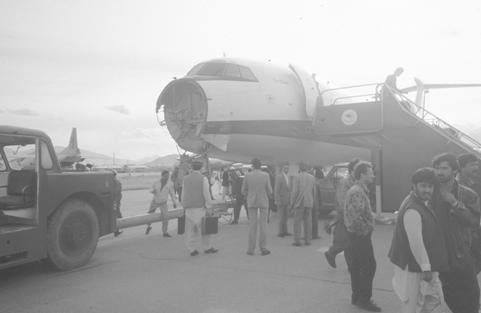
President Sibghatullah Mujaddidi’s damaged airplane sitting on the tarmac at Kabul airport, May 29, 1992. The airplane, which had ferried Mujaddidi back from Islamabad, came under rocket attack while approaching Kabul airport. During the attack, the airplane’s nosecone was sheared off and the co-pilot suffered shrapnel wounds, but the pilot managed to land safely. Mujaddidi, who was unharmed, blamed the attack on both Hekmatyar and agents of the former communist government. Jamiat and Junbish forces attacked Hekmatyar’s Hezb-e Islami forces in the south of Kabul the next day. © 1992 Ed Grazda
One resident described to Human Rights Watch a rocket attack in the summer of 1992:
Hekmatyar would rocket civilian areas all the time. One time, in the summer of 1992, I was standing behind the ministry of education, in Da Afghan Nan. I was waiting for a bus. A poor old man had a little cart and was selling chocolate and peanuts and almonds. The bus came, and it moved past me, so I moved down the block to get on the bus. I was getting on the bus, and suddenly, a rocket hit, where I had been. That man disappeared completely. No one found even one piece of his flesh. He completely disappeared. I think that 20 other people died there, and many more were wounded.39
A woman in west Kabul described indiscriminate shelling in the west of Kabul in June 1992. She believes the attacks were by Hekmatyar’s forces south of Kabul, since she heard artillery firing to the south during the attack:
It was about 4 p.m., and I was baking some bread outside, over a fire. Suddenly, there was a big explosion. I took cover, on the ground. Then, there was another explosion. I got up and I could see this woman here [pointing to a neighbor who is crying], and she was just running about. [The women asked her neighbor to tell her story for her, and nodded throughout.] Her son had been sitting near this wall outside, where the artillery landed, and he was completely blown up. This woman here was running about, collecting pieces of [his] flesh in her apron, and crying. Her son’s name was Sakhi. He was completely blown up, disappeared. Her grandson, Mukhtar, was also killed in the same explosion.40
A middle-aged man described a rocket attack that occurred around the same time, when Hekmatyar was firing rockets and artillery regularly into the city:
We were in Micrayon 3 [in the east of the city, controlled by Jamiat and Junbish forces], it was about three o’ clock in the afternoon. I was near this man’s house, Alaz. We were in his yard, by a tree. He had some tomato plants, there were some good tomatoes, and I was asking him how much they cost. Suddenly there was a missile, and it hit the land, about 40 meters away. I dove to the ground. After a minute, I saw Alaz. He was bleeding. He was still alive. I asked him, I said, “Let’s go to the hospital!” But he said: “No, there’s no time. I am about to die.” I held him, and then I carried him—he was bleeding from the side, the left side. My clothes were soaked with blood. The family came and gathered, they were screaming and crying. After about ten minutes, he died. This was in Block 19, in Micrayon.41
A journalist working in Kabul recounted seeing the terrible effects of the attacks in Kabul hospitals at the time, hospitals filled after the city came under fire from the south:
I remember pretty terrible scenes from those days, from the hospital. I saw children, kids, women wounded. Kids with their legs blown off. I once saw some kids arriving at the hospital in a car; their legs had been blown off by a bomb and they were just lying in the boot of the car. They were shelling into the city. It was Hekmatyar’s forces.42
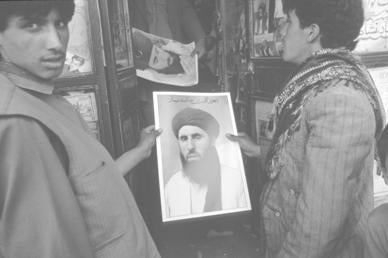
Two young men in Kabul hold up posters of Gulbuddin Hekmatyar, the military and political leader of Hezb-e Islami. © 1992 Ed Grazda
A photojournalist described the typical scene at a hospital in west Kabul after rocket attacks: “There’d be four or five bodies by the door, some coffins, then the bodies inside. . . . It was a grim scene, bleak. These rockets would rip pieces out of you.”43
In August 1992, Hekmatyar’s forces—who had already been rocketing civilian areas regularly since April—launched a new artillery and rocket blitz, bombarding all areas in Kabul held by Jamiat, Junbish, Ittihad, Harakat, and Wahdat—essentially the whole city. The apparent aim of the blitz was to force the government into a political compromise with Hezb-e Islami, as Hekmatyar likely did not have enough troops to launch an actual invasion of the city.
During the attack, hundreds of homes were destroyed, approximately 1,800 to 2,500 persons were killed, and thousands more were injured.44 Governmental functions, already severely hampered, ceased. The Presidential Palace and numerous government buildings were hit, as well as the headquarters of the Red Cross and at least two of its hospitals. The city’s water and electricity grids were severely damaged.45 On some days, shells and rockets fell without interruption, and the city was gripped with terror.
The contemporaneous notes of a Kabul resident, Jamilurrahman Kamgar, who was quoted above, chronicle the daily barrage:
August 1, 1992: Kabul’s airport came under rocket attack. Hezb-e Islami took responsibility and said [via the radio]: these attacks were a response to the government’s attacks on southern Kabul yesterday.
August 2, 1992: Nearly 150 rockets hit different parts of Kabul; the government blamed Hekmatyar. . . . As a result of the attacks, many people were killed.
August 5, 1992: The recent missile attacks have killed 50 people and injured nearly 150.
August 10, 1992: At 5 a.m. there was heavy fighting between government forces and Hezb-e Islami. The government said that Hezb forces attacked from three directions, Chelsatoon, Darulaman and Maranjan mountain. There was not enough medicine in the hospitals and medical personnel could not be seen. A shell struck the Red Cross hospital.
August 11, 1992: Nearly a thousand rockets hit various parts of the city of Kabul. The airport sustained at least 250 hits. It’s possible that a thousand people were killed. These attacks came from Hekmatyar’s direction. . . .
August 14, 1992: The war is progressing severely. The people of Kabul are escaping. The Pol-e Charkhi prison has become a refuge. . . .46
Ittihad and Jamiat forces, in turn, were launching artillery and rocket attacks on Hekmatyar’s positions to the south, which were also hitting civilian areas in the southwest of Kabul.
Hamid Karzai, now the president of Afghanistan and at the time a deputy foreign minister in the government, told a journalist in Kabul on August 9, 1992: “I don’t know what’s going to happen. . . . We’re just killing each other. It’s senseless.”47
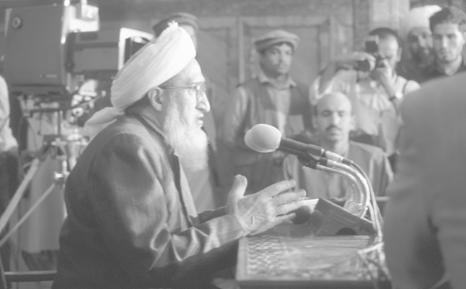
President Sibghatullah Mujaddidi speaking at a news conference in June 1992. Hamid Karzai, deputy foreign minister at the time, is visible just beyond the microphone. © 1992 Ed Grazda
Kabul’s hospitals were hard pressed to keep up with the violence. An ICRC representative in Kabul, quoted in a U.N. memorandum in 1992, described the situation on August 13, 1992 in the following terms:
This afternoon we had 353 patients in our hospital which has only 300 beds. There are patients in the entrance hall, in the courtyard. Thirty-eight wounded died before they could be treated, 77 were waiting to be operated on, 60 were admitted this afternoon, 91 yesterday and 183 Saturday.48
The chief of the United Nations mission in Kabul told journalists on August 20:
It’s a terrible situation. The government no longer controls anything; there is no longer law and order. The streets are entirely deserted, except for armed soldiers. Water and electric power have been cut off for nearly a week and my colleagues from WHO [the World Health Organization] are afraid of an outbreak of epidemics.49
The United Nations estimated that approximately 500,000 persons fled Kabul by the end of the summer for safer areas inside and outside of Afghanistan, primarily because of Hekmatyar’s rocket and artillery attacks.50
Violations of International Humanitarian Law
The armed conflict in Afghanistan in 1992-93 was a non-international (internal) armed conflict in which the Geneva Conventions and customary international humanitarian law applied to government forces and non-state armed groups. (The specific legal status of the conflict and culpability of specific individuals are discussed in more detail in section IV below.)
Many of the events described above amounted to war crimes. Launching indiscriminate attacks that may be expected to cause loss of civilian life, or intentionally targeting the civilian population and civilian objects, are violations of international humanitarian law, amounting to war crimes. More specifically, customary international law prohibits treating an entire city as a single military objective,51 and requires belligerents to take feasible precautions to protect civilians against the effects of attacks, including choosing methods and means of warfare that avoid loss of civilian life, and to cancel or suspend attacks causing unnecessary civilian loss. In addition, deliberate and widespread killing of civilians, through prolonged indiscriminate shelling and artillery attacks, can amount to crimes against humanity.52
Individuals—combatants and civilians—are criminally responsible for war crimes they commit. Commanders are criminally liable for war crimes committed pursuant to their orders or as a matter of command responsibility. Command responsibility makes a commander culpable for war crimes committed by subordinates if the commander knew or had reason to know such crimes were being committed and did not take all necessary and reasonable measures to prevent the crimes, or punish those responsible for crimes already committed.53
With respect to Wahdat, Ittihad, and Jamiat hostilities in west Kabul, there is compelling evidence that factions regularly and intentionally targeted civilians and civilian areas for attack, and recklesslessly and indiscriminately fired weapons into civilian areas. There is little evidence that the factions made meaningful efforts during hostilities to avoid harming civilians or stopped attacks once the harm to civilians was evident.
One Afghan journalist, quoted above, told Human Rights Watch that he witnessed on several occasions Ittihad and Wahdat forces intentionally firing rockets into occupied civilian homes during hostilities in 1992.54 He also said that Jamiat forces, once they joined Ittihad in battling Wahdat late in 1992, regularly fired randomly into civilian areas in west Kabul:
It was a normal, everyday experience that they would fire off of the television mountain, and from the top of Karte Mamorine, at Dasht-e Barchi, Karte Seh [District 3], and Deh Mazang. Also, on Koiatub [or Koiatab] mountain, there was a tank on top of it. This was the place that during the King’s time [before 1973] they would fire off a canon there, everyday at 12 noon. They would fire from there also.55
A former high-level official in Shura-e Nazar confirmed that Jamiat troops on the Mamorine mountain (the western peak next to Television Mountain and above west Kabul) regularly launched rockets and artillery into the civilian areas of west Kabul in 1992 and 1993.56
“There was little effort [by any of the factions] to aim at targets,” an international journalist told Human Rights Watch, describing the fighting between Wahdat, Ittihad, and Jamiat.57 “It was Massoud and Sayyaf versus the Hazaras. Deh Mazang [an area in west Kabul] was a front line. They would shoot at anything in between, whatever it was.”58
S.K., a hospital worker quoted above, also told Human Rights Watch about the attacks on civilians by Jamiat forces stationed on Television Mountain in the center of Kabul:
There was a time when the Jamiat troops on TV Mountain would target anything on Alaudin Street [the main road running north-south through Karte Seh]. They would target anything that moved, even a cat. . . .
I remember [one time] I went out to go to this clinic [to obtain medical equipment], and as soon as they saw me on that mountain they were shooting.
Anything that looked like a human being would be targeted. They shot everything: rockets, shells, bullets. There were times when the streets were littered with bullets. . . .59
A photojournalist who worked in Kabul regularly during 1992, and visited numerous military posts, told Human Rights Watch about Jamiat forces firing into civilian areas from the same mountain:
Yeah, they’d fire off T.V. Mountain all the time. Some of the wackos up there, they’d get bored. They’d strafe the neighborhoods below with anti-aircraft fire. For fun—just for the hell of it. The civilian homes below, near the zoo, by the traffic check-post, near the silo. They wouldn’t aim at any ministries [government buildings], that’d be their own turf. No, they’d fire toward the southwest, and not just at Wahdat but at civilians. And there were Tajiks down there too [same ethnicity as Jamiat], not just Shi’as [Hazaras are predominately Shi’a].60
Wahdat, Ittihad, and Jamiat forces regularly used imprecise weapons systems, including Sakr rockets and UB-16 and UB-32 S-5 airborne rocket launchers clumsily refitted onto tank turrets. The aiming of these rocket systems are considered “dumb” or non-precision.61 Sakr rockets are “like bottle rockets,” according to one military analyst,62 and rocket systems generally as not designed for accuracy in close combat: they cannot be adequately aimed within urban settings or made to distinguish between military targets and civilian objects. The use of the makeshift S-5 system in particular, within Kabul city, demonstrated an utter disregard of the duty to use methods and means of attack that distinguish between civilian objects and military targets.63
Further research is needed into the exact command structure of the Wahdat, Ittihad, and Jamiat forces involved in the fighting detailed above. Discussion of the command structure of the Wahdat, Ittihad, and Jamiat forces, and the responsibility of individual commanders, appears in sections below and in Section IV.
Hezb-e Islami forces used artillery and rockets in a manner indicating that they were intentionally targeting civilian areas, failing to properly aim (with respect to artillery guns), recklessly using weapons which could not be aimed in a dense civilian setting (with respect to rockets), and treating the whole city as one unified military target.
With respect to artillery attacks, there is evidence that Hezb-e Islami had the capacity to aim artillery at military targets, but either recklessly chose not to do so, or intentionally aimed artillery at civilian objects instead, in violation of international humanitarian law. As the primary recipient of international assistance and training from Pakistan, the United States, and the United Kingdom, Hezb-e Islami was arguably the most well-trained mujahedin group in Kabul at the time. Many commanders and troops were trained by Pakistani, American, and British experts on the use of rocket and artillery systems. Journalists who visited sites held by Hezb-e Islami forces to the south of Kabul saw numerous D-30 122mm cannons that were being used for attacking Kabul—a relatively precise artillery system.64 Reporting and footage from 1992 and 1993 suggests that Hezb-e Islami forces could, when they wanted to, precisely aim such artillery: BBC film footage from May 1992 shows accurate targeting of artillery by Hezb-e Islami of Jamiat and Junbish positions in Kabul.65 Terence White, a correspondent with Agence France-Presse, reported precise artillery fire against Jamiat positions in south Kabul in early 1993.66 Yet in many cases, including ones documented in this report, Hezb-e Islami artillery and rockets hit civilian areas, suggesting that they were either purposely targeting such areas, or recklessly aiming at Kabul as a whole. The prolonged timeframe in which the attacks took place, their scope, and their continued inaccuracy, strongly suggest there was neither a fixable problem with artillery aim calibration, nor weapons systems’ failure. Accurate and aimable weapons were being shot into civilian areas in violation of international humanitarian law.
Hekmatyar’s forces also often used BM-40, BM-22, BM-12 rocket launchers and Sakr Soviet-made rockets in their attacks on Kabul.67 As noted earlier, such rocket systems are generally considered “dumb” or non-precision: these weapons are not designed for accuracy in close combat and cannot be adequately aimed within urban settings or made to distinguish between military targets and civilian objects.68 The very use of such rocket systems within Kabul may have been an indiscriminate method or means of warfare in violation of international humanitarian law.
The pattern and characteristics of the attacks also suggest that Hekmatyar and his commanders were attacking the whole city, or treating the city itself as a single target.69
General Mohammed Nabi Azimi’s memoirs, discussing the July and August blitzes, reinforce the view that Hekmatyar’s forces bombarded civilian areas intentionally:
So once again, Hekmatyar’s heavy weapons roared and rained fire on Kabul. The height of the fighting and clashes was in late July and early August 1992. As soon as it became light, Hekmatyar’s rocket launchers and artillery would come to life. Hekmatyar now controlled the Takht-e Shahi heights which command Kabul [to the south]. There, the artillery teams had wireless communication sets. Hekmatyar’s artillery teams were reinforced by trained officers. . . . Hekmatyar could now accurately fire on military targets. But he preferred to fire on the city and defenseless civilians in order to create tension and dissatisfaction among the people against Rabbani and Massoud.70
“They weren’t picking out military targets,” one journalist who witnessed the repeated attacks in Kabul told Human Rights Watch. “Once the shelling started, artillery would fall everywhere, across the city. Across the city, you could hear the shells.”71
The pattern of casualties, and how so many civilians died, suggested that they were firing indiscriminately. . . . I suppose, yes, they hit some military targets, whatever that means, but mostly the bombs were just hitting various parts of the city, and it was mostly civilians who were getting hit, as you would see at the hospital.72
Marc Biot, a medical official at the Jamuhuriat hospital, told Human Rights Watch:
It was like this: At any moment a missile could fall. . . . When you were outside, you never knew if a missile would fall on your head. They were shooting them blindly, anywhere: into roads, markets, houses. . . . The most awful thing was that any bomb could fall on any place at any time. There was a clear political will to shell the city, as a city—to shell the city as a civilian place. The shelling was ubiquitous, everywhere.73
One journalist cited above, who visited Hezb-e Islami positions to the south of Kabul, suggested to Human Rights Watch that artillery spotters must have been intentionally directing artillery at civilian areas:
We talked to the officers pretty regularly—they had spotters, observers. They insisted they were hitting military targets. But they [the officers] knew what was going on. Both Massoud and Hekmatyar had a lot of artillerymen who were trained. They could aim. Elevation and windage [lateral and vertical movement] could be changed. But they [Hezb-e Islami forces] were aiming into the city. They had spotters in the city: Hezb-e Islami were able to infiltrate Kabul, it was easy. The aim was to terrorize the population.74
The testimony above suggests that Hezb-e Islami and Hekmatyar were deliberately targeting the city of Kabul as a whole entity, to terrorize and kill civilians.
Further investigation will be needed to determine the role of specific commanders in the attacks. According to the Afghan Justice Project, an independent non-governmental group that has investigated military operations in Afghanistan from 1979 through 2001,75 besides Hekmatyar the following commanders had operation control over the military posts firing artillery and rockets at Kabul during the period discussed in this report:
- Commander Toran Khalil, chief artillery officer in Hezb-e Islami who supervised shelling and rocketing operations during late 1992 into 1993, commander of a base at an oil depot at the south of Charasiab, south of Kabul.
- Toran Amanullah, commander of the Firqa Sama, stationed at the Rishkor military base, south of Kabul.
- Commander Zardad, commander of a military post at the Lycee Shorwaki.
- Engineer Zulmai, of the Lashkar Issar, commander of a post at the Kotal Hindki pass to the south of Chilsatoon, south of Kabul, near the Rishkor base.
- Nur Rahman Panshiri, commander of a post in the village of Shahak, to the southeast of Kabul, directly controlled by the Sama division.
- General Wali Shah, an officer in the Najibullah government who joined Hezb-e Islami in 1992, commander of a base at Sang-e Nevishta, Logar, south of Kabul.
- Shura Nizami (military council) commanders Faiz Mohammad, Kashmir Khan, and Sabawon.
The legal responsibility of these Hezb-e Islami commanders, as well as Hekmatyar himself, is discussed further in section IV below.
Abductions, “Disappearances,” Torture, and Other Mistreatment of Detainees
[Reuters, June 4, 1992] Gunfire and explosions echoed across western Kabul. . . . Guerrillas of the Hezb-e-Wahdat Shi’a alliance fought gunbattles with Sunni Ittehad-i-Islami fighters close to Kabul university, a Shi’a base, for the third day running. . . . Guerrillas of the two groups rounded up hundreds of civilians at gunpoint on Tuesday and Wednesday and took them to makeshift detention centres after demanding to see identity papers, which state the bearer's ethnic group, at street checkpoints. Shi’a guerrillas took away Sunni Muslim ethnic Pashtuns, while Ittehad guerrillas detained ethnic Hazaras, who are Shi’as. Witnesses said some people were beaten with sticks as they were led away. . . .76
In addition to the war violence, the fighting between Ittihad and Wahdat through 1992 was spawning another problem with especially terrible effects on civilians: ethnic abductions. Ittihad and Wahdat forces were increasingly abducting civilians and holding them for ransom or exchange—Ittihad holding Hazaras, and Wahdat holding Pashtuns, Tajiks, and other non-Hazaras. A journalist told Human Rights Watch:
There was a lot of kidnapping in the west. The commanders under Sayyaf and the commanders under Hizb-e Wahdat would stop buses or cars, and look for Hazaras and Pashtuns. Sayyaf’s men would look for Hazaras. Hizb-e Wahdat forces would look for Pashtuns.77
As shown below, the practice seems to have begun in May of 1992. Gen. Mohammed Nabi Azimi, the high-level military officer quoted earlier in this report, described how the two forces began erecting checkpoints and engaging in routine abductions:
Hazaras abducted Pashtuns and Pashtuns abducted Hazaras wherever they saw each other. They pulled out the fingernails of prisoners, cut off hands, cut off legs, even hammered nails into prisoners’ skulls. Humans were kept in [shipping] containers and containers were set on fire. . . . Cruelty, injustice, and inhumanity began, and became a chronic disease; humanity and honor were crucified.78
Many of the civilians abducted by the two sides during this time were never seen again. Some did manage to be released, however, usually after prisoner exchanges or personal interventions by government officials or religious or tribal leaders with connections to those detained.
Human Rights Watch spoke with several former detainees in Kabul in 2003—Hazaras, Pashtuns, and Tajiks—who described their experiences. Their stories follow:
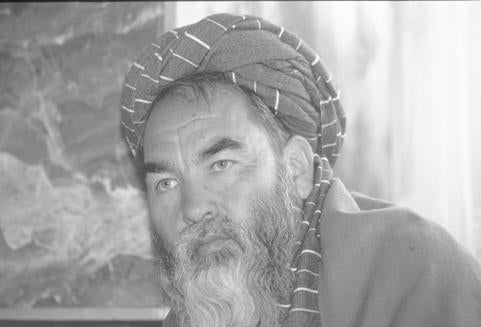
Abdul Ali Mazari, the military and political leader of Hezb-e Wahdat in the early 1990s. Mazari’s faction, as well as Abdul Rabb al-Rasul Sayyaf’s Ittihad faction, committed war crimes and other atrocities in west Kabul in the early 1990s. © 1994 Robert Nickelsberg
Abductions by Wahdat
A young Tajik man from west Kabul, who said he was held by Wahdat forces in December 1992 after some streets fighting that occurred near the government silo, told Human Rights Watch about his abduction and detention by men he identified as members of Wahdat:79
[M]y brother came and said he wanted us to leave the area with him. We were talking about this, sitting in our home, drinking tea, when some gunmen [Wahdat] came and knocked on the door.
“Whose house is this?” a commander said. He was at the door. —“It is mine,” I said. —“What is your name?” I said my name was [deleted]. —“Where are you from?” he asked. —“Kabul,” I said. —“You’re lying,” he said. He pulled out a list, and found my name on the list: my parents and brothers names were on the list also, and next to my name it said we were from Shomali [a predominately Tajik area north of Kabul]. The commander said, “Are you from Shomali?” And I said yes, that I was studying in Kabul and lived there. He said, “Let’s go inside,” and pushed me into my own house. As I came in, I told my brother [with my hands] to hide himself, but he didn’t understand. So then the commander saw him also. . . . Before taking us away, they arrested a guy from Wardak next door. He was complaining a lot, so they blindfolded him. . . . They put us all in a vehicle, and when we got to Kohte-e Sangi they put blindfolds on us too. After that, we couldn’t see and could not understand where they were taking us. . . .
When the vehicle stopped, the men assumed they were at Dasht-e Barchi, where Wahdat had a base, but the man later discovered he was at Onchi Baghbanan [to the north of Dasht-e Barchi, about 4 kilometers west of Karte Seh].
We got out. They threw the three of us into a container . . . . Then, a commander with two bodyguards came, and he came into the container, and questioned us. “You both are some guys from Shomali and you are helping Massoud!” he said. —I said, “I am a medical student; neither I nor my brother are soldiers. We are from Shomali, but we are not soldiers.” —“Keep quiet,” he said. And then the guards cocked their Kalashnikovs [assault rifles]. The commander signaled to his troops to take us away. We were blindfolded, and made to walk somewhere else. They were kicking us. Finally, we were imprisoned in a small room.
The man said he and the other prisoners were later given a plate of rice to share. But that night, other prisoners were brought in and together they were transported to another site:
We drove there. Then they threw us into a basement—no, the basement of a basement. It was dark, and dirty, and very cold. We could hear machine guns were being fired above us. We assumed that we were somewhere near the front line.
That night, they brought three other guys: a guy from Jalalabad, a worker from Shomali, and a lecturer from the university. They were also thrown into the basement with us. There was not enough room for us. There was dirty air, and it was completely, completely dark. We were there for several days. They would let us out two times a day, to urinate.
The basement room was freezing, and the young man said at times he was so numb that he feared he was going to die. After a week, the man and his brother were released, apparently because of the intervention of relatives who were able to make contacts with Wahdat commanders. But the man said his fellow prisoners met a different fate:
Those other people who we were imprisoned with were never released. They disappeared. I know because they told us to find their families. And I contacted their families, several times. Those families pressured us, to help them. We gave them some advice. But a month later those prisoners were not released. And later on, when I spoke with them again, I learned that those prisoners had never been released.
An elderly Pashtun man described being arrested by Wahdat forces in mid-May 1992, and seeing other prisoners killed by them:
It was morning, I was going by Chelsatoon garden. I was with my 10-year-old son. We were stopped by Hezb-e Wahdat troops. Two men. They took us to Habibi high school. They didn’t give me any problems at first, they were just questioning me. . . . But I saw this container nearby, with prisoners. The two men were arguing. One was saying, “Leave him, he’s innocent.” The other was saying, “No, we should arrest them because they’re Pashtuns.” They had arrested some other Pashtuns, and I saw them putting them into a container there.
The first one was saying, “Put him in the container!” And the other was saying, “No, he has a young kid with him.” Then the first one was saying, “No—he is Pashtun. Put him in the container!” Their argument lasted a few minutes. Finally, they let me go and I was set free.80
The man said the troops sometime soon after apparently fired a missile or rocket-propelled grenade into the container:
I was walking away with my son. We heard the explosion. The container had been closed after they put the prisoners in it. I heard the explosion and I looked, and then I took my son and started to move away, because we were in danger. . . . When I looked I saw that all these people were running away from where the container was. . . . I heard screams from the container and there was smoke coming out of the hole. The rocket had penetrated and exploded. . . .81
Human Rights Watch interviewed several other Pashtuns and Tajiks held by Wahdat forces in 1992 and released when family members or acquaintances were able to convince leaders in the various factions to have them released. A senior civilian official in the Jamiat-dominated government told Human Rights Watch that numerous complaints were made to the government about Wahdat arrests, and that they documented that Wahdat had set up a prison at a compound in west Kabul called Qala Khana, run by a senior Wahdat commander called Shafi Diwana (Shafi the Mad), in which prisoners were tortured and killed.82 Petitioners brought allegations to the Jamiat officials that Wahdat forces were burning the bodies of prisoners in brick-making furnaces in the compound.83
A health worker in west Kabul, quoted above, told Human Rights Watch that hospital staff in west Kabul knew that thousands of prisoners were kept by Wahdat forces in Dasht-e Barchi, and that they were sometimes able to negotiate to have them released, although most were never seen again.84
Abductions by Ittihad
As noted above, Ittihad was holding prisoners too. Human Rights Watch interviewed a Pashtun man who, despite his Pashtun ethnicity, was held by Ittihad forces in the summer of 1992 because of a non-ethnic dispute with troops. The man said he was put in detention with approximately thirty to forty Hazara prisoners who said they were abducted based on their ethnicity.85 He described his experience:
[S]ome of Sayyaf’s men, from Paghman, came and took me. They were looking for my brother-in-law [because of a private financial dispute], but they took me instead, as a hostage. They took me to Khoshal Khan Mina, the headquarters for the electric buses, near the silos. They put me in a room there, and they told me that they would hold me there, for a night, and then I would be released. The commander there was named Tourgal. But the next day, Wahdat and Sayyaf started fighting.
That night, as fighting raged outside, the man said that the Ittihad forces brought in Hazara civilians: “Sayyaf’s forces brought thirty or forty Hazara civilians. . . . They were not fighters, but civilians, old and young.” Later in the night, according to the man, the Ittihad forces shot at the prisoners in their holding cell with an automatic weapon:
[T]he fighting got severe. We could hear the artillery. There was a lot of shooting. I could hear these people, Sayyaf’s people, talking about retreating. And at one point, one of them said to Commander Tourgal, “What should we do with these prisoners?” They were speaking in Pashto, and the Hazara people couldn’t understand them. But I could understand. Somebody said, “Go and shoot them.”
I was near the door. When I heard this, I hurried away and hid away from the door, in the corner of the room [on the side of the room with the door]. A person came, and opened the door, and shot all over the room with his kalashnikov, on automatic. He just fired randomly all over the room. About ten people were killed, immediately, and four were wounded. . . . After, no one moved. We [who were still alive] were trembling with fear. The fighting outside was serious—the commander called on this guy to come back to fight at the windows with them, so the man left, to go back to fighting.
The prisoners were too afraid to move the dead bodies. But when the fighting stopped, the man desperately pleaded with the troops to release him: “The next time the troops came by, I rushed to the door and said, “Listen, I am a Pashtun, and I was not arrested with these people.” The man said the troops then put him into another room, presumably because he was not Hazara. “I don’t know what happened to the [other] people in that room,” the man said.
Ultimately, the man was released after a relative, who knew some members of Ittihad, visited Sayyaf in Paghman, to plead for his release. The relative told Human Rights Watch that Sayyaf ordered another minister (the name is deleted here to protect the man and his relative) to order the man’s release.86 The minister then wrote an order to Commander Tourgal, the relative said, which he took to Tourgal, who then released the prisoner—a series of events that suggests that Sayyaf had knowledge of Ittihad’s regular detention of civilians and that he had control over the commanders holding them.
Human Rights Watch interviewed numerous other Hazara men in west Kabul who were held by Ittihad forces in 1992 and early 1993, forced to work in manual labor for Ittihad forces (their stories are in the following section: “The Attack on Afshar”).
Abuse of Prisoners
Human Rights Watch received consistent and credible testimony that many of the persons detained by Wahdat and Ittihad were forced to work, mistreated, or tortured while in the custody of Ittihad and Wahdat forces. S.K., a hospital worker quoted above, described seeing detainees after their release from both factions who were badly injured, who told her they had been subjected to torture and other mistreatment:
I saw hostages who had been tortured: civilians and non-civilians. This was something common: people released by each side, their families would bring them to the hospital [because they had been abused in captivity]. Wahdat would capture Pashtuns and Tajiks, and Ittihad would capture Hazaras.
I saw what they had done to them: People beaten up. People who had been tortured. They had put RPGs [Rocket Propelled Grenades] into the anus. They gang-raped girls. I saw these victims.87
Human Rights Watch interviewed several Afghan journalists who spoke with detainees in 1992 and 1993, who described abuses while in detention.88 Journalists with the British Broadcasting Corporation and Associated Press in 1992 interviewed detainees of various ethnicities who related descriptions of their arrests and abuse.89
It is likely that the abductions and abuse were fueled in part as retaliation for continuing atrocities. Abdul Haq, a mujahedin commander who served as police chief in Kabul in 1992 (Haq was later killed by Taliban forces in eastern Afghanistan in October 2001), told a journalist in 1992 that non-Wahdat and non-Ittihad commanders had worked to arrange large prisoner swaps between Wahdat and Ittihad in the first week of June, but that the exchanges collapsed after both sides saw that some prisoners had been tortured or mistreated.90
(Further descriptions of abuse of detainees captured by Ittihad and Wahdat appears in the “Rape” section below, and in the section “The Attack on Afshar” below.)
“Disappearances”
Human Rights Watch interviewed several families in west Kabul who said that their relatives had been abducted in 1992 by Wahdat or Ittihad, and never seen again. For fear of continuing threats to their security from the same factions, they refused to allow Human Rights Watch to use the names of their disappeared relatives.
In 1996, Afghan aid workers working in west Kabul published a book documenting some of the abductions and “disappearances” of persons from west Kabul, with names and pictures (when available) of victims.91 The project, based on research conducted in 1993-1995, focused predominately on Hazara disappearances at the hands of Ittihad. But the book does detail abductions by Wahdat and Jamiat as well, and partly reveals the scope of the overall problem.
The book documents 671 cases of abductions and disappearances, mostly in west Kabul and mostly in 1992-1993. H.K.,92 one of the books’ researchers, told Human Rights Watch that over 1,000 people were reported missing in west Kabul in the first year after the fall of the Najibullah government:
The number we put in the book was less, because we chose only the cases where we had some information about the how the people were kidnapped. There were more documents, with more information about the commanders, but we were pressed for time and we just published some of what we had.
It was very difficult to work on these issues at the time. One of our employees at the time was arrested by Harakat forces, and held for ransom, because of the research he was targeted. [Name deleted.] He was arrested in Dasht-e Barchi, sometime around the report research. He told us later that they beat him severely while he was held.93
H.K. said that the project staff tried to obtain the release of some of those who were held by the different forces:
Almost everyone we documented was never heard from again. However, in a few cases, rare cases, where we had all the information about who captured a person, and where they were held, we managed to get some people released. There was someone who worked with our information, and negotiated with Ittihad to get people released. That person negotiated with Sayyaf, [and later] with Ahmadzai [an Ittihad official who later served as prime minister].
All the commanders, in all the groups, would completely and totally deny that their forces were holding people. But in those rare cases where we had complete information about the detained person, and we confronted them with it, they would release the people. But this only happened in a few cases.
H.K. said that most of those who were released were tortured by their captors and exhibited physical signs of it. He told the story of one man he worked to have released, from Ittihad’s forces, who said he had been forced to work “as a slave” on a commander’s farm in Paghman. (The section “The Attack on Afshar” below contains addition information about forced labor).
We documented all of this. I interviewed him after he was released. He had been tortured by Ittihad when he was captured, and beaten severely in their prison. There were fifty other people being held with him, he said, somewhere in Paghman. After a few weeks, they sent him to this farm, to work on the land, during the day and night.
Former officials in the Rabbani government also supplied information to Human Rights Watch about Wahdat and Ittihad abductions, noting that commanders in Jamiat, Harakat, Junbish, and Hezb-e Islami sometimes detained civilians as well, usually just for ransom.94 R.D., a former official in the interim government who was familiar with ongoing criminality by various factions, said that Anwar Dangar, a high-level commander in Shura-e Nazar, was “deeply involved in kidnapping schemes,” and that another Jamiat commander, Kasim Jangal Bagh, was regularly implicated in abduction, or hostage-taking, for ransom.95
The research project noted above uncovered some of these abduction cases. As the researcher H.K. explained:
Shura-e Nazar [meaning Jamiat forces under Massoud] arrested people as well. . . . In most cases, we were unable to do anything, but in three cases we managed to document what happened, and they released three people. They negotiated with the head of Amniat-e Melli [Afghan intelligence agency] at the time—Fahim [Mohammad Qasim Fahim]. To have them released they spoke with him.
Human Rights Watch also received testimony about abductions and killings of prisoners by Junbish forces in 1992 and 1993. Former Jamiat and Junbish officials confirmed to Human Rights Watch that Junbish forces regularly engaged in killings of prisoners in 1992 and 1993.96
Pillage and Looting
Human Rights Watch interviewed scores of journalists, health workers, aid workers, taxi drivers, civil servants, and soldiers who witnessed widespread pillage and looting by Jamiat, Junbish, Wahdat, Ittihad, Harakat, and Hezb-e Islami forces after the Najibullah government fell.
Merchants in southeast Kabul told Human Rights Watch about looting by Hezb-e Islami forces in the area around Bala Hissar (southeast Kabul) in April 1992.97 Embassies and diplomatic residencies were also reported to be targeted.98 The U.N. human rights rapporteur for Afghanistan received reports that apartment complexes built for government employees in Micrayon were a focus of looting.99 Journalists in Kabul covering the collapse of the old regime saw shops and houses being pillaged across the city.100 An Afghan journalist described what he saw in April 1992:
I saw with my own eyes Sayyaf’s troops and Massoud’s troops looting as they entered the city, breaking windows, stealing whatever they wanted. They were acting like animals, doing whatever they wanted.101
A BBC journalist described to Human Rights Watch looting he saw in May 1992:
I saw General Dostum’s Uzbek troops looting. . . . It was easy to recognize them. I knew who they were from their clothes and features. They were totally recognizable. I saw some of them carrying refrigerators on their backs, and other things like that, air conditioners. I remember especially some guys, Dostum’s Uzbeks, coming out of a compound somewhere. These were happy and contented guys, smiling. They had some refrigerators and other appliances like that, carrying them on their backs. And I saw these smiling guys put the goods in their trucks and drive away. The Presidential Palace was looted by government troops [Jamiat and Junbish]. The troops went in, and were taking out carpets and things like that.102
Human Rights Watch received accounts that Dostum’s highest military commanders in Kabul, including Majid Rouzi, were profiting from the looting by Junbish troops.103
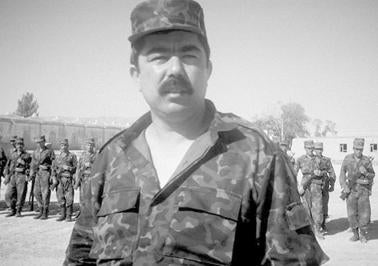
General Abdul Rashid Dostum, leader of the Junbish faction, August 11, 1992. Junbish forces were implicated in war crimes and other abuses in Kabul in the early 1990s. As of mid-2005, Dostum holds a senior post in the ministry of defense. © 2001 Reuters Limited
A former official in Shura-e Nazar told Human Rights Watch about looting by Jamiat troops working for Kasim Jangal Bagh, a mid-level Jamiat commander:
Kasim Jangal Bagh’s troops were responsible for the trouble that went on in [Micrayon and Wazir Akbar Khan—two neighborhoods in eastern Kabul]: looting, kidnapping, and raping of girls. . . . Kasim had a Ghund [military post]—it was independent I think. Bismullah Khan [a Shura-e Nazar commander] was his operational commander, but he may have reported directly to Massoud. . . . Massoud was giving him money [to pay his troops], but he was taking it for himself. I know—I know how these things work even now. He had cars, houses, but his gunmen were poor. So they were taking whatever they wanted from people. The soldiers were not paid, so they were robbing.104
A photojournalist who worked in Kabul through 1992 described seeing blocks of houses in west Kabul that were looted by Jamiat forces: “You’d notice blocks getting hit. Roof beams were torn out of the houses, electricity wires torn out, appliances, all the possessions.”105
When questioned in late May 1992 about the looting, Commander Muslim, a senior official in the Jamiat faction and ostensibly in the Afghan ministry of defense, told a journalist, “Every society has its thieves and robbers. Ours is no different. Yes, there’s chaos, yes there’s disorder. But it’s no worse than Los Angeles.”106 This was a reference to the large-scale riots and looting which had broken out in late April 1992 in Los Angeles, California, after a jury acquitted several police officers who had been videotaped beating an African-American motorist named Rodney King.
But Kabul was not Los Angeles. Many Kabul residents told Human Rights Watch that a culture of total impunity and chaos had come over Kabul in 1992, and that there was a general sense that the militia troops could do whatever they wanted at any time. Besides pillage and looting, there were regular incidents of killings and other violence.
A journalist with the British Broadcasting Corporation told Human Rights Watch about Junbish forces targeting civilians in April of 1992:
Junbish had been looting. . . . We filmed Junbish troops beating up this guy who had a bicycle. I guess they wanted to take the bicycle. I think that this was one of those rare cases where the presence of a camera literally stopped someone from being killed. They were clubbing him with Kalashnikovs, but when one of the troops saw us and pointed at us, they sent the guy on his way.
In another case, near the Intercontinental [Hotel], the camera led to problems. These Uzbek troops [Junbish] saw us, and they were acting up for the camera. They had this guy, this civilian, and they wanted to show off. They were making him stand a few meters away and they were shooting at his feet with their Kalashnikovs, making him dance. They were yelling, “Dance! Dance!” and shooting at his feet.107
Human Rights Watch documented several cases of killings by Junbish, Jamiat, and Harakat forces during 1992-1993. Former officials in Junbish and Jamiat admitted to Human Rights Watch that military forces in their former factions engaged in killings connected to pillage and looting.108
A Junbish official detailed some of the specific commanders involved in abuses:
Shir Arab, Ismail Diwaneh [“Ismail the Mad”], and Abdul Cherik109 from the beginning engaged in widespread looting of the market. Killing took place only over looting. In late 1371, early 1372 [January to May 1993], they looted the Porzeforooshi Bazaar. . . . Ismail Diwaneh was in Bala Hissar [on the southeast edge of Kabul]. He regularly killed and robbed Pashtuns from Paktia who were passing through on the way to Kabul.110
Another former Shura-e Nazar official, discussing general looting by Jamiat forces in 1992 and 1993, described a particularly bad commander, Rahim “Kung Fu,” who the official said was “a robber and killer and a thief, in a word, a criminal.”111 The official (who began crying as he was interviewed about Rahim) also told Human Rights Watch that Rahim was involved in killings of Hazara civilians, and children, during an operation against Wahdat forces posted in Timani neighborhood in 1992: “There were many rapes, the killing of many women and men. He was killing so many Hazaras. He killed children. I’m sorry, I cannot talk about it anymore.”112
In a later interview, he described how he heard Rahim boast about crimes committed during the Taimani operation:
He said he pochaghed Hazara [slaughtered, or cut their throats]. “We killed 300, 350 people,” he said. “I went to a house. I saw an infant. I put the bayonet in its mouth. It sucked on it like a tit, then I pushed it through.”113
One Kabul resident—a civil society organizer who often acted as a mediator between factions—told Human Rights Watch about an incident he witnessed in December 1992 when he said Junbish troops executed a Tajik man who had come to pay a ransom to release his brother, who he said was being held by a Junbish commander, Abdul Cherik:
One day [a woman came to me] asking for a favor. [I] had a few connections with some people in Junbish, she was asking me to help her: her brother’s car had been seized by some Junbish forces in December 1992. The car had been seized by Abdul Cherik—a commander with a checkpoint near the Kabul City Electrical Station (in east Kabul) in Chaman Waziri.
I went to his checkpoint. While I was sitting there, waiting to talk to him [Cherik], a young guy, about 18 or 19, entered with a bag full of money. It was a Panshiri guy—I could tell because of his accent, and he looked Tajik.
He asked Abdul Cherik to release his brother. He said: “This is the ransom you have asked for, for my brother,” and he opened up the bag. It was full of money. I don’t know how much.
Abdul Cherik looked at him, and then looked at his guards, and said, “Take him to his brother.” And his guards motioned him to come, and they took his arm, and went out the back door. So they went out.
I was waiting in that room. About three minutes later, I heard the sound of gunshots, about fifty meters away. It was a burst of automatic gunfire. And then a little later, the gunmen came back in. They had some rings and a watch in their hands, and they gave Abdul Cherik the rings and watch, on his desk. I had gone to that place to try to convince this commander to release this guy’s car, but after this happened, I immediately left the compound and walked away. I got outside and said to myself, “God save me,” and left there.
I asked this guard near the door to the compound, “Did you kill him, or just take his rings and watch?” The Junbish guy said, “What a question! Can a Panshiri remain alive when he is imprisoned by us or is in our control?”
It was unimaginable to me that they would kill someone like that. It was something ordinary for them. You couldn’t believe that they had killed him. It was like nothing had happened. The gunmen who were in the room there while I was waiting, they showed no reaction when those other men returned. It was an ordinary thing for them.114
A resident of Tiamani neighborhood of Kabul described a summary execution of a civilian by a Harakat soldier which he witnessed on a street in a neighborhood in north Kabul in September 1992:
I had [a store] in front of my house. I was selling some things there, one morning, sitting there. I saw this younger guy walk by—he had recently been married. Then I heard some shooting down the street. I looked down the street, and I saw that the guy who had passed was on the ground, and this other guy was over him—he held a pistol up to his head and shot him in the temple. The guy was dead. Some other people on the street walked a little forward [i.e., toward the body, to look], and then stopped.115
The man said he did not know the reason for the killing, and did not know the name of the gunman but recognized him as someone he had seen with the Harakat faction:
This gunman, he was a Harakat gunman, just walked by us, slowly. Like he could do whatever he wanted. We saw him clearly. We knew who he was—he was a Harakat man.116
A Kabul resident, a bus driver, told Human Rights Watch about being arrested, having his bus stolen, and almost being executed by Hezb-e Islami forces, in late 1992:
One time, I was driving, and I had got to the end of my route, all the [passengers] had gotten off and the bus was empty. . . . A man and a teenager asked me to stop, and I slowed down, to give them a ride. Suddenly, armed men surrounded the truck, and got in, and ordered me to turn around, and when I hesitated, they beat me. So I turned around, and they made me go on a small road, toward Gardez. . . . They took me to this checkpost there—they were Hekmatyar’s people. They made me show them how to use the car, the gears, and how to start it.
Then the commander said, “Take him to the mountain, and shoot him.” And they started to lead me away. On the path [up the mountain], an old man saw me, and said, “What’s the matter?” And I asked him to help me if he could. The troops pushed me forward. The old man went down to the commander [behind me] and told him not to kill me. [As an elder, the man presumably had additional influence.] The commander called up to the troops, “Just beat him.” And that’s what they did. They beat me very severely, and I lost consciousness. When I woke up, they had taken my watch, and I was alone. I went down the mountain on the other side, and got a cart to stop and take me into the city. I got a rickshaw driver to take me to my house, but I fainted on the way, and my family had to carry me into my house. . . . 117
Violations of International Humanitarian Law
As noted earlier in this report, the intentional targeting of civilians and civilian objects for attack is a violation of international humanitarian law that can amount to a war crime. In addition, article 3 common to the four Geneva Conventions, which is applicable in non-international armed conflicts, requires the humane treatment of civilians and detained combatants. Arbitrary deprivation of liberty, murder, torture, rape and other ill-treatment violate this requirement. International humanitarian law also prohibits “pillage,” which is defined as the forcible taking of private property from an enemy’s subjects, and other forms of theft.
Murder, adverse treatment and unlawful deprivation of liberty of civilians (as well as captured combatants), on the basis of their ethnicity or other distinction, violates common article 3 to the Geneva Conventions. Furthermore, widespread or systematic abductions, killings and “disappearances” that are part of an attack on a civilian population, such as an ethnic group, may amount to crimes against humanity.118
There is compelling evidence presented above that Ittihad and Wahdat forces abducted thousands of persons in the first year of the post-Najibullah era, as well as more in later years. The fact that so many persons arrested were never again seen by their families suggests that both the Ittihad and Wahdat factions killed thousands of these detainees. There is also compelling evidence that detainees who survived their detention were tortured or otherwise mistreated. The widespread murders, arbitrary deprivations of liberty, torture and other mistreatment committed by Ittihad and Wahdat forces may amount to war crimes and crimes against humanity.
Sayyaf, as the leader of Ittihad, is centrally implicated in the abuses described above, since he exercised ultimate control of Ittihad forces. Officials in the Rabbani government in 1992-1993, allied with Sayyaf, acknowledged to Human Rights Watch that Sayyaf, as the senior military commander of Ittihad forces, was in regular contact with his commanders, and that he had the power to release prisoners held by his subordinates, and in fact ordered such releases on several occasions, demonstrating his command over those commanders.119 Health workers in west Kabul told Human Rights Watch in 2003 of additional cases in which negotiators with the International Committee of the Red Cross spoke with Sayyaf to obtain the release of prisoners, further demonstrating his control over subordinate commanders.120 Human Rights Watch also spoke with an individual who negotiated with Sayyaf to obtain a relative’s release.121 And in June 1992, when interviewed by a journalist in Kabul about the abductions, Sayyaf did not deny that Ittihad forces were abducting Hazara civilians, but merely accused Wahdat of being an agent of the Iranian government.122
Further investigation will also be needed into other Ittihad commanders and their role in the abductions and abuses documented here. Investigations will need to focus in particular on the role of Ittihad commanders Shir Alam, Mullah Ezat, Zalmay Tofan, Abdul Manan, Dr. Abdullah, and Noor Aqa, who were named by several sources in this report as being implicated in abductions and holding of prisoners for forced labor.123 More detailed discussion of the potential legal responsibility of Sayyaf and his other commanders, for the abuses described here and elsewhere in this report, is set forth in section IV below.
As for Wahdat, its leader, Mazari, who was killed in 1995, was implicated in the abuses above. Mazari and his deputy, Karim Khalili (now the vice-president of Afghanistan), acknowledged taking Pashtun civilians as prisoners in interviews with Reuters and Associated Press.124 Mazari defended the practice by stating that Ittihad troops had first seized Hazaras.125 (Mazari later said that detained prisoners were kept in houses, given food and water, and not tortured.126)
Further investigation will be needed into the command-and-control structure of Wahdat and the culpability of the commanders who are still alive. More investigation is needed into Karim Khalili’s involvement in military decision-making and his control over Wahdat forces. Shafi Dawana and Nasir Dawana have been killed, but Wahid Turkmani, Mohsin Sultani, Tahir Tofan, Sedaqat Jahori, and Commander Bahrami are believed to be still alive, and should also be investigated for their role in the Wahdat abuses documented here. The potential legal responsibility of Wahdat commanders for the abuses documented here is further discussed in section IV below.
In addition to the abductions and killings, the widespread looting and pillage that took place in Kabul during the period discussed above should also be investigated. Troops or commanders from all the factions named above who were involved in pillage need to be thoroughly investigated.
Rape and Sexual Violence
Several health workers in Kabul who spoke with Human Rights Watch stated that rape and other forms of sexual violence were commonly committed against women who were abducted by Wahdat and Ittihad forces in 1992-1993, as well as generally during the hostilities around Kabul at the time.127 Human Rights Watch was unable to obtain direct accounts from victims of rape during this period, in large part due to deep reluctance among women and girls to grant interviews on the subject, or refusals by families of the victims to allow such interviews. But there is evidence of its occurrence. H.K., who worked on a documentation project into abductions discussed earlier in this report, told Human Rights Watch that researchers working on this issue in the early 1990’s knew of widespread abductions and rape of women in west Kabul, although he said that families were in most cases unwilling to give information about details:
It was impossible to document the rape or kidnapping of women in these cases. The families always denied cases where the women were kidnapped or raped, because of the dishonor and shame. The families would deny that their women were kidnapped, or refuse to discuss these cases; it is because Afghan families are very conservative. There would be lots of stories, lots of talk about how “other families” had had the women abducted. A set of people would tell us, “Look, that family over there, across the street, their women were kidnapped,” but when we went over to ask the family themselves, they would deny it, and say nothing had happened. This is how it always happened. Maybe they would admit it if a boy was abducted, for rape, but not the women.128
Human Rights Watch did receive accounts from several journalists and civil society organizers about cases of rape which they documented—specifically, cases of troops from Jamiat, Hezb-e Islami, and Wahdat breaking into houses and raping women.129 Human Rights Watch also received credible information from government sources about cases of rape by Jamiat, Wahdat, and Junbish forces.130 S.K., the health worker in west Kabul quoted earlier, said she treated numerous women who said they had been raped by militia forces in west Kabul in 1992-1993, and collected bodies of women in the streets who showed signs of having been raped.131
More investigation is needed to determine the scope of rape as a practice among the various troops in Kabul in the post-Najibullah period. Based on the available information, rape may have been a chronic problem in Kabul during the period and numerous commanders, including at the highest levels of each faction, appear to have failed to take appropriate steps to prevent further cases from occurring. In some cases, sub-commanders themselves may have been involved in rapes.132
B: October 1992-February 1993
Kabul suffered relatively less intense fighting after the August 1992 blitz on the city, but serious firefights and shelling rocked the city throughout the later part of the year.
In October, the leadership council set up under the Peshawar accords voted to extend Rabbani’s term for forty-five days, until December, on the grounds that the summer fighting had made the summoning of the council impossible. Jamiat forces repeatedly battled Wahdat in the west, near Kabul University, causing further casualties and damage. At the same time, there were increasing signs that Dostum’s Junbish faction was starting to negotiate with Hekmatyar’s Hezb-e Islami, despite the fact Hekmatyar had initially opposed Dostum, and used Dostum’s presence in Kabul (as a former communist government official) as a pretext for opposing Massoud.
In December 1992, Rabbani convened the council of representatives called for under the Peshawar Accords to choose the next government—or just reelect him as president.133 The council, however, was not representative of the different warring factions or the general Afghan population. Many of the invited members boycotted the vote, including representatives of Junbish, Wahdat and Hezb-e Islami. Rabbani was “reelected” by his supporters, allies and proxies in the meeting, and stated his intention to serve as president for another 18 months. Hekmatyar, however, refused to accept the outcome of the council, and vowed to dislodge Rabbani’s government, and Massoud’s forces, in the coming months. Wahdat rejected the new government as well, and soon made an official alliance with Hekmatyar. Junbish, for the most part, stayed on the sidelines.134
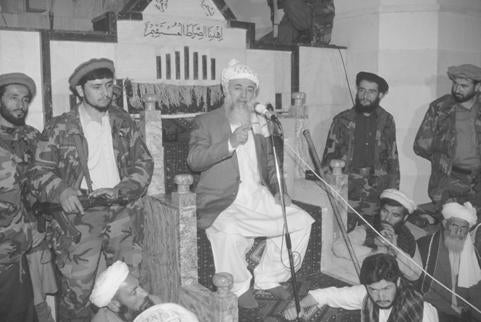
Burhanuddin Rabbani, seated,
the political leader of Jamiat-e Islami and President of Afghanistan after Mujaddidi.
© 1992
Robert Nickelsberg
January – February 1993: Conflict Continues
Fighting between Jamiat and Hezb-e Islami/Wahdat flared up the week of January 19, 1993. Jamiat forces attacked several Hezb-e Islami positions to the south and southeast of Kabul early in the week, and Hekmatyar’s forces soon restarted rocket and shelling attacks on the city center.135 Heavy fighting broke out later in the week between Wahdat and Jamiat forces in west Kabul, near the Intercontinental Hotel and the large agricultural compound west of Mamorine neighborhood, known as “the Silo,” as well as in other places in the west. Wahdat and Hizb-e Islami forces were now cooperating.136
In statements given to journalists, the two opposing sides—Jamiat on one side and Wahdat and Hizb-e Islami on the other—blamed the other for the resumption in hostilities.137
Over the next three weeks, thousands of Kabul residents were wounded and killed in the fighting, according to health officials interviewed by Human Rights Watch and others who spoke with journalists at the time. Some of the last diplomatic offices in Kabul were evacuated, including the Turkish, Iranian, Chinese, and Indian embassies.
The fighting grew worse as weeks passed. Journalists working in Kabul at the time told Human Rights Watch that the hospitals they visited were constantly full, with scores of wounded civilians and soldiers brought in daily. Many of the dead were never brought to hospitals at all. A journalist recalled the general level of chaos at the time, and driving from the city center to west Kabul to see the fighting:
It was complete madness. No one was on the roads. On the main road [running to Darulman in west Kabul] there were rockets coming in all around. It was terrifying really. It wasn’t really possible to tell where they were coming from.
When you went down to Charasyab [southwest of Kabul] you’d see rocket launchers, where Hekmatyar’s troops were. And on that mountain behind Wazir [Bibi Mahru hill] also. . . . There were attacks all the time. It was completely arbitrary whether you could get to the places that had been hit quickly enough to cover it [interview people and file stories]. We saw terrible things. Dead people, wounded people, corpses on the side of the road. One time we saw the remains of a child, lying on the ground. One time we picked up a guy who had been wounded, a civilian, with a huge hole in his side. It was horrible really. We had to put him in the boot of the car and we drove him to the hospital. It was quite absurd. I don’t think that he lived. . .138
Many of the rockets and shells fired by both sides were clearly hitting civilian areas on a regular basis, and most of the patients brought to the hospitals mentioned above were in fact civilians.139
There is no accurate tally of dead and wounded civilians during the fighting, but journalists in Kabul at the time were able to gather limited reports day-to-day:
- On January 19, a health official reported to Agence France-Presse that 33 wounded persons had been brought to a central hospital, of whom eight died.140
- On February 4, according to reports gathered by the Reuters journalist quoted above, at least 41 persons were admitted to one hospital in Wazir Akbar Khan, 10 persons died at a nearby military hospital (with “many more” injured) and at the Jamhuriat hospital, there were 26 wounded admitted, of whom four died.141 Dr. Said Omar, a doctor at Jamhuriat, told the journalist: “This is heavy artillery and it totally cuts up the bodies. . . . This is the worst morning we have had.”142
- On February 8, 1993, Hezb-e Islami and Wahdat forces fired rockets and artillery at Jamiat positions throughout the day, including in civilian areas in the eastern and central parts of the city, while Jamiat positions on Bibi Mahru hill, behind the Wazir Akbar Khan neighborhood, fired rockets at Hezb-e Islami positions to the south.143 Scores of shells and rockets fell in the city: in Micrayon, Wazir Akbar Khan, West Kabul, Afshar, and neighborhoods on the lower part of Television Mountain, killing and injuring hundreds of people. There was also fighting between Jamiat and Hezb-e Islami in and near the Russian Embassy and the Presidential Palace. That day, a hospital in Wazir Akbar Khan reported 20 dead and 60 wounded; a journalist saw the hallways filled with groaning patients with shrapnel wounds, and dead bodies in the parking lot. Dr. Mohammad Qasem told the journalist: “This is the highest number since the fighting began.”144 Medical staff at other hospitals couldn’t count the bodies that day: “We don’t have time to count them, we’re too busy trying to look after them,” a nurse at the Jamhuriat hospital told another journalist.145
By the end of the first week of February, medical staff in Kabul reported 800 deaths and 3,500 to 4,000 injuries since January 19, 1993—a three week period—while pointing out that the number of dead was likely much higher, since most families were not bringing the civilian dead to hospitals or reporting deaths.146 Armin Kobel, the chief of ICRC, told journalists that 368 wounded were admitted to Kabul’s hospitals February 10.147 On February 12, a doctor at an ICRC hospital told an Agence France-Presse journalist that the total dead citywide in the period (civilian and combatants) was probably around 5,000.148
A Kabul resident who was present in West Kabul at the time of the fighting told Human Rights Watch:
It was a terrible time. There were rockets coming every day. During the night, bullets and artillery would be launched from Qargha from the west [area on the border of Paghman district to the west of Kabul, controlled by Jamiat and Sayyaf’s Ittihad forces]. And from the mountain, Mamorine [controlled by Jamiat], came shells. They were shelling from Mamorine, into Afshar, hitting the side of mountain. We lived in the basement during this time. . . .149
Another witness, a doctor who was a medical student at a hospital at the time, told Human Rights Watch about the situation in both West Kabul and the central city:
There was a lot of fighting going on in our neighborhood around this time. There were many times I saw fighting like this. We saw terrible rocketing and shelling, by Shura-e Nazar and by Hekmatyar. Rockets hitting hospitals; people would be broken into pieces: hands, feet, heads.
One time, a rocket flew in and exploded at the Amniat hospital, where we were studying at the time because of the insecurity at the main university. It was about ten in the morning. . . . Some doctors died, some of the female students died, one girl went crazy, from an injury to her head. One girl lost her eyes. I myself saw all of this—the damage after the rocket hit: people torn into pieces. Many people were killed by that rocket. It came from the west, over television mountain [the main peak in central Kabul, suggesting it was fired from Hekmatyar’s positions in southwest Kabul].150
A resident of Afshar in West Kabul told Human Rights Watch how his brother and later his father were killed by shelling and rockets in his neighborhood in late January 1993:
One early morning [the last week of January], while I was still asleep, my older brother went down to a well below our house [down the mountain] to get some water for the family. . . . Later, the neighbors woke us, telling us to come down to this shop . . . . We went down: there were seven or eight corpses, lined up near this store there. We were told that a rocket had hit near to the well, and my brother had been killed. There were explosions all the time in those days. . . .
We couldn’t bury him, it was so unsafe to be outside for too long. . . . That night, we took him out to bury him near to our house. We brought a hurricane lamp with us, but didn’t light it. It was quiet, as we dug a hole and the cleric with us spoke and we prayed. Then we lit the hurricane lamp, in order to lower him into the ground. As soon as we lit that hurricane lamp, we heard them firing from Mamorine [the mountain southeast of Afshar, held by Jamiat], and explosions hit nearby, so we extinguished the light and buried him in the dark. It was Shura-e Nazar [Jamiat forces]. They would shoot at us from Mamorine all the time—at ordinary civilians. They would shoot at anyone, but especially crowds of four or more.151
The man’s father was killed in an attack three days later:
It was morning, and we thought we could go out, it was quiet. We needed some food. So my father went out. As he was going down the steps, in the mountain, a rocket hit very near to him. My father collapsed. We went to him. Shrapnel had hit him. He was seriously wounded. We started to carry him, to get a way to go to the hospital. But he was bleeding so much, and it didn’t stop. He bled to death. . . . When we had to bury him, we faced the same difficulties as with my brother.152
Thousands of civilians fled their homes in Kabul throughout late January and early February. Human Rights Watch interviewed several men who sent their families out of Kabul during this time, complaining of the constant fighting. “We left because there was heavy shelling and a lot of shooting, with heavy weapons,” one man who fled in early February told Human Rights Watch.153 “Sakr [Soviet-made] rockets were flying into the area [west Kabul]. . . . The artillery and rockets were hitting the houses, indiscriminately. We didn’t feel safe, so we left.”154 Journalists in Kabul at the time reported seeing families fleeing on roads out of the city. One man shouted to journalists as he pushed a cart with his belongings out of the city on February 9: “These mujahedin are taking us back to the first century!”155
C: February 1993: the Afshar Campaign
The Wahdat and Hezb-e Islami alliance was a new threat to the Rabbani government, since Wahdat already held positions in central Kabul itself, including much of west Kabul and areas between the eastern portions of the city, where most government buildings were located, and the western hills of Paghman, where Sayyaf and his Ittihad militia were headquartered. Wahdat’s possession of the peak of Afshar mountain, north of the main road to Paghman, made their position especially strong.
In early February 1993, the government of Burhanuddin Rabbani and the senior Jamiat and Ittihad commanders decided to take action against the Wahdat and Hezb-e Islami alliance by attacking Wahdat’s main positions in the west of the city and, in particular, their positions on the top of Afshar mountain and in several government compounds to the east of the Afshar residential area at the foot of the mountain.
Human Rights Watch received credible and consistent accounts from several officials who worked in Shura-e Nazar and the interim government that a military campaign against Wahdat was planned and approved by officials at the highest levels of Jamiat and Shura-e Nazar, Ittihad, and the Rabbani government.156
The plan was for a coordinated military attack on Wahdat headquarters located in the Academy of Social Science, near the Polytechnic University, at the foot of the Afshar neighborhood in west Kabul. The specific objectives of the campaign were for Jamiat and Ittihad forces to seize and occupy the headquarters and main Wahdat positions around Afshar so that the government forces could link up their control of Kabul from the west (around Paghman district) to the eastern parts of the city, and to capture the political and military leader of Wahdat, Abdul Ali Mazari.
The Afghan Justice Project, the independent non-governmental group that investigated the Afshar incident and other military operations in Afghanistan from 1979 through 2001, described the operation in a January 2005 report:
The Afshar operation of February 1993 represented the largest and most integrated use of military power undertaken by the ISA up to that time [ISA refers to the Islamic State of Afghanistan, the Rabbani-led government]. There were two tactical objectives to the operation. First, Massoud intended through the operation to capture the political and military headquarters of Hizb-i Wahdat, (which was located in the Social Science Institute, adjoining Afshar, the neighborhood below the Afshar mountain in west Kabul), and to capture Abdul Ali Mazari, the leader of Hizb-i Wahdat. Second, the ISA intended to consolidate the areas of the capital directly controlled by Islamic State forces by linking up parts of west Kabul controlled by Ittihad-i Islami with parts of central Kabul controlled by Jamiat-i Islami.157
The attack was not a well-kept secret among the militias. Wahdat political officials knew that an offensive was planned several days before it began, as did a small number of well-connected Afshar residents, who fled in the days before the attack.158 A few Afshar residents who received word of an impending attack were able to leave. A resident described to Human Rights Watch how he learned of the attack:
A friend of mine, he was involved in Shura-e Nazar. He worked in the headquarters and in the government. He came to me, before the invasion, two days before, and he said, “You must get out of here. There is an order for an invasion. Paghmani people [Ittihad] will attack this area, kill everyone, and loot every house.”159
Another said:
A family relation we had, who was a fighter with Massoud, told us to leave. He said to us, ‘Sayyaf’s people and Massoud’s people are going to attack here.’ This was four days before. He told us to leave. So we left.160
And another:
Five days before the attack, a nephew of mine who was a bodyguard for Anwari [Harakat’s leader] came and told me: “You should get out of here, this place will collapse. And even if you are not a combatant, there will be lots of destruction.” Two days later, at night, we left.161
Most residents in the area, however, were not aware of the impending operation and were not warned or evacuated.162
The operation’s key was the top of Afshar mountain itself, lying above Afshar neighborhood. The military strategy centered around Jamiat taking control of the peaks of the mountain, before moving on Wahdat positions at the southeast base of the hill, to the east of Afshar’s civilian area.163 Just before the attack, agents in the Jamiat-controlled Afghan intelligence service, or Amniat-e Melli, headed by Mohammad Fahim (Afghanistan’s defense minister from 2001-2004 and a key military ally of the United States during operations against the Taliban in late 2001) paid off several Harakat faction commanders to the north and west of Afshar, to cooperate with the invasion and allow Jamiat and Ittihad troops to pass their posts unmolested and to seize Afshar’s peak.164 When the attack later began, Jamiat forces did seize Afshar’s peak, and Ittihad entered Afshar itself and took control of Wahdat positions at the Academy of Social Science and along the road that runs south of Afshar from Paghman into central Kabul. Jamiat forces also took positions on the roads leading in and out of Afshar. Wahdat forces, meanwhile, fled south into west Kabul, leaving the predominately Hazara civilian population of Afshar in the hands of the predominately Pashtun Ittihad troops.
Two days before the attack, Massoud convened a meeting at the military base at Badambagh in Kabul, comprised of senior commanders in Jamiat and Ittihad, and other commanders within the overall structure of Shura-e Nazar.165 The senior leadership of Jamiat at the time included Mullah Ezat (Ezatullah), a commander in Paghman; Mohammad Qasim Fahim (the head of Amniat-e Melli); Baba Jan; Anwar Dangar; Gadda Mohammad; Baba Jalander; Haji Almas; Gul Haider, and Bismillah Khan.
Human Rights Watch was unable to confirm exactly who was at this meeting, but it is almost certain that Fahim was there, given the importance of his role in organizing the preparation for the operation. According to a witness interviewed by the Afghan Justice Project, two senior Ittihad commanders—Shir Alam and Zalmay Tofan—were at the meeting, as well as Hossain Anwari, leader of the Harakat faction.166
The next day, Sayyaf reportedly met with senior Ittihad commanders in Paghman to discuss the planned attack.167 Ittihad’s leadership at the time included Sayyaf himself, Haji Shir Alam, Zalmay Tufan, Abdullah Shah, and Mullah Taj Mohammad. Several mid-level commanders were probably also at the meeting.
Another commanders’ meeting was held by Massoud in a safe house in Karte Parwan, near the Hotel Intercontinental, on the night before the offensive.168 According to the Afghan Justice Project, Massoud also convened a meeting in the Hotel Intercontinental on the second day of the operation, February 12, attended by military commanders and political figures, including Rabbani, Sayyaf and Fahim.169
Human Rights Watch interviewed numerous residents in Afshar who were present at the time who described how the attack and its aftermath unfolded. As shown here, there is credible and consistent evidence of widespread and systematic human rights abuses and violations of international humanitarian law during and after the Afshar operation, including intentional killing of civilians, beating of civilians, abductions based on ethnicity, looting, and forced labor. The widespread and deliberate nature of these attacks suggests that some of the commanders involved in these abuses could be liable for crimes against humanity.
Artillery Attacks
Before the actual ground attack, Jamiat forces positioned new artillery on the peaks of Aliabad hill and Mamorine mountain, nearby; Ittihad already had artillery and rocket launchers in place at Qargha, on the Paghman border to the west of Afshar. Journalists and military officials familiar with the operation believe the weapons deployed on Mamorine and Television Mountains, at the Hotel Intercontinental, and at the Kabul Zoo included BM-40, BM-22, and BM-12 rocket launchers (mounted cubes of 12), Sakr 18 rocket launchers, 120mm mortars, 82mm mortars, and D30 (or “DC”) 105mm cannons. Jamiat forces also put tanks in various areas to use their cannon fire.170
There was periodic artillery and rocket fire directed at the Afshar area February 7-10. According to residents who lived in Afshar at the time, ordinance fell repeatedly on the civilian homes below the top of Afshar mountain and to the west and northwest of Mazari’s headquarters at the Academy of Social Science.171 A resident who was wounded at the time told Human Rights Watch about the effects of the initial artillery fire:
They [referring to Ittihad and Jamiat] were firing at the top of the hill [Afshar]. . . . Mostly the artillery was falling into this area. Many houses were hit. Our house was hit during this time.
I remember: I heard my son shriek. I was wounded also, in the torso here, in the stomach. My granddaughter was also killed by the same shell, and my other daughter was wounded in the face and disfigured. My house was on fire. Three or four other houses were hit as well around here [gesturing in a circle].172
Another resident, J.L.S., saw the beginning of the attack: “My house is at the foot of the mountain. I woke up early on the morning of the attack, to take ablution for prayer. Suddenly, there was a lot of artillery firing. I looked up toward the communication center [at the top of Afshar mountain] and it was on fire. The base was on fire. There was a lot of artillery landing nearby.”173
One resident, a Tajik man who lived in Afshar, said that the constant firing of shells and rockets kept many residents inside: “Before the invasion, there was no announcement or effort to make people leave, or evacuate. No one knew what was happening, everyone was a prisoner in their home.”174 The man described seeing a neighbor hit by shrapnel on or about February 7:
Mir Yaqub, a neighbor of mine just next to me, in the house below, a rocket hit his house and he was killed. This was about four days before the main attack started. After the rocket hit, I looked out this little space, between the bags of dirt we had laid in the windows. I looked out and down into his yard, and I saw that he had been injured, and was lying on the ground. Members of his family picked him up . . . to take him to the hospital, but he died [there], and they brought him back and buried him on the mountain.175
The Ground Attack
The Afshar operation started in earnest in the early hours of February 11, 1993. Jamiat forces (with Harakat’s agreement to allow it) seized the top of Afshar mountain itself. Ittihad and Jamiat positions then launched a massive barrage of rockets and artillery at the entire area around the foot of the mountain—both the Wahdat positions along the main road south of Afshar and the neighborhood to the north. Much of the barrage hit civilian homes in Afshar area through the morning.176 As the morning continued, Wahdat troops fled south, away from Afshar. Ittihad and Jamiat forces began to enter the area.177
L.S., an Afshar resident, told Human Rights Watch how the morning unfolded:
It was five o’ clock in the morning. There were rockets firing and artillery. . . . At first, people thought: “It is fighting between the mujahedin.” I myself thought this, and I didn’t worry so much. I thought that they were fighting amongst themselves—Rabbani, Wahdat—and that civilians would face no harm. But there was a lot of rocketing. Then around ten a.m. we saw the first troops come from the west, into Afshar. . . . We stayed indoors.178
A.L.S., another resident who was a boy when the attack occurred, said that many families started to flee as the morning progressed, including his own:
It was terrible. There were rockets, explosions. . . . I saw a rocket hit a neighbor’s house. His son was killed. There was blood pouring out of him. I saw that. . . . The [ground] attack started sometime later. Our family left [then]. When we went, we saw a lot of dead bodies on the street: people who had been killed.179
Many families tried to go east, towards the Hotel Intercontinental and into the Timani neighborhood beyond, where many people later took refuge.
A resident, Q.L.N., described the scene of fleeing residents: “A number of families were fleeing. One family was holding a dead child, wouldn’t let it go. One young girl had lost her family; she was wounded, dying on the ground.”180
Ittihad troops were now arresting Hazara men: numerous residents interviewed by Human Rights Watch described Ittihad troops stopping Hazara men and separating them from their families.181 The troops were also killing unarmed civilians. F.A., a woman from Afshar, told Human Rights Watch about how both her husband and son were killed by Ittihad troops the first day of the attack:
As we were leaving [to flee Afshar], three of Sayyaf’s gunmen came up to our house. My husband, my son, and us women. Just as we opened our door, they were there. They came in, and without exchanging a single word, they aimed their guns at my husband and my son and they shot both of them, right in front of our eyes. . . . We were hitting our heads and sobbing and throwing ourselves on our men. The troops said that if we didn’t stop screaming they would throw grenades at us and kill us. . . .182
(The woman later fled east with another family to Taimani, a predominately ethnic Ismaili neighborhood where many Afshar residents took refuge during the attack.183)
Another woman, F.W., said she had to leave her wounded husband behind as she fled:
That first day, a rocket hit our house. My husband was wounded in the foot. He was bleeding. . . . People were rushing around: men, women, children, all fleeing their houses, going toward the Intercontinental Hotel. I told my husband, “Everyone is leaving, fleeing, no one is left.” And I said that we should go. But he said, “I can’t move. I can’t go with you. Leave me here, and flee.” And he told me to take the eldest daughter, and that taking her away was the most important thing. . . .
We went out [of the house], but I couldn’t go. I couldn’t leave him there—my husband. I had to go back. So I went back, and I told him that I wanted him to come with us, and that I would help him walk. . . . So then we went, I was helping him, he had his arm around my shoulder. I was also carrying my three-month-old son, and my eldest daughter was holding my three-year-old. We got as far as the water canal [about 80 meters away].
At that moment, some gunmen came up to us, Mullah Ezatullah’s men. The commander said, “Qalfak Chapat.” [A derogatory term for Hazaras referring to their facial features.] “I’m one of Ezatullah’s men, and I’ve been ordered to seize this area. I’ll teach you a lesson you’ll never forget, for all of history.” He was a fat strong man, in plain Afghan clothes. But they didn’t do anything to us. They said, “We can reach you anywhere you go, we are everywhere, we control everything.” And they moved on.
So we were very scared. My husband said he could not go on. So we went back to our house. He made us leave, he insisted that I take our daughter, and so we went. We went [past] the Intercontinental . . . and we went to the Ismaili people [in Taimani], who helped us.
A few days later, a neighbor came to us, a Tajik who knew what was going on. He told us that Afshar was destroyed, my house was burned, and my husband was killed. . . .184
The woman returned to the house over a year later: “When we entered the house, we found only a skull, and four big bones, on the ground. There was nothing else. A neighbor, who knew Sayyaf’s people and had seen more of what happened, told me that my husband was shot with many bullets and killed.”185
Another resident, R.J.G., said that he witnessed rockets fired into crowds of fleeing civilians off the top of Afshar mountain on the afternoon of February 11:
Jamiat took the top of the mountain. Around five in the afternoon, they started firing rockets from the top of the mountain, down into this area. They killed people right here on this street. People were rushing out of Afshar. They were rushing down this street here [the main street running north south through the eastern part of Afshar]. The street was filled with people, running away from Afshar. . . . My house is right there, at the top of the street. . . . Massoud’s forces were shooting at them. . . . They were firing into this street. Three times the street was hit. Seventeen people were killed—there were seventeen bodies lying in the street—we counted. The corpses were lying here in the streets. . . . Clearly they were civilians. Yes, it was clear: they had burqas, there were children. It was clear they were civilians.186
Another resident, L.M., was almost killed by a rocket the next day:
As we were walking up towards our compound, a shell or a rocket hit right in front of my compound. I was walking with my two neighbors, both of them were hit. One was killed instantly. A piece of the rocket went into his eye, and out the back of his head. He died. And the other person was hit in the knee, and he was injured, and he fell down. We were about fifty meters from where the explosion was. . . . I was not wounded. It was a miracle.187
Notably, this incident, which took place in a residential area, occurred after Wahdat forces had left the nearby headquarters, suggesting that whatever force fired the rocket was either intentionally or recklessly targeting civilians.
Y.B.K., a Hazara Afshar resident who was a boy at the time, said he was arrested in his house by troops he believed were Pashtun—likely Ittihad—and taken to the Academy of Social Science. He said he saw scores of dead civilians on the way.188
I saw some Paghmani people [i.e., Ittihad], searching house by house. I fled into my house. This commander, Hasan Yaldar [the witness said he learned the name of the commander from his neighbor, mentioned below], came into our house, with seven or eight gunmen. . . . They grabbed me and took me with them. I was afraid. . . . Hasan Yaldar pushed me down to the ground, and he kneeled on my chest, pulled out his bayonet, and pushed it into [against] my throat. —“Where are the guns?” he yelled at me. —“I don’t know anything, I swear to God,” I said. But he hit me with a strong slap. And he was yelling at me. I was crying and crying. I was so afraid. Then, the other gunmen told him to release him, and he did, and they started to beat me, kicking me, punching me, and hitting me with their guns. I had cuts all over my body. I was hurt badly.
My neighbor, a Panshiri [Tajik], came up and he tried to stop them. He said to Hasan Yaldar, “He’s just a child!” And he said to them that when Wahdat was in power, my family had protected them [as Tajiks] as much as possible, and that he had to protect me. But they took me away. They made me walk toward the Academy of Social Science.
On the way, I saw fifty or sixty corpses all over the roads. Some were shot. Some were cut up, limbs severed. There was a lot of blood on the ground. It was a shocking scene. It stuck in my mind how awful it was. . . . Some of them were shot. I saw some bodies, their stomachs had been cut open. Others had been hit in explosions, in rockets, and were burned. . . . I think that most were killed by gunmen. . . .
My neighbor was following us, begging them to release me. He was trying to convince them, saying I was just a child, and asking them again and again. Finally, I think he talked to a higher commander, who told Hasan Yaldar to release me. Finally, they released me, and my neighbor grabbed my hand, and took me back to my house, to my mother. We were in a panic. . . .189
F.W., quoted above, who fled during the fighting east toward the Hotel Intercontinental, said that some troops were stopping civilians and killing some of them at the side of the road, although at least one commander attempted to stop abuses:
While we were fleeing, toward the Intercontinental, the troops were stopping civilians, and killing them. One of the commanders said to the troops, “Stop bothering these people. We are fighting with gunmen, not children and wives.” But some others disagreed with him, and said, “No, on the battlefield, everyone is an enemy. Everyone who helps the enemy is an enemy.”190
Some residents said that Jamiat troops stopped Hazaras as well, and arrested them. Q.L.N told Human Rights Watch that he saw Jamiat troops stopping Hazara civilians at a post at Bagh Bala: “Qari Moheb, the Jamiat commander, stopped me. . . . They took my watch, my clothes. . . . There were two wounded people in the car with me, Hazara. They [the Jamiat troops] just said ‘You’re Hazara, you must come with us.’”191 Q.L.N. said he was able to be released because another Jamiat commander there knew him. “The others were taken,” he said.
On February 12, as more Ittihad troops fanned through the neighborhood, residents continued to flee. According to numerous residents interviewed, Ittihad troops were still stopping Hazara families, separating men from their families and arresting them, and sometimes beating or killing them.
L.M., an Ismaili, told Human Rights Watch that Ittihad troops (after they robbed his store nearby) asked him which houses were inhabited by Hazaras: “‘Where are the Hazaras?’ they said. I said, ‘I don’t know, we all live in different houses, I don’t know.’”192 A short-time later, as troops continued to move through Afshar, some Hazara neighbors came to L.M.’s house asking him for help: “[T]hese two Hazara guys came into my house, some neighbors, and they said, ‘We live nearby. We know that you are a good person. Please help us, they are looking for us.’”193 L.M. said that family members later escorted the two men out of Afshar.194
As he fled later, L.M. saw Ittihad troops beating a Hazara teenager at a checkpost:
[H]e was the son of the servant at the mosque. He was behind us [as we left Afshar]. The gunmen stopped him, and started to beat him. I turned around, and I said, “Stop, he is the son of the servant at the mosque. He’s not a fighter.” But they pulled him off and took him away somewhere. Three days later, when I came back, I saw his corpse behind the wall of the Academy of Social Science. I saw two corpses; his was one of them.195
L.S., a Hazara man quoted above, described what he saw and experienced:196
When I looked into the street, I saw a lot of people, men, women, and children running down the hill, escaping. . . . We decided to leave. . . . I got outside of my house, with my wife and children, and we started to flee. Along the way, we came upon gunmen, who were arresting people. They were stopping the families, and separating the men from the families. There were about seven or eight gunmen. They saw us, and some of them came up to us and they separated me from my family. . . .
L.S. said that he saw thirty to forty other Hazara men and boys lined up against a wall, guarded by Ittihad troops:
The gunmen were tying people up and putting them against the wall. Women were crying, or they were running away. They were very afraid. The soldiers saw us and came over to us. I know who the commander was: Shir Agha Zarshakh. It was one of Sayyaf’s commanders.
According to L.S., Shir Agha Zarshakh addressed him specifically:
He said, “Hey, Hazara: this is your graveyard. Where are you going?”
I said, “I am an ordinary person. I have no involvement with political parties or fighting. I live here with my family.”
He said, “Whether you are a civilian or not a civilian, you are Hazara.” And immediately the soldiers started beating me with the butts of their guns. My seven-year old son rushed away from my wife towards me, to help me, but one of the gunmen hit him hard with a gun, and knocked him down to the ground. Then the gunman took the bayonet off his gun, and put it up to my boy’s throat, like to cut off his head. I started shrieking, and the women started shrieking, and my wife and some other women threw themselves on top of the boy. The soldier moved back, toward me. I signaled with my hand to my wife to leave, to go. Then the women rushed off with the boy.
L.S. said he saw two women killed by the same set of troops:
At this time, they killed some women also. . . . This is how it happened: Najaf Karbalie [one who has made a pilgrimage to Karbala], an old man, had come out of his house, and they had separated him from his family to arrest him. As this happened, his wife came to him and grabbed him and was pulling on him, saying, “Please, leave him, he is old. Leave him.” But the gunmen did not let go of him.
Karbalie said to the gunmen, “Well, we thought you were Muslim. If we had known that you would behave like this, you would never have succeeded in capturing Afshar.” And the gunmen started beating him. They were also beating someone else, next to him. Karbalie’s wife and another woman threw themselves on them, their husbands, and were yelling at the troops, insulting them. The troops grabbed the one woman, and then the other, pushed them off the men, and then threw them on the ground and killed them.
They took their guns, with the bayonets, and stabbed the women as they lay on the ground, stabbed them many times over, at least ten times. [Motions like he is holding a gun with a bayonet, stabbing it down into the ground.] We saw all of this.
After, the women were lying on the ground. They were shaking at first; their feet were twitching. They were dead. The two men, both of them, fainted. They were unconscious. The women were about thirty-five, or forty. I think that one of them was pregnant. She looked pregnant. . . .
J.L.S., quoted above, a physically disabled Hazara man in Afshar who was detained in a house by Ittihad troops on February 12, told Human Rights Watch that troops beat him: “They beat me, really badly. I am a lame person [disabled]. I said [to them], ‘I am just a lame man, I can hardly walk.’”197 J.L.S. also said the troops harassed his female relatives:
They went to the women in my family, and they started to grab them, and pull at their chador [to remove it]. I threw myself on the legs of the troops, and said, “How dare you search these women?” This one troop I grabbed, he took his gun and pointed it down at me [to shoot me], but one of the women grabbed the butt of the gun before it fired, and the shot went into the ground. The women cried, “Please, give us mercy, he is just a lame man.” And they let us go. They said, “We’ll come back for you later.”
Y.B.K., quoted above, said that Ittihad troops started searching houses, apparently to look for weapons but also to harass Hazara civilians. He described seeing one of his neighbors being harassed, a 70-year-old man:
They said, “Hey, old man, where are your guns?” The old man said, “I don’t have anything, I don’t have any guns.” But the troops knocked him down and punched him. They took him by the ankles and held him upside down into the well [hanging into the well], and yelled at him: “Where are the guns?” But he yelled out, “My dear son, have mercy on me! I don’t have any guns!” They pulled him up again, and they threw him on the ground. . . .198
R.J.G., quoted above, fled Afshar with his family early on the morning of February 12. He said that Jamiat forces near the Hotel Intercontinental stopped his family and told them that the “fighting was over” and told them return to Afshar. R.J.G. and his family returned. “But when we got back, we could see that Sayyaf’s forces were there—and that there were Kandaharis among them, and that they were looting.” He fled once again: “We saw that there was no security, so we left again. There were many, many corpses [on the roads].”199 As he left his house for the second time, R.J.G. said he saw Ittihad troops randomly kill a Hazara boy who was passing a nearby checkpost on the way out of Afshar:
I saw Sayyaf’s troops kill this guy on the street here, a Hazara, about 16 years old. I saw from my house. There were these gunmen posted here, and this guy was passing on his way down the road. The gunmen, they were Pashtuns. They didn’t do anything to the boy as he went by, and the boy passed. After he passed, they shot him in the back, two of them I think, and he was killed. . . .200
Evidence of Mutilations, and Cases of Looting and Forced Labor
Ittihad forces compelled persons they had taken into custody to bury the dead, and those who did so say they saw evidence of torture and mutilation of corpses. Ittihad forces were also reported to have forced captured civilians to assist them in looting property and otherwise take part in forced labor.
L.S., quoted above, told Human Rights Watch that after he was arrested on February 12, Ittihad gunmen forced him to bury corpses and load trucks with stolen goods:
[After we were arrested,] three trucks arrived. Since my home was closest, they made us go into that house, to take out the property. They made us go in and carry all my property to the truck. We loaded property from many houses. . . .201
L.S. said that he and other detainees were then taken to the campus of the Polytechnic University nearby, where they were tied up. L.S. said that Ittihad troops beat them once they were tied up, kicking them and hitting them with their guns.202
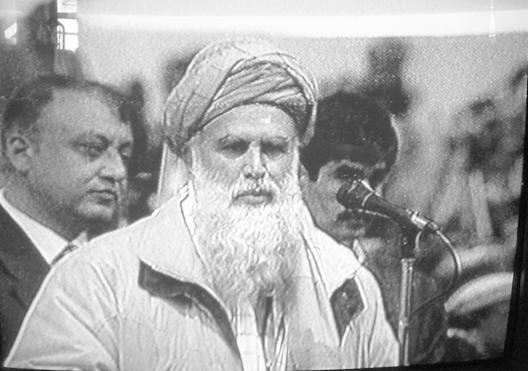
Abdul Rabb al-Rasul Sayyaf, the leader of the Ittihad faction, speaking
on television during Afghanistan’s constitutional loya jirga, December
2003. Several delegates to the 2003 loya jirga condemned Sayyaf and other
commanders for their involvement in war crimes and human rights abuses in Kabul in the early 1990s.
© 2003 Human Rights Watch
The men were later untied, said L.S., and deployed to pick up dead civilians and bury them. “They said, ‘Go and collect your corpses in Afshar, go collect your dead.’ So we went out, with them guarding us.”203
The first person we found was Faizal Ahmed, an old man. He was decapitated. One of his arms was cut off and one of his legs. And his penis was cut off, and his penis was put in his mouth.
Then we collected three other corpses, near Balki’s shrine, and four others from the street between the Academy of Social Science and the police academy. We buried all of these eight across from the Polytechnic mosque, in the potato field there.
Then they separated us, the older men from the young men. [The witness is an older man.] They took us to Qala Hazrat Sayeed and to Qala Qorna [Old Mosque]. The old to the old: I was in the Old Mosque. They made us put property from these areas into trucks. We loaded the property, and they took all the property off to Paghman. These people were from Paghman. They drove the trucks off to the west, toward Paghman.
As they were looting, they were saying, “You Hazaras were asking to be kings,204 but you don’t deserve these things. We deserve these things.”
Until eight p.m. it was our duty to load property from these houses in Afshar into the trucks. We had nothing to eat. When we asked for water, they were saying to us, “You should drink poison.” We were drinking water from the wells in some of the houses, as we were taking the property. Almost forty trucks were loaded, I think.205
The Ittihad troops, L.S. said, then took L.S. back to the Old Mosque, where he and other prisoners were tied up and kept for the night. “Some people slept,” he said. “Most did not. We feared death.”206 The next morning they buried more corpses, said L.S., although later in the day Ittihad troops made them load more trucks and told them to stop trying to pick up the dead:
From seven to ten a.m., we found eleven corpses. . . . We found one seven-year-old boy, he was decapitated. His head was nearby, it had been cut off, from behind: you could see from the head that they cut from the back, and that the skin had been torn off from the front of his neck, not cut. We found a woman in the same house, dead. She was holding a copy of the Koran in her arms, embracing it. Then we found the two women who I told you about before, who had been stabbed. We found seven other bodies, in the streets. Men. They had been shot. Three of them were shot in the head. We buried them behind Balki mosque, on the east side. . . . Later, we loaded more trucks: at around two p.m., we went to Cotton Textile Street, and Shir Ali Street, and took the property out of those houses. In a house on Cotton Textile Street, we saw a man, Haji Hasan: his head was cut off, and his feet, and his hands. There was nowhere to bury him, and no time: they were not letting us bury the corpses. So we put him into the well there. It would be better for him than to be eaten by dogs. . . .
The Ittihad troops apparently wanted to leave some evidence of their crimes—to terrorize the local population:
Then we went on to Shir Ali street. There, there was a woman who was shot. She had been the wife of the servant in the mosque there. We wanted to bury her, but they didn’t let us. They said, “Let her lie here. Let the other people learn from this, and fear us.”
On Jaghori Street, there was a guy there, Hussein Ali, he was about eighteen. He had been shot. They did not let us bury him either. “There are many others like him, you can’t spend all your time burying people.” [They said.] “There are others who will be eaten by dogs, let him be eaten too.” These all were Shir Agha Zarshakh’s men. He was with us the whole time.207
L.S. said he escaped from custody the second night after he was arrested. He says that the Ittihad men guarding them at the Old Mosque left them alone in the evening:
I and an old man and his nephew threw ourselves out of a window there. We crept up Afshar Mountain, and got to the water canal. There, we crawled all night, on our knees and elbows, across the hill, in the canal, to the northeast. All the skin was worn off our elbows. We moved on, toward the center of the city, and joined the other Afshari people at the Qahraman Karbala Mosque [in Taimani]. . . . Of the forty other people who were imprisoned with me, we never heard of them again, or found them. We have talked to their families: none of them was ever returned, and no one ever saw them again.208
A.Q.L., another Hazara man who was arrested during the operation, told Human Rights Watch that he was also forced to help Ittihad troops loot homes:
Four armed men from Sayyaf’s forces came. It was around 10 a.m. I begged for mercy, saying, “We are commoners.” They said: “You are Hazara, you work for Mazari.” They beat me up. . . . Sayyaf’s men forced me to carry the loot. . . .209
Y.B.K., also quoted above, said that he saw Ittihad troops forcing residents to carry looted goods: “The troops were making [people who they arrested] drag precious things with them, like they were porters. They were carrying what the troops looted, behind them.”210 He saw civilians forced to “drag the corpses out on to the street.”211 He also said his own home was looted: “They took everything valuable. What they couldn’t take, they broke into pieces—for instance, the refrigerators.”212
Soldiers involved in looting did so openly, apparently unconcerned that their superiors would try to stop them:
At around twelve that day I heard some drums. I was amazed. Who would be having a wedding in the middle of this massacre? I looked outside and saw the troops walking by, playing on drums, laughing. They had some porters with them, carrying some televisions and radios.213
L.M., the Ismaili man quoted above, was also detained and forced to work, after he returned to Afshar to look for his son, who had gone back to get some of his belongings and (as L.M. later learned) was detained as well.214
I saw many corpses on the road. . . . Many had been shot, or stabbed. I went to my home. Everything was stolen. There was nothing there. They had taken all the valuable things, and what was left, too big to take, had been broken, and shot with bullets, like the refrigerator.215
L.M. said he could not find his son, and he went to a nearby mosque to pray:
I was really upset, and feeling very sad and broken. I went to the shrine, and I prayed there. When I finished praying, I stood up, and some gunmen saw me. They called me over, and they said, “Old man! Who are you?” I said, “I am an inhabitant of this area.” And they said, “Oh yes, we know you. You have two guns. Give them to us.” I said, “Believe me, I swear to God, I am only a shopkeeper.” They said, “No, you are a fighter, give us the guns.” I said again, “I don’t have any.” But they started to beat me. They all beat me, all of them. I fell to the ground, my eyes were hurt, they turned black and blue later. My head was full of bumps. After they beat me, they made me stand up, and they ordered me to walk towards the north of Afshar, with them. As we went, they entered into houses, to search, or to shoot people. They were laughing, enjoying themselves.
L.M. said that the troops took him into a small cemetery, where he says he saw the corpses of about eleven boys:
They made me walk up and stand next to those corpses. They said to me, “Give us the guns, or you will face the same fate as these eleven boys.” They were all around me, pointing their guns. They ordered me to sit down on the ground. The commander said, “I’ll count to three, and you have to confess.”
I said, “I am a Muslim, let me pray, and then kill me.” They told me: “You’re dirty, you’re not a Muslim—you’re Shi’a.”
So then I just started praying, with my mouth [i.e., not out loud]. They counted, “One. . . Two . . . Three,” and then they fired, right in front of me, so that the dirt on the ground sprayed up into my face. . . . It was on automatic.
“O.K.,” they said. “He won’t confess. He will die digging holes for us in Paghman. There is no need to kill him.” So then they took me away.
A more senior commander then appeared and asked the other troops who L.M. was:
They said, “We have arrested him. He has two guns, and he won’t give them to us.” The man said, “Shoot him. Kill him. Don’t waste your time. And put his corpse with the others.” And he pointed towards the cemetery.
But the troops apparently had other ideas. L.M. says they took him to a nearby compound, Qala Said, where there was a tokia khana, a Shi’a prayer hall, and made him carry out belongings from it: “They made me go in and carry out many valuable things, everything. They sent for a truck, to load things into.”
Then the troops put L.M. in a car and drove west with him, toward Paghman.
When we got to the Qargha, they stopped. There was a house there. We went into that house, and there they divided up all the property. I carried the property into the house. I saw them divide it. The commander got two shares, and the soldiers got one share.
L.M. spent the night there, sleeping on the ground at the Qargha base. The troops, who seem to have taken an inexplicable liking to L.M., drove him back into Kabul the next morning and released him.
A.Q.L., quoted earlier, said that after he was forced to help loot homes in Afshar, Ittihad troops took him with them back to Paghman and made him build fortifications.216 A.Q.L. says he was then kept there, essentially as a slave, for the next three years, working on a base controlled by Zalmay Tofan, one of Sayyaf’s main commanders.
They took me to Khandaq Tarik in Kampani, to Zalmay Tofan’s base. . . . They threw us in a container. There were forty prisoners there, Hazaras, in that one container. Every day they gave us one piece of bread and slapped us. By day we worked, by night we were put in the container. It was very cold; there was no sleep. I stayed there for forty days. Then they transferred us to Badam Ghol in Paghman. . . . There were twelve of us [there]. We went to a mountain between Maidanshah [district west of Kabul] and Paghman. There were four posts on that mountain. . . . I built these posts; I carried all the food and water there.
[When asked how he knew the commander’s name:] The men there told us “We are Zalmay’s men.” Conditions were very bad. . . . At dinner, they manacled us with chains on the legs, two of us to a chain. . . . We stayed in a room, about three by four meters. . . We never received anything from Sayyaf and Tofan. But after Sakhi came [another commander], he at least loosed our manacles at night, our food improved. I stayed there for three years. I had no news from my family. Out of the twelve [prisoners], one died due to disease. We couldn’t escape, because if one escaped the rest were under pressure. . . . I saw Zalmay Tofan up close personally once; it was in the second year I was up there.217
A.Q.L. says he was released in 1996, as the Taliban seized control of the area and Ittihad troops fled north. He then set off to find his family:
It took me eleven days to walk to Kabul. It was snowy, it was winter. . . [A] car came, he agreed to give us a ride. . . .
[When] I saw my face in the [car] mirror, I was shocked. The driver paid for the barber, for our shoes and clothes. I was dropped in Taimani. It was quiet, I didn’t know anyone anymore. I found someone I knew; he said your family is in Karte Seh, so I went there.
[Witness was quite distressed, but refused to stop interview.]
My wife didn’t recognize me, only after a few minutes.218
Both A.Q.L. and L.M. (quoted earlier) told Human Rights Watch that their sons were also arrested by Ittihad. A.Q.L. said his son was only eight years old when he was taken, and was kept for over three years: “After Sayyaf’s forces were defeated by the Taliban [in 1996], he was kept imprisoned by the Taliban. . . . I paid a lot of money to the Taliban and then he was released.”219 Human Rights Watch has documented that many young boys were and are still held by commanders for the purposes of sexual abuse.220 A.Q.L. did not allow Human Rights Watch to interview his son: “It is not good to remind the child from his bitter memories in the past.”221
L.M.’s son was 16 when he was arrested. L.M. managed to have him released after about two months, when he learned that he was being held at Bagh-e Daoud, in Paghman, by a commander under Mullah Ezatullah, named Masjida:
I went to Bagh-e Daoud, to the post there. . . . I eventually got a meeting with a commander named Ghafar, who was under Mullah Ezat, and he ordered Masjida to release my son. And so Masjida released him to me. I took him with me from that compound and brought him home.222
L.M.’s son, who was held for about two months, became mentally ill soon after his release. Said L.M.: “For a month or so, my son was alright, he was quiet, depressed, but more or less he was of sound mind. Now he is insane.”223 Human Rights Watch researchers observed L.M.’s son in 2003, in a semi-catatonic state. According to his family, he no longer communicates with other people, and spends his days sleeping or staring into space, sometimes muttering or laughing. L.M. described what his son told him before his mental health problems set in:
[Before the mental health problems,] I asked about what had happened to him. He wouldn’t talk so much about it. But he said this: he said he tried to escape from that compound once. He said he had tried to run away, but that they had fired guns at him. He said that that had really shocked him. . . . There were five or six other prisoners who were held with my son. He told me that. . . . They were made to work, my son said. He said they did work for the commanders and troops, washing their clothes, chopping wood, and that sort of thing.224
As detailed in earlier sections, Ittihad was not the only faction implicated in abductions. The Afshar campaign also exposed further Wahdat abuses: An Ittihad soldier who fought in the Afshar campaign told Human Rights Watch that after his troops seized the Academy of Social Science from Wahdat, they found several women there who said they had been raped by Wahdat. They also found a small pile of corpses of women prisoners. In another room, they found another pile of dead men and approximately twenty-five male prisoners: “They were all completely insane—from being tortured. They were completely, completely insane.225 The man said he was unable to stay longer to get a more detailed look: “I ran away. Because of the smell. It was disgusting.”226
The effects of the Afshar campaign
It is impossible to know for certain how many civilians were killed during the Afshar campaign, and how many were abducted and never released. After the Rabbani government came under strong pressure from Shi’a community leaders in the summer of 1993, they assigned a commission to catalog the destruction, for the purposes of paying out some form of compensation. The commission was comprised of civilians appointed by Wahdat and Harakat leaders, and they received complaints from families of approximately 800 arrests during the operation, mostly males between the ages of ten and thirty-five, with a small number of younger children and older men. According to officials, the final documents produced by this commission were destroyed after the Taliban captured Kabul in 1996.227
Officials with the commission said that approximately eighty to two hundred persons were later released, and that ransoms were paid to Ittihad commanders holding them to secure their release, but that approximately 700-750 persons were never returned, and were presumably killed or died in captivity.228 The commission said it documented that approximately 70 to 80 people were also killed in the streets in Afshar, a figure which is consistent with the testimony in this report. The same official said that the commission received information that many women were abducted during the operation, but said that few families would report it:
People were feeling so much shame: no one was reporting that the females were taken. [It was] because of the dishonor, and shame, families would report that the women were killed. [T]he men were reported kidnapped, and the women were reported killed [but] there is no doubt that women were kidnapped.229
The commission estimated that approximately 5,000 houses were looted in the Afshar area during and after the operation, a figure which is not inconsistent with the accounts and information received by Human Rights Watch.230
The larger import of the campaign was felt through Kabul. Many Kabulis viewed Afshar as a milestone in the post-communist era, a moment when they realized the real ethnic tensions underlying the fighting in Kabul and the extent to which different mujahedin factions—who had mainly fought the Soviet regime for so long—were now prepared to kill fellow Afghans. Much of the rest of the civil war, even into the Taliban period, was almost wholly defined in terms of ethnic and religious tensions between the different factions, stemming from perceived injustices which occurred in the first year of post-communist rule, the Afghan year 1371, which ended with the Afshar incident.
After Afshar
The Afshar campaign and the surrounding violence were ended by a short-lived peace agreement fashioned in late February 1993. (Hamid Gul, the former head of Pakistan’s Inter-Services Intelligence, or ISI, flew into Kabul in February and took part in negotiations.) Hekmatyar was granted a position in the Rabbani government as prime minister, but would not enter the city to take up his post. There were a few weeks of relative calm, but the peace did not last. By late March, Hezb-e Islami forces were again attacking Jamiat and Ittihad positions in the city. Violence continued in the city throughout the year. By the end of 1993, Junbish switched sides and join Hekmatyar’s forces, launching a new chapter of violence in the city. January 1994 was marked by huge battles in east Kabul, more shelling, and more civilian deaths. Violence continued through 1994 into 1995, at which point the Taliban began its attacks on Kabul, which were also marked by grave violations and abuses.
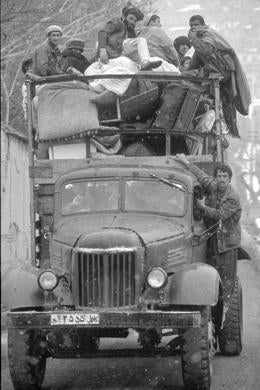
Civilians fleeing Kabul, March 5, 1993. Over a half million people were displaced by fighting in Kabul in 1992-1993. © 1993 Robert Nickelsberg
This report, which focuses on the first year of the post-Najibullah government, does not cover events after March 1993. But Human Rights Watch has gathered large amounts of information on further abuses in 1993-1996 involving the factions mentioned in this report, as well as the Taliban. This information will be supplied to the Afghan Independent Human Rights Commission and the U.N. Office for the High Commissioner for Human Rights, in Geneva.
Violations of International Humanitarian Law
The Afshar campaign was marked by widespread and serious violations of international humanitarian law. War crimes included attacks on the civilian population and civilian objects, killings, torture and other inhumane treatment, rape, abductions and forced disappearances, forced labor, and pillage and looting. As discussed in Section IV below, there is compelling evidence that the senior Ittihad and Jamiat commanders involved in the Afshar campaign are implicated in these violations.231 It is also possible that some commanders may be liable for crimes against humanity. Illegal acts that were part of a widespread or systematic attack on a civilian population, such as the killing or abduction of members of certain minorities, may amount to crimes against humanity.
Abdul Rabb al-Rasul Sayyaf, the overall leader of Ittihad, is implicated in the war crimes documented above either directly or indirectly, as a matter of command responsibility. As a senior leader of Ittihad, Sayyaf controlled all Ittihad commanders throughout the Afshar attack. Witnesses, including a soldier who fought with Ittihad, say that they saw Sayyaf coordinating military operations during the campaign and meeting with sub-commanders.232 Sayyaf met with senior Ittihad commanders in Paghman the day before the Afshar campaign to discuss the Afshar attack.233 Sayyaf was also present at the meeting convened by Massoud in the Hotel Intercontinental on the second day of the Afshar operation on February 12.234 His leadership role in Ittahad as well as his involvement in planning the Afshar campaign place him in the position of being directly responsible for abuses or culpable under the doctrine of command responsibility.
Other Ittihad commanders are potentially implicated. Several officials, journalists, and military commanders described how Ittihad commanders Shir Alam, Zalmay Tofan, Mullah Taj Mohammad, Abdullah Wardak, “Doctor” Abdullah, and Abdullah Shah had effective control over troops engaged in abductions and street fighting with Wahdat forces in west Kabul, and said that they commanded troops at Afshar.235 Commanders Khanjar and Patang were said to have been commanding troops at Afshar.236 One witness who was abducted and put into forced labor in Paghman under Ittihad troops saw and spoke with Zalmay Tofan while in captivity, pleading for medical assistance.237 Witnesses interviewed by Human Rights Watch and the Afghan Justice Project claim that they saw Zalmay Tofan, Shir Alam, “Doctor” Abdullah, and Abdullah Shah leading troops on the ground during the Afshar campaign.238 One witness cited above, who was abducted by Ittihad forces, said he was under the control of an Ittihad commander named Shir Agha Zarshakh, who was leading a group of soldiers.239 The Afghan Justice Project interviewed witnesses who identified other commanders who were seen directing troops during the Afshar campaign, including “Doctor” Abdullah and Khanjar, as well as other Ittihad commanders, including Jaglan Naeem, Abdul Manan Diwana, Amanullah Kochi, Shirin, Mushtaq Lalai, and Mullah Kachkol.240 According to one witness interviewed by the Afghan Justice Project, two senior Ittihad commanders—Shir Alam and Zalmay Tofan—were at the meeting convened by Massoud the day before the Afshar attack.241
Several Jamiat commanders, including Massoud, Fahim, Baba Jalander, Bismullah Khan, Baba Jan, Ahmadi Takhari, Kabir Andarabi, and Mullah Ezat, were directly involved in the 1993 Afshar campaign, according to officials who worked within the Rabbani government in 1992-1993.242 General Fahim, who was chief of the Afghan intelligence service in 1992-1993 but controlled several military posts as well, was one of the chief commanders under Massoud. Officials in the Rabbani government in 1992-1993 told Human Rights Watch that Fahim was directly involved in the Afshar attack, controlled at least one of the military posts on Television Mountain throughout the period of this report, and that he was involved in the planning of the Afshar campaign and took part in negotiations with Harakat commanders to gain their cooperation before the attack.243 The same officials said Mullah Ezat and Anwar Dangar were also involved in the Afshar campaign.
[22] Steve Coll, “Afghanistan’s Fate: Healing or Disintegration?” Washington Post, May 3, 1992.
[23] Sharon Herbaugh, “President Accuses Rebels, Communists Of Trying To Kill Him,” Associated Press, May 31, 1992. Herbaugh quoted Abdul Qadir Qaryab, a spokesman for Hezb-e Islami, dening the allegations: “If we had done it, we would have used at least 20 missiles and left no chance for survival, but we would never do that.”
[24] For an overview of Hekmatyar’s public statements during this period, see Sangar, Neem Negahi Bar E’telafhay-e Tanzimi dar Afghanistan, pp. 115-116, and sources cited therein.
[25] Mohammed Nabi Azimi, Ordu va Siyasat, p. 606 [translation by Human Rights Watch].
[26] See John Jennings, “Warring rebel groups blast Afghan capital,” Associated Press, July 19, 1992; Suzy Price, “Kabul shelling injures hundreds of people,” Reuters, July 19, 1992.
[27] Human Rights Watch interview with S.K., Afghan medical worker in Karte Seh (West Kabul) during early 1990’s, Kabul, July 9, 2003.
[28] Ibid.
[29] Human Rights Watch interview with F.R.G., Kabul resident, Kabul, July 3, 2003.
[30] Human Rights Watch interview with O.U., Afghan journalist, Kabul, July 13, 2003.
[31] Health officials in Kabul told Agence France-Presse on June 9, 1992 that 100 people were killed and 400 wounded during the first week of June. Agence France-Presse news dispatch, June 9, 1992.
[32] Jamilurrahman Kamgar, Havadess-e Tarikhi-e Afghanistan 1990-1997 (“Afghanistan’s Historic Events”) (Peshawar: Markaz-e Nashrati Meyvand, 2000), pp. 66-68 [translation by Human Rights Watch]. Kamgar also wrote of nighttime artillery barrages on Hezb-e Islami positions, by Junbish militias loyal to General Rashid Dostum, “whose flares turned the night into day” (June 10).
[33] Sharon Herbaugh, “Pro-Government militias intervene as fighting continues in Kabul,” Associated Press, June 5, 1992. See also Andrew Roche, “Gunbattles rage in Kabul, death toll over 100,” Reuters, June 5, 1992: “At least three civilians were shot dead on Friday morning [June 5], witnesses said. Residents scurried out of the area and units from neutral guerrilla factions sealed off road junctions around the maze of alleys near Temur Shahi Park as bullets flew over rooftops. . . .”
[34] Agence France-Presse dispatch, June 2, 1992.
[35] Human Rights Watch interview with F.K.Z., resident of west Kabul, Kabul, July 9, 2003.
[36] Andrew Roche, “Gunbattles rage in Kabul, death toll over 100,” Reuters, June 5, 1992.
[37] Kurt Schork, “Fighting Erupts in Center of Kabul,” Reuters, June 25, 1992; and “Kabul—‘Beirut without the Green Line,’” Reuters, June 26, 1992.
[38] Numerous media stories over the summer of 1992 documented the day-to-day violence. Archive footage of the British Broadcasting Corporation from April through August show artillery and rocket explosions in various parts of Kabul, and scenes of wounded and dead from Kabul’s hospitals. Print journalists wrote extensively about the carnage through the year. See, e.g., John Pomfret, “Rocket Attack Terrorizes Musicians’ Neighborhood,” Associated Press, May 5, 1992; Sharon Herbaugh, “Rebel Faction Hammers Afghan Capital,” Associated Press, May 5, 1992; “Fighting follows attempt on Afghan leader’s life,” Associated Press, May 31, 1992; Kurt Schork, “Afghan Factions Battle on Edge of Kabul,” Reuters, June 24, 1992; “At least 48 killed in Kabul by rocket barrage,” Reuters, July 4, 1992; “At least 100 dead in heavy fighting in Kabul,” Agence France-Presse, July 5, 1992; “Rebel rocket attacks kill at least 50,” Associated Press, July 5, 1992; “Rebels Rocket Kabul,” Associated Press, August 6, 1992; John Jennings, “Rival Factions Shell Afghan Capital,” August 8, 1992.
[39] Human Rights Watch interview with A.S.F., Kabul resident, Kabul, July 2, 2003.
[40] Human Rights Watch interview with F.W., woman in Afshar, Kabul, July 2, 2003.
[41] Human Rights Watch interview with G.M.A., Kabul resident, December 7, 2003.
[42] Human Rights Watch telephone interview with Jeremy Bowen, correspondent with the British Broadcasting Corporation in Kabul in 1992, April 12, 2004.
[43] Human Rights Watch interview with R.N., photojournalist, New York, December 18, 2004.
[44] Interim Report on the Situation of Human Rights in Afghanistan, prepared by Felix Ermacora, Special Rapporteur on Afghanistan for the U.N. Commission on Human Rights, November 17, 1992, U.N. Doc A/47/656, para. 34 (citing reports of 1,800 killed, thousands wounded); Human Rights Watch interviews with former U.N. officials working in Afghanistan in 1992, Kabul, December 10 and 11, 2003.
[45] For detailed accounts of the August 1992 attacks on Kabul, see Interim Report of the Special Rapporteur, November 17, 1992, para. 34; Barnett R. Rubin, The Fragmentation of Afghanistan, pp. 272-273 (citing U.N. Department of Humanitarian Affairs, “Note on Winter Emergency Needs in Afghanistan,” November 1, 1992, and U.N. Office for the Co-ordination of Humanitarian and Economic Assistance Programmes Relating to Afghanistan, “Immediate Humanitarian Needs in Afghanistan Resulting from the Current Hostilities,” press release, August 23, 1992); Saikal, “The Rabbani Government, 1992-1996” in Fundamentalism Reborn, p 33; Goodson, Afghanistan’s Endless War, pp. 74-75. See also, John Jennings, “Rival factions shell Afghan capital,” Associated Press, August 8, 1992; “Residents curse rebel rivalries,” Associated Press, August 15, 1992; Mushahid Hussain, “Kabul and rebels claim advances,” Inter Press Service Global Information Network, August 21, 1992.
[46] Kamgar, Havadess-e Tarikhi, pp. 78-80 [translation by Human Rights Watch].
[47] “Fighting in Afghanistan’s Capital Kills 35,” Associated Press, August 9, 1992.
[48] Interim Report of the Special Rapporteur, November 17, 1992, para. 35.
[49] Philip Bruno, “La seconde bataille de Kaboul ‘Le gouvernement ne contrôle plus rien,’” Le Monde, August 20, 1992.
[50] See Rubin, The Fragmentation of Afghanistan, pp. 272-273 (citing U.N. documents).
[51] See Section IV below. Provisions of Article 51 of the Geneva Conventions Additional Protocol I, which are considered generally to amount to customary international law for international or non-international conflicts, prohibit indiscriminate attacks “by bombardment” which treat “as a single military objective a number of clearly separated and distinct military objectives located in a city. . . .” Protocol I (1977) Additional to the Geneva Conventions of 1949 (“Protocol I”), art. 51 (5).
[52] For more on the definition of crimes against humanity, see section IV below.
[53] See section IV below.
[54] Human Rights Watch interview with O.U., Afghan journalist, Kabul, July 13, 2003.
[55] Ibid.
[56] Human Rights Watch interview with S.A.R., former Shura-e Nazar official, Kabul, July 20, 2003.
[57] Human Rights Watch interview with Suzy Price, correspondent for the British Broadcasting Corporation and Reuters, New York, April 1, 2004.
[58] Ibid.
[59] Human Rights Watch interview with S.K., Afghan medical worker in Karte Seh (West Kabul) during early 1990’s, Kabul, July 9, 2003.
[60] Human Rights Watch interview with R.N., photojournalist, New York, December 18, 2004.
[61] Human Rights Watch telephone interview with Colonel Ron Bailey, weapons system expect, United States Marine Corps, December 20, 2004. Human Rights Watch interview with A.G., military analyst, New York, April 9, 2004.
[62] Human Rights Watch interview with A.G., military analyst, New York, April 9, 2004.
[63] A weapons expert who inspected photographs of Jamiat weapons systems in 1992 told Human Rights Watch that the UB airborne rocket launchers were essentially reckless: “[T]hey took them off a Hind [Soviet attack helicopter], and then attached them to the turret of the tank. But here’s the thing: there’s no accuracy at all with a system like that. There’s no aiming. You can move the turret around, and you can raise the vehicles angle of elevation up and down, but there’s no system to aim, and there’s no mechanism to sight the system. It’s just like they fire the mortars. You can aim it in the general direction of where you’re shooting, but that’s all.” Human Rights Watch telephone interview with Colonel Ron Bailey, weapons system expert, United States Marine Corps, December 20, 2004.
[64] Human Rights Watch telephone interview with John Jennings, April 10, 2004; Human Rights Watch telephone interview with Anthony Davis, July 9, 2004.
[65] This information is based on viewing by Human Rights Watch of stock film footage from April and May of 1992, on file with the libraries of the British Broadcasting Corporation.
[66] Terence White, “South Kabul under intense rebel bombardment, many casualties,” Agence France-Presse, January 21, 1993 (Chelsitoon palace gardens in south Kabul, “once likened to a Greek temple setting, were being chewed up by the very accurate Hezb artillery barrage”).
[67] Human Rights Watch telephone interview with John Jennings, April 10, 2004; Human Rights Watch telephone interview with Anthony Davis, July 9, 2004. The Afghan Justice Project (see footnote 75 and accompanying text) also interviewed witnesses who described Hekmatyar’s weaponry to include BM-21 rocket launchers.
[68] Anthony Davis, who is a military analyst with Jane’s Defense Weekly, confirmed Hekmatyar’s use of Sakr rockets in Kabul in 1992 and 1993 and described their inaccuracy: “These are aerial weapons; not pinpoint weapons. They’re quite unsophisticated weapons. You fire them and then they’re off: very inaccurate.” Human Rights Watch telephone interview with Anthony Davis, July 9, 2004.
[69] See text in Section IV below outlining prohibitions on indiscriminate attacks including attacks “by bombardment” which treat “as a single military objective a number of clearly separated and distinct military objectives located in a city. . . .” from Protocol I (1977) Additional to the Geneva Conventions of 1949 (“Protocol I”), art. 51 (5).
[70] Mohammed Nabi Azimi, Ordu va Siyasat, pp.626-627 [translation by Human Rights Watch].
[71] Human Rights Watch telephone interview with Jeremy Bowen, correspondent with the British Broadcasting Corporation in Kabul in 1992, April 12, 2004.
[72] Ibid.
[73] Human Rights Watch telephone interview with Marc Biot, official at Jamhuriat hospital in Kabul in 1992-1993, July 10, 2004.
[74] Human Rights Watch telephone interview with John Jennings, Associated Press correspondent in Kabul 1992-1993, April 10, 2004.
[75] See Afghan Justice Project, “Addressing the Past: The Legacy of War Crimes and the Political Transition in Afghanistan,” January 2005 (“AJP report”), pp. 23-24.
[76] Andrew Roche, “Guerrillas clash in Kabul, some hostages freed,” Reuters, June 4, 1992.
[77] Human Rights Watch interview with O.U., Afghan journalist, Kabul, July 13, 2003.
[78] Mohammed Nabi Azimi, Ordu va Siyasat, p. 609 [translation by Human Rights Watch].
[79] Human Rights Watch interview with F.K.Z., resident of west Kabul, Kabul, July 9, 2003.
[80] Human Rights Watch interview with Y.N., Kabul, December 6, 2003.
[81] Ibid.
[82] Human Rights Watch interview with R.D., former official in the interim government 1992-1995, Kabul, July 16, 2003.
[83] Ibid.
[84] Human Rights Watch interview with S.K., Afghan medical worker in Karte Seh (West Kabul) during early 1990’s, Kabul, July 9, 2003.
[85] The quotes and descriptions of this case are taken from a Human Rights Watch interview with F.R.G., Kabul resident, Kabul, July 3, 2003.
[86] Human Rights Watch interview with L.R.G., relative of the prisoner, Kabul, July 3, 2003.
[87] Human Rights Watch interview with S.K., Afghan medical worker, Kabul, July 9, 2003. See also testimony of H.K., Afghan NGO worker, below.
[88] Human Rights Watch interview with Y.U., Afghan journalist, Kabul, July 8, 2003; Human Rights Watch interview with O.U., Afghan journalist, Kabul, July 13, 2003.
[89] See e.g., Sharon Herbaugh, “Civilians Tell of Captivity, Torture by Rebels,” Associated Press, June 6, 1992, quoting interview with released Hazara prisoner. “‘We were kept in containers, so many of us that we couldn’t sit down. They wouldn’t give us food or water,’ said Nadir Ali, a 22-year-old Hazara candymaker who was held with [. . .] others at an abandoned interrogation center of the former secret police. He was clutching his right arm, which was swollen and probably broken from the blows with rifle butts and chains.”
[90] Andrew Roche, “Gunbattles rage in Kabul, death toll over 100,” Reuters, June 5, 1992.
[91] Cooperation Centre for Afghanistan, “The Prisoners and the Missing, Kabul, Afghanistan 1992-1995” (Peshawar: CCA, 1996).
[92] The name of this person has been changed to protect his security.
[93] Human Rights Watch interview with H.K., aid worker, Kabul, July 5, 2003.
[94] Human Rights Watch interview with S.A.R., former Shura-e Nazar official, Kabul, July 20, 2003; Human Rights Watch interview with C.S.A., former government security official, July 18, 2003.
[95] Human Rights Watch interview with R.D., former official in the interim government 1992-1995, Kabul, July 16, 2003. This was consistent with testimony by a former Shura-e Nazar official, Human Rights Watch interview with J.G.M., government security official in 1992-1993, Kabul, July 10, 2003.
[96] Human Rights Watch interview with U.J., former Junbish official, Kabul, July 13, 2003; Human Rights Watch interview with M.O.Q., former military official in Junbish, Kabul, July 17, 2003; Human Rights Watch interview with C.S.A., former government security official, July 18, 2003 (describing reports received by government officials about abuses by Junbish forces).
[97] Human Rights Watch interview with three merchants near Bala Hissar, Kabul, July 13, 2003 (describing Hezb-e Islami troops stealing from the bazaar).
[98] See Malcolm Davidson, “New government struggles to halt Kabul fighting,” Reuters, April 30, 1992 and Sharon Herbaugh, “Anarchy rules in independent Afghanistan,” Associated Press, June 1, 1992 (describing looting of diplomatic offices and residences).
[99] See Final Report on the Situation of Human Rights in Afghanistan, prepared by Felix Ermacora, Special Rapporteur on Afghanistan for the U.N. Commission on Human Rights, February 18, 1993, U.N. Document E/CN.4/1993/42, para. 19.
[100] Human Rights Watch interview with Steve Coll of the Washington Post, April 24, 2004; Human Rights Watch interview with Jeremy Bowen of the British Broadcasting Corporation, April 12, 2004; Human Rights Watch interview with Mark Urban of the British Broadcasting Corporation, April 29, 2004. See also, “Kabul leaders seek to restore city: but rocket attacks, looting go on as interim council meets,” Los Angeles Times, May 1 1992. See also Derek Brown, “Rebel chief bombards Kabul homes,” The Guardian, May 5, 1992; “Afghan city plagued by armed gangs,” Reuters, June 20, 1992.
[101] Human Rights Watch interview with Y.U., Afghan journalist, Kabul, July 8, 2003.
[102] Human Rights Watch telephone interview with Jeremy Bowen, correspondent with the British Broadcasting Corporation in Kabul in 1992, April 12, 2004. Mark Urban, another journalist with BBC, also told Human Rights Watch about looting in April and May of 1992, Human Right Watch telephone interview with Mark Urban, correspondent with the British Broadcasting Corporation, April 29, 2004.
[103] Human Rights Watch interview with U.J., former Junbish official, July 13, 2003. This is consistent with testimony taken from another official in the interim government in 1992-1993: Human Rights Watch interview with C.S.A., former government security official, July 18, 2003.
[104] Human Rights Watch interview with J.G.M., former official in Shura-e Nazar 1992-1996, Kabul, July 10, 2003.
[105] Human Rights Watch interview with R.N., photojournalist, New York, December 18, 2004.
[106] Herbaugh, “Anarchy rules in independent Afghanistan,” June 1, 1992.
[107] Human Rights Watch telephone interview with Mark Urban, correspondent with the British Broadcasting Corporation, April 29, 2004.
[108] Human Rights Watch interview with U.J., former Junbish official, Kabul, July 13, 2003; Human Rights Watch interview with M.O.Q., former military official in Junbish, Kabul, July 17, 2003; Human Rights Watch interview with J.G.M., former government security official in 1992-1993, Kabul, July 10, 2003; and Human Rights Watch interview with S.A.R., former Shura-e Nazar official, Kabul, July 11 and 20, 2003.
[109] These are the names of three Junbish commanders in 1992-1993, of whom only Shir Arab is still alive. The witness cited here told Human Rights Watch that he currently lives in Denmark.
[110] Human Rights Watch interview with M.O.Q., Kabul, July 17, 2003
[111] Human Rights Watch interview with S.A.R., former Shura-e Nazar official in 1992, Kabul, July 11, 2003.
[112] Ibid.
[113] Human Rights Watch interview with S.A.R., Kabul, July 20, 2003.
[114] Human Rights Watch interview with J.J.E, civil society leader, Kabul, July 10, 2003.
[115] Human Rights Watch interview with T.S.L., resident of Timani, Kabul, July 12, 2003.
[116] Ibid.
[117] Human Rights Watch interview with F.R.G., Kabul resident, Kabul, July 3, 2003.
[118] For more on article 3 common to the Geneva Conventions and other specific prohibitions within international humanitarian law, see section IV below.
[119] Human Rights Watch interview with S.A.R., former Shura-e Nazar official in 1992, Kabul, July 11, 2003; Human Rights Watch interview with R.D., former official in the interim government 1992-1995, Kabul, July 16, 2003; Human Rights Watch interview with C.S.A., former government security official, July 18, 2003.
[120] Human Rights Watch interview with H.K., aid worker, Kabul, July 5, 2003; Human Rights Watch interview with S.K., Afghan medical worker in Karte Seh (West Kabul) during early 1990’s, Kabul, July 9, 2003.
[121] Human Rights Watch interview with L.R.G., Kabul, July 3, 2003.
[122] See Roche, “Kabul fighting erupts again despite ceasefire,” Reuters, June 4, 1992
[123] “The Prisoners and the Missing,” cited above, alleges that these commanders were responsible for many of the disappearances and abductions documented in that report.
[124] Andrew Roche, “Kabul fighting erupts again despite ceasefire,” Reuters, June 4, 1992; Sharon Herbaugh, “Civilians tell of captivity, torture by rebels,” Associated Press, June 6, 1992.
[125] Roche, “Kabul fighting erupts again despite ceasefire,” June 4, 1992. Under article 3 common to the four Geneva Conventions of 1949, parties to non-international armed conflicts have no right to resort to reprisals, defined as normally unlawful acts used by a belligerent to force the enemy to respect international humanitarian law. For instance, common article 3 prohibits inhumane treatment such as abductions “at any time and in any place whatsoever.”
[126] Herbaugh, “Civilians tell of captivity, torture by rebels,” June 6, 1992.
[127] Human Rights Watch interview with S.K., Afghan medical worker, Kabul, July 9, 2003; Human Rights Watch interview with H.K., aid worker, Kabul, July 5, 2003.
[128] Human Rights Watch interview with H.K., aid worker, Kabul, July 5, 2003.
[129] ‘Human Rights Watch interview with Y.U., journalist, Kabul, July 8, 2003 (documented rape of women by Hezb-e Islami forces); Human Rights Watch interview with J.J.E, civil society leader, Kabul, July 10, 2003 (documented case of three women raped by Jamiat forces in Micrayon); Human Rights Watch telephone interview with John Jennings, Associated Press correspondent in Kabul 1992-1993, April 8, 2004 (describing evidence of rape by Wahdat). Terence White, a journalist with Agence France-Presse, also documented cases of rape of Afghan women by various mujahedin forces in 1992 and 1993. See Terence White, “Afghan women protest outside UN office as Turks evacuate Kabul,” Agence France-Presse, February 9, 1993.
[130] Human Rights Watch interview with J.G.M., former government security official in 1992-1993, Kabul, July 10, 2003 and Human Rights Watch interview with S.A.R., former Shura-e Nazar official, Kabul, July 11 and 20, 2003 (admitting Jamiat forces were regularly implicated in rapes); Human Rights Watch interview with K.M.B., former combatant who served under Ittihad forces, Kabul, July 4, 2003 (witnessed women who said they were raped by Wahdat); Human Rights Watch interview with C.S.A., former government security official, July 18, 2003 (documented rapes by Junbish).
[131] Human Rights Watch interview with S.K., Afghan medical worker in west Kabul during early 1990’s, Kabul, July 9, 2003. S.K. described a typical case of a woman she found on the street in Karte She, in west Kabul: “A Pashtun; she had some tattoos on her face. She had been killed, and she had been tortured, you could see, and raped. We picked her up and took her to the hospital. . . .” Ibid.
[132] For more information on the specific legal standards of international humanitarian law applicable to rape and the culpability of individual commanders, see section IV below.
[133] For an account of this meeting, see Sayyid Alamuddin Assir, Elal-e Soghoot-e Dolat-e Islami-e Afghanistan Taht-e Ghiyadat-e Ustad Rabbani dar Kabul (“The Reasons for the Fall of the Islamic State of Afghanistan Under the Rule of Ustad Rabbani in Kabul”) (likely Peshawar: publisher unknown, 2001).
[134] Assir, Elal-e Soghoot, pp. 91-103; Sangar, Neem Negahi Bar E’telafhay-e Tanzimi dar Afghanistan, pp. 162-167.
[135] This account of the first three weeks of fighting in Kabul, starting the week of January 19, 1993, is based on extensive interviews with witnesses to the fighting, aid workers, Afghan and international journalists, officials in the various factions, and other witnesses knowledgeable about the events.
[136] Yunis Qanooni, in 1993 a senior official in Jamiat and the government defense ministry under Massoud, told journalists in Kabul the first week of February that Wahdat and Hezb-e Islami were now loosely aligned with each other.
[137] Terence White, “Rebel faction holds out under pressure from government,” Agence France-Presse, January 20, 1993 (“government” and “Hezb” officials quoted); Terence White, “South Kabul under intense rebel bombardment, many casualties,” Agence France-Presse, January 21, 1993 (quoting “government” officials); Suzy Price, “Hundreds of casualties in Afghan fighting,” Reuters, January 21, 1993 (quoting “government” and “Hezb” statements); and Suzy Price, “Rebel Afghan chief attacks Kabul for the 19th day,” Reuters, February 6, 1993 (quoting Yunis Qanooni and Abul Ali Mazari).
[138] Human Rights Watch interview with Suzy Price, correspondent for the British Broadcasting Corporation and Reuters, New York, April 1, 2004.
[139] Human Rights Watch telephone interview with Marc Biot, official at Jamhuriat hospital in Kabul in 1992-1993, July 10, 2004; Human Rights Watch interview with S.K., Afghan medical worker in west Kabul during early 1990’s, Kabul, July 9, 2003.
[140] Terence White, “Rocket attack kills eight, Afghan troops suffer heavy losses,” Agence France-Presse, January 19, 1993 (quoting hospital officials).
[141] Suzy Price, “Hospitals full as more rockets hit Afghan capital,” Reuters, February 4, 1993; Human Rights Watch interviews with Suzy Price, New York, March 2004.
[142] Ibid.
[143] This account of February 8, 1993 is based on newswire stories filed by international journalists in Kabul and interviews with some of those journalists: Human Rights Watch interview with Suzy Price, correspondent for the British Broadcasting Corporation and Reuters, New York, April 3, 2004, Human Rights Watch telephone interviews with John Jennings, April 8 and 10, 2004. See also, Terence White, “Kabul pounded by rocket fire,” Agence France-Presse, February 8, 1993; John Jennings, “Fighting intensifies in Afghan capital,” Associated Press, February 8, 1993; Suzy Price, “Dozens killed, hurt in shelling of Afghan capital,” Reuters, February 8, 1993.
[144] Price, “Dozens killed, hurt in shelling of Afghan capital,” February 8, 1993.
[145] Jennings, “Fighting intensifies in Afghan capital,” February 8, 1993.
[146] Price, “Dozens killed, hurt in shelling of Afghan capital,” February 8, 1993; Jennings, “Fighting intensifies in Afghan capital,” February 8, 1993.
[147] Terence White, “Former Pakistan secret service chief arrives in Kabul,” Agence France-Presse, February 10, 1993 (quoting Kobel).
[148] Terence White, “No respite in Kabul rocket barrage, death toll close to 5,000,” Agence France-Presse, February 12, 1993.
[149] Human Rights Watch interview with L.M., resident of Afshar, Kabul, July 12, 2003.
[150] Human Rights Watch interview with F.K.Z., resident of west Kabul, Kabul, July 9, 2003.
[151] Human Rights Watch interview with Y.B.K., former resident of Afshar as a young boy, Kabul, July 11, 2003.
[152] Ibid.
[153] Human Rights Watch interview with A.S.F., resident of west Kabul, July 2, 2003.
[154] Ibid.
[155] Suzy Price, “Afghans flee Kabul during lull in shelling,” Reuters, February 9, 1993.
[156] Human Rights Watch interview with K.S., former government security official, Kabul, July 24, 2003; Human Rights Watch interview with C.S.A., former government security official, July 18, 2003; Human Rights Watch interview with R.D., former official in the interim government 1992-1995, Kabul, July 16, 2003; Human Rights Watch interview with J.G.M., former government intelligence official 1992-1996, Kabul, July 10, 2003. Intelligence agents in Wahdat also told Human Rights Watch that they knew in advance of an impending attack by Jamiat and Ittihad forces.
[157] Afghan Justice Project, “Addressing the Past: The Legacy of War Crimes and the Political Transition in Afghanistan,” January 2005, (“AJP report”), page 27.
[158] Human Rights Watch interview with Q.E.K., former Wahdat political official, Kabul, July 15, 2003.
[159] Human Rights Watch interview with I.R.H., resident of Afshar, Kabul, July 12, 2003.
[160] Human Rights Watch interview with I.K., resident of Afshar, Kabul, July 2, 2003.
[161] Human Rights Watch interview with K.I.K., resident of Afshar, Kabul, July 6, 2003.
[162] Several residents told Human Rights Watch they had not been prepared to evacuate; e.g., Human Rights Watch interview with F.A., woman from Afshar, Kabul, July 6, 2003 (“I didn’t know that the top of the mountain had been sold to Massoud.”).
[163] The general descriptions of the Afshar campaign here are based on testimony taken by researchers with the Afghan Justice Project, as well as Human Rights Watch interviews with officials named in the proceeding note, and interviews with two soldiers who took part in the Afshar campaign; Human Rights Watch interview with K.M.B., soldier who served under Ittihad forces in 1993, Kabul, July 4, 2003 (describing his orders on the day of the attack) and Human Rights Watch interview with T.E.S., soldier in Shura-e Nazar in 1993, Kabul, July 5, 2003 (describing aim of attack on Afshar as told to him by his commanders).
[164] The Harakat and Wahdat commanders alleged to have received payments from Jamiat were Sadaqat, Zabit Mohsin Sultani, Iwaz Ali Ghorjai, Tabbish, Malik Sherif, and Sayyid Sherif. Human Rights Watch received consistent testimony on these names from former officials in Wahdat and Shura-e Nazar. Human Rights Watch interview with Q.Q.S., former Wahdat commander, Kabul, July 14, 2004; Human Rights Watch interview with Q.E.K., former Wahdat political official, Kabul, July 15, 2003; Human Rights Watch interview with C.S.A., former government security official, July 18, 2003.
[165] See AJP report, January 2005, p. 29.
[166] Ibid.
[167] AJP report, p. 29.
[168] Ibid.
[169] AJP report, January 2005, p. 30.
[170] Human Rights Watch telephone interview with John Jennings, Associated Press correspondent in Kabul 1992-1993, April 10, 2004 (observed weapons deployments); Human Rights Watch interview with Q.E.K., former political official in Wahdat who observed attack from west Kabul, Kabul, July 15, 2003; testimony of a military official interviewed by the Afghan Justice Project, see AJP report, January 2005, p. 29.
[171] Human Rights Watch interview with A.S.F., Tajik man from Afshar, Kabul, July 2, 2003; Human Rights Watch interview with F.K.M., Afshar resident, Kabul, July 2, 2003; Human Rights Watch interview with B.O.Q., Afshar resident, Kabul, July 6, 2003; Human Rights Watch interview with I.A.S.M., Afshar resident, Kabul, July 6, 2003; Human Rights Watch interview with L.M., Afshar resident, Kabul, July 12, 2003; Human Rights Watch interview with A.Q.L., Afshar resident, July 21, 2003; Human Rights Watch interview with Q.L.N., Afshar resident, Kabul, July 23, 2003.
[172] Human Rights Watch interview with F.K.M., Afshar resident, Kabul, July 2, 2003.
[173] Human Rights Watch interview with with J.L.S., Afshar resident, Kabul, July 6, 2003.
[174] Human Rights Watch interview with A.S.F., Tajik man from Afshar, Kabul, July 2, 2003. The resident described the barrage in detail: “The rockets were coming from different directions. The path could be seen in the earth, the scratch into the earth. There were different sounds: sometimes a humming sound, sometimes a fast flapping sound, for about two or three seconds before the explosion. Before the shells there would be a deep whistling noise.”
[175] Human Rights Watch interview with A.S.F., Tajik man from Afshar, Kabul, July 2, 2003.
[176] A resident told Human Rights Watch about how ordinance continued to fall into civilian homes: “That day, it was a terrible day. Sakr rockets were hitting altogether, in dozens. One rocket hit near my house and a person died nearby. Two houses above ours, two other people were killed. One explosion happened in the next house above ours, and six or seven people were killed.” Human Rights Watch interview with L.M., Afshar resident, Kabul, July 12, 2003.
[177] Human Rights Watch telephone interview with John Jennings, Associated Press correspondent in Kabul 1992-1993, April 10, 2004 (describing events on Thursday morning); Human Rights Watch interview with Q.E.K., former political official in Wahdat who observed attack from west Kabul, Kabul, July 15, 2003. J.L.S., a resident quoted above who was higher up on the mountain, said he and some of his neighbors saw troops entering Afshar in the morning, and they took refuge in a small cave in the side of the mountain: “After that, we didn’t move. We stayed where we were until late at night. The troops were going among the houses, we could see. . . .” Human Rights Watch interview with J.L.S., Afshar resident, Kabul, July 6, 2003.
[178] Human Rights Watch interview with L.S., Afshar resident, Kabul, July 4, 2003.
[179] Human Rights Watch interview with A.L.S., Afshar resident, Kabul, July 6, 2003.
[180] Human Rights Watch interview with Q.L.N., Afshar resident, Kabul, July 23, 2003.
[181] Human Rights Watch interview with F.W., woman in Afshar, Kabul, July 2, 2003; Human Rights Watch interview with Y.B.K., July 11, 2003; Human Rights Watch interview with L.M., July 12, 2003; Human Rights Watch interview with L.S., July 4, 2003.
[182] Human Rights Watch interview with F.A., woman from Afshar, Kabul, July 6, 2003.
[183] Ibid. Another Afshar woman, F.W., explained: “The Ismaili people helped us when we got past that area—in their mosque. The leaders of the Ismaili people divided us up, to live with Ismaili people, and they ordered the Ismaili people to be hospitable to us, and they were.” Human Rights Watch interview with F.W., woman in Afshar, Kabul, July 2, 2003.
[184] Human Rights Watch interview with F.W., woman in Afshar, Kabul, July 2, 2003.
[185] Ibid.
[186] Human Rights Watch interview with R.J.G., Afshar resident, Kabul, July 6, 2003.
[187] Human Rights Watch interview with L.M., Afshar resident, Kabul, July 12, 2003.
[188] This account is taken from a Human Rights Watch interview with Y.B.K., former resident of Afshar as a young boy, July 11, 2003.
[189] Human Rights Watch interview with Y.B.K., former resident of Afshar as a young boy, July 11, 2003.
[190] Human Rights Watch interview with F.W., woman in Afshar, Kabul, July 2, 2003.
[191] Human Rights Watch interview with Q.L.N., Afshar resident, Kabul, July 23, 2003.
[192] Human Rights Watch interview with L.M., Afshar resident, Kabul, July 12, 2003.
[193] Ibid.
[194] Ibid. “I told them to go upstairs, and I told my family to make them some tea. But they said, “No, you are very kind, but we have not come for tea. We are in danger, and we need to do something.” We agreed. We had to leave. So I took all my family, and my neighbor’s family, and these two Hazaras, and we left. We went down to the road, and we hired a car we found somehow, nearby, and moved towards Kha Khana.”
[195] Human Rights Watch interview with L.M., Afshar resident, Kabul, July 12, 2003.
[196] The following quotes are taken from a Human Rights Watch interview with L.S., July 4, 2003.
[197] Human Rights Watch interview with J.L.S., Afshar resident, Kabul, July 6, 2003.
[198] Human Rights Watch interview with Y.B.K., former resident of Afshar, July 11, 2003.
[199] Human Rights Watch interview with R.J.G., Afshar resident, Kabul, July 6, 2003. Another resident complained that troops made no efforts help fleeing civilians: “Shura-e Nazar didn’t say anything to us about whether to stay or go. I didn’t know the corridor out [where it was safe to flee to], it was chaos.” Human Rights Watch interview with A.Q.L., Afshar resident, July 21, 2003.
[200] Human Rights Watch interview with R.J.G., July 6, 2003.
[201] Human Rights Watch interview with L.S., Afshar resident, Kabul, July 4, 2003.
[202] Human Rights Watch interview with L.S., July 4, 2003.
[203] Ibid.
[204] This is a possible reference to the Wahdat party’s demands in December 1992 that it be given a larger share of posts in the interim government.
[205] Human Rights Watch interview with L.S., July 4, 2003.
[206] Ibid.
[207] Ibid.
[208] Human Rights Watch interview with L.S., Afshar resident, Kabul, July 4, 2003.
[209] Human Rights Watch interview with A.Q.L., Afshar resident, July 21, 2003.
[210] Human Rights Watch interview with Y.B.K., former resident of Afshar as a young boy, July 11, 2003.
[211] Ibid.
[212] Ibid.
[213] Ibid.
[214] Human Rights Watch interview with L.M., Afshar resident, Kabul, July 12, 2003.
[215] Ibid.
[216] Human Rights Watch interview with A.Q.L., Afshar resident, July 21, 2003.
[217] Ibid.
[218] Ibid.
[219] Human Rights Watch interview with A.Q.L., Afshar resident, July 21, 2003.
[220] See Human Rights Watch, “Killing You is a Very Easy Thing For Us”: Human Rights Abuses in Southeast Afghanistan, A Human Rights Watch Short Report, vol. 15, no. 5 (C), July 2003, available at http://www.hrw.org/reports/2003/afghanistan0703/, section III, subsection entitled “Rape of Boys”; Human Rights Watch, “All Our Hopes are Crushed”: Violence and Repression in Western Afghanistan, A Human Rights Watch Short Report, vol. 14, no. 7(C), October 2002, available at http://hrw.org/reports/2002/afghan3/herat1002-06.htm#P997_155129, section IV entitled “Torture and Arbitrary Arrests”; Human Rights Watch, “On the Precipice: Insecurity in Northern Afghanistan,” A Human Rights Watch Briefing Paper, June 2002, available at http://www.hrw.org/backgrounder/asia/afghanistan/afghan-bck-04.htm, section IV entitled “Continued abuses against Pashtuns in Faryab.”
[221] Human Rights Watch interview with A.Q.L., Afshar resident, July 21, 2003.
[222] Human Rights Watch interview with L.M., Afshar resident, Kabul, July 12, 2003.
[223] Ibid.
[224] Ibid.
[225] Human Rights Watch interview with K.M.B., former combatant who served under Ittihad forces, Kabul, July 4, 2003.
[226] Ibid.
[227] Human Rights Watch interview with P.G., member of 1993 commission appointed to estimate civilian damage during the Afshar campaign, Kabul, July 4, 2003; Human Rights Watch interview with Q.E.K., former Wahdat official in 1993 commission appointed to estimate civilian damage during the Afshar campaign, Kabul, July 15, 2003.
[228] Human Rights Watch interview with P.G., July 4, 2003 and Human Rights Watch interview with Q.E.K., July 15, 2003.
[229] Human Rights Watch interview with P.G., July 4, 2003.
[230] A Shura-e Nazar official also told Human Rights Watch that the government received numerous complaints that Jamiat forces looted buildings around the Silo south of Afshar and in areas to the east of the Afshar neighborhood. Human Rights Watch interview with R.D., former official in the interim government 1992-1995, Kabul, July 16, 2003.
[231] For more information on the specific legal standards of international humanitarian law applicable to the Afshar campaign, and the culpability of individual commanders, see section IV below.
[232] Human Rights Watch interview with K.M.B., former combatant who served under Ittihad forces, Kabul, July 4, 2003; See AJP report, January 2005, p. 30.
[233] See AJP report, January 2005, p. 29.
[234] See AJP report, January 2005, p. 30.
[235] Human Rights Watch interview with H.A.W., former official in the interim government 1992-1993, Kabul, July 23, 2003; Human Rights Watch interview with S.A.R., July 11, 2003; Human Rights Watch interview with R.D., July 16, 2003; Human Rights Watch interview with C.S.A., July 18, 2003.
[236] Human Rights Watch interview with K.S., former government security official, Kabul, July 24, 2003 (“Khanjar and Patang were direct operational commanders.”); Human Rights Watch interview with C.S.A., July 18, 2003.
[237] Human Rights Watch interview with A.Q.L., Afshar resident, July 21, 2003.
[238] Human Rights Watch interview with A.S.F., Tajik Afshar resident who traveled in and out of Afshar during February 11-16, 1993, Kabul, July 2, 2003; Human Rights Watch interview with Q.E.K., former Wahdat political official who witnessed the attack, Kabul, July 15, 2003. See AJP report, January 2005, p. 28.
[239] The following quotes are taken from a Human Rights Watch interview with L.S., July 4, 2003.
[240] AJP report, January 2005, p. 28.
[241] Ibid., p. 29.
[242] Human Rights Watch interview with S.A.R., former Shura-e Nazar official in 1992, Kabul, July 11, 2003; Human Rights Watch interview with R.D., former official in the interim government 1992-1995, Kabul, July 16, 2003; Human Rights Watch interview with C.S.A., former government security official, July 18, 2003.
[243] Human Rights Watch interview with S.A.R., July 11, 2003 (“Fahim had two headquarters: one at Karte Mamorin, near Bagh Bala, another near Karte Sakhi or Karte Parwan. The night before [the attack on Afshar], he went there to see what was going on. Massoud went to TV mountain. Fahim and Massoud commanded the bombardment from there.”); Human Rights Watch interview with R.D., July 16, 2003 (“Fahim was directly involved [at Afshar]; he was directly above the other commanders. Fahim and Massoud were in Bagh Bala, which was the headquarters [during the attack].”); Human Rights Watch interview with C.S.A., July 18, 2003 (“Fahim controlled the deal [for Harakat to turn over Afshar mountain].”).
| <<previous | index | next>> | July 2005 |