
<<previous | index | next>>
II. An Anatomy of Military Economic Activity
This chapter outlines the main features of the military’s economic activities and some of their negative consequences. It offers a typology of military economic ventures in Indonesia that places them in four broad categories: businesses owned or partly owned by the military, often via foundations and cooperatives; alliances with private businesses, many of which revolve around payments for security or other services; involvement in organized illicit business activity; and corruption. We explain the defining characteristics of each category and identify some sample ventures to show how the different kinds of economic activity play out in practice. Several of the examples illustrate that, in ways both large and small, military economic engagement helps undermine accountability, fuel conflict and criminality, and facilitate human rights abuses. This human rights analysis affords two key lessons: that the problem of military involvement in the economy is a serious one requiring immediate attention; and that any solution must be comprehensive in nature if it is to be effective.
Military-Owned Businesses
Companies owned in whole or in part by the Indonesian military span the full range of the economy, from agribusiness to manufacturing and from golf courses to banks. In September 2005 the TNI complied with a request from the Ministry of Defense for an inventory of its business interests.72 (Preparation of the inventory was a first step toward implementing the TNI law passed a year earlier that mandated the transfer of these businesses to government control.) The initial inventory identified 219 military entities (foundations, cooperatives, and foundation companies) engaged in business activity.73 As of March 2006, the TNI had provided information on 1,520 individual TNI business units.74 (See Table 1, below.) By April 2006, the Ministry of Defense had initiated a separate review process to examine whether its three foundations were engaged in business activity.75
Table 1: TNI Inventory of Military Businesses
|
Initial Inventory (September 2005) |
|
|
Foundations |
25 |
|
Companies under Foundations |
89 |
|
Cooperative Units Engaged in Business |
105 |
|
Revised Inventory (March 2006) |
|
|
Individual Business Units |
1520 |
Source: Ministry of Defense letter to Human Rights Watch, December 22, 2005; Maj. Gen. Suganda, then TNI spokesman,
“TNI commits to reform[,] upholds supremacy of law,” opinion-editorial, Jakarta Post, March 15, 2006.
The TNI and other authorities who have access to the inventory results have not publicly identified the individual business interests held by the military or provided information on their total value. Officials involved in the review of the military’s businesses declined to share a copy of the inventory with Human Rights Watch, to provide the names of the businesses listed on it, or to reveal the businesses’ total declared value.76 They said the data supplied by the TNI could not be considered final because it was “very rough” and included many entities that, in their view, did not constitute “real businesses.”77 According to these officials, the list incorporated many small-scale ventures, some with assets of negligible value, alongside other, much larger enterprises.78
|
Box 1: How Much are Military-Owned Businesses Worth? No reliable information is currently available about the value of the military’s business holdings. Most military-owned companies are privately held, rather than publicly listed, so their financial statements are not available for scrutiny.79 Up to mid-2005, when the TNI submitted an initial inventory of its businesses, even top military officials credibly maintained that they did not know the number, scope, value, or profits of the military’s business investments. In May 2005, for example, the air force chief said he lacked data about the number or profits of air force-owned companies.80 Ongoing government efforts to verify the financial condition of the companies listed in the TNI inventory should provide answers to such basic questions. In the meantime, public statements offer some indications. In mid-2005, unnamed officials told the Singapore-based Straits Times newspaper that the top twenty or so military companies in Indonesia had a total estimated annual income of $200 million.81 For the sake of comparison, perhaps the best available historical figure is one used by foreign finance officials. An “informal review” of a selection of eighty-eight military businesses in Indonesia found that they had a combined turnover of Rp. 2.9 trillion ($348 million) in 1998/1999.82 The Far Eastern Economic Review, referring to the same study, further revealed that annual revenue from the selected military businesses amounted to approximately Rp. 500 billion ($60 million).83 Contrasting this to the $200 million figure offered in mid-2005 (which covered a smaller number of companies), it appears that those military businesses that survived the Asian financial crisis of the late 1990s were able to rebound significantly from that low point. (See below for additional data specifically for businesses held under military foundations.) |
Many of the military’s business holdings are little more than empty partnerships. The military’s stake in a company is typically a passive interest, also known as “golden shares” or “goodwill shares,” donated by the true investors with no expectation that the military will play an active role in the operation or management of the company.84 For example, in 2005, the commander of Kostrad (the army strategic reserve—see below) acknowledged publicly that over the years private investors had given Kostrad ownership stakes in various companies—and had done so for free.85 According to the Ministry of Defense, almost all TNI businesses have private-sector partners.86 Many are run as closely held companies, making it all the more difficult to obtain information on profits.87
Since the passage of the TNI law of 2004, the military has begun to liquidate some of its business holdings. The description below reflects the limited information that is publicly available about the extent of such restructuring. The military has argued that the TNI should be allowed to continue limited economic activity under its foundations and cooperatives. Thus, while some of the military’s business investments have been dropped, the presumption here is that the overall structure of military economic activity has not fundamentally changed.
Inevitably, formalized military businesses have led to a variety of independent economic ventures by military officers. These officers also have many opportunities to use their positions of power and influence to establish business ventures on their own or with private partners. High-ranking officers are in the most advantageous position to make business connections and form private-sector alliances. In addition, many mid-level officers are believed to run small businesses to earn extra income.88 In one example, a military intelligence officer reportedly owned an ebony business in Central Sulawesi.89 Commonly, an officer’s stake is assigned to his wife or another family member.90
It is worth noting that in many cases, though not all, the private business holdings of retired military personnel can be traced to the military as an institution.91 Many military retirees launch businesses or form relationships with private entrepreneurs while on active duty. For example, the former armed forces commander General (ret.) Wiranto has stated that he intends to build a resort in Sukabumi, on the West Java coast, on land he obtained, along with permission to build, in the 1990s.92 Local farmers, however, say they have farmed that land since the late 1960s and, under an agrarian reform law, claim to own it.93 Wiranto was a very senior official throughout the 1990s but was suspended from the post of security minister early in 2000 following allegations he presided over atrocities in East Timor.94
Foundations
Many important military business holdings have been established under the umbrella of tax-exempt foundations (yayasan). Military foundations were set up beginning in the 1960s to provide social services, such as housing and education, for the troops and their families. They soon expanded into businesses ventures as a way to generate revenue, ostensibly to pay for their welfare activities. The best known foundations have been those established by each of the service branches and special commands, as well as by TNI headquarters itself, but foundations also exist at other levels.95
Despite their nominally independent status, the military foundations were set up with funds donated by the government.96 As acknowledged by a senior Indonesian military official, Lt. Gen. Sjafrie Sjamsoeddin, for thirty years under Soeharto the military foundations benefited from monopoly control in many areas, priority for government licenses, and more generally the full backing and authority of an authoritarian government.97 As a result, the military’s foundations were economically prominent during the Soeharto years. They declined sharply in value as a result of the Asian financial crisis and poor management. Increased competition also was a factor. Military businesses still enjoyed certain privileges but after Soeharto’s fall they lost their dominance in many sectors.98 Some military-owned businesses were forced to close, while others underwent major changes.
Additional changes were required to comply with a 2001 law on foundations.99 That law specified that foundations could take part in business activities only indirectly through related entities whose activities were consistent with the foundation's designated social (or religious or humanitarian) purpose.100 This measure prompted military foundations to restructure their business interests and place them under holding companies. A separate provision in the law set a limit on the profit-making of foundations by capping investments at 25 percent of their assets.101
Foundations also continued to benefit from government resources. At least through 2001 government funds continued to flow to the foundations to help cover operational expenses, according to a government auditor who reviewed their accounts.102 Speaking that year, the auditor added that the military foundations “can and usually do take advantage of the resources and mandate of the founding department or agency” and were operated and managed by active military personnel: “In effect, these yayasans operate as quasi-governmental agencies.”103 The Indonesian government acknowledged this was true in a 2003 statement that referred to “military and other foundations receiving state funds or financing state activities.”104 In 2006, Lt. Gen. (ret.) Agus Widjojo, the former TNI chief of staff for territorial affairs and former deputy speaker of the People’s Consultative Assembly (MPR) from the armed forces faction, independently affirmed that, despite changes to staff the foundations with retired (rather than active-duty) personnel, they nevertheless retained strong ties to the military institution: “De facto, practically speaking, the foundations were established by the military command and the military command feels they own the foundation.”105
Each service branch has at least one foundation, and each foundation typically has at least one holding company that invests in individual businesses on the foundation’s behalf. The foundations may have sole or majority interest in the businesses but, as noted, often hold a minority stake though shares donated by private partners. (See “Illustrative Diagram of a Military Business,” below.)
Illustrative Diagram of a Military Business
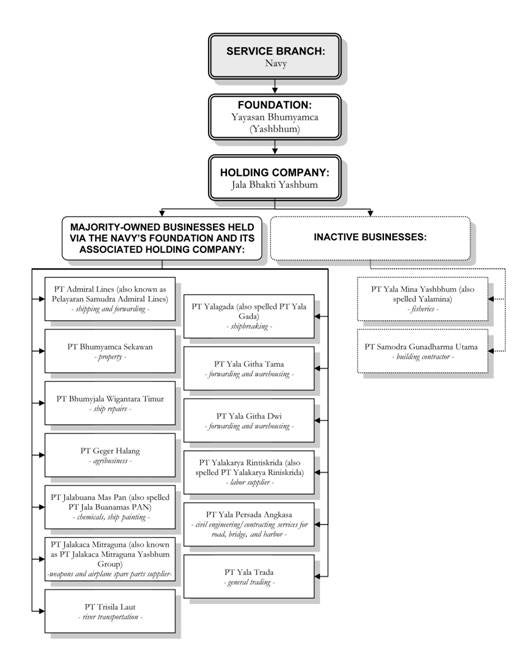
Note: This example is provided here to demonstrate the ownership
structure of military businesses and does not purport to make a substantive
claim about the businesses listed. It is based on information provided by TNI
headquarters and supplemented by two people familiar with the navy’s businesses
because they reviewed them (in one case, as part of an internal review by the
navy and in the other independently).
(Information as of May 2006.)
|
Box 2: Military Foundations and their Assets The descriptions presented below reflect the information available to Human Rights Watch at the time of writing.106 Army: Yayasan Kartika Eka Paksi (YKEP). The largest military foundation, at least by reputation, it was established in 1972. Foundation holdings as of 2001 included eleven subsidiaries and twenty-two joint ventures. The disparate companies at that time fell into six broad categories: forestry/plantation, construction, property, manufacturing, services, and mining.107 Among its most visible holdings at one time was its part-ownership of the Sudirman Business District, a prime real estate development in Jakarta run by private partners that in 1999 was estimated to be worth $3 billion.108 Still suffering the effects of the financial crisis, YKEP suffered a net loss from its investments of approximately Rp. 8 billion ($880,000) per year in 2000 and 2001.109 The TNI chief declared in 2002 that YKEP generated a profit of no more than Rp. 50 billion ($5.5 million).110 The negative trend apparently continued: according to a former deputy army chief , Kiki Syahnakri, YKEP’s profits in 2005 showed a steady decline from previous years.111 As of that time, it was believed to have largely retained its earlier investments and to continue to own, among others, timber companies, hotels, property, and transport services.112 In 2006, the Ministry of Defense announced that one of the army’s most prominent businesses, PT International Timber Corporation Indonesia (ITCI), was in dire financial condition, as it was experiencing large losses and was unsure if it could pay its thirteen thousand employees.113 Kostrad (Army Strategic Reserve Command): Yayasan Kesejahteraan Sosial Dharma Putra (YKSDP Kostrad). This foundation was first set up as Yayasan Dharma Putra Kostrad (YDPK) in 1964, under Soeharto’s command. Information provided to Human Rights Watch in 2004 showed that YKSDP was believed to have an investment in thirteen companies, including in the automobile, plastics, and insurance industries.114 In April 2005, however, Kostrad commander Lt. Gen. Hadi Waluyo declared that his forces only retained an ownership stake in three companies: PT Mandala Airlines (100 percent), Darma Medika General Hospital (25 percent), and PT Darma Mandala (25 percent).115 He said they had divested themselves of all other business holdings because the businesses had fared poorly.116 Waluyo, in his capacity as the Kostrad chief, also served as a commissioner of Mandala Airlines.117 Potential buyers were reluctant to take over the company because of concerns that financial information was incomplete and presented the risk of hidden liabilities.118 In April 2006, Kostrad sold the foundering airline.119 Kopassus (the Army Special Forces Command): Yayasan Kesejahteraan Korps Baret Merah (Yakobame), formed in 1995.120 As of 2004, it was thought to have investments in the construction business.121 Air Force: Yayasan Adi Upaya (Yasau). Yasau owned ten companies in 2000.122 Its holdings in 2004 (eight companies) were in forestry, construction, property, airlines and related companies, and a pharmaceutical company.123 Several air force-owned businesses remained active as of early 2006, including PT Konstruksi Dirgantara (construction), PT Angkasa Pura (property), and PT Dirgantara Husada (pharmacy).124 Navy: Yayasan Bhumyamca (Yasbhum). Established in 1964, Yasbhum had thirty-two companies in 2000.125 The number of navy-owned companies had dwindled to six by late 2004, according to the then navy chief of staff, Adm. Bernard Kent Sondakh, who said these would be sold off to the private sector.126 Information provided by TNI headquarters, however, listed the navy as owning one holding company and fifteen individual businesses as of early 2006.127 (See “Illustrative Diagram of a Military Business,” above.) The TNI also identified two other navy foundations, Yayasan Nala and Yayasan Hangtuah, without indicating if they owned businesses.128 TNI headquarters: Yayasan Markas Besar ABRI (Yamabri). Founded in 1995 with a combination of military and civilian ownership and initial capital of only Rp. 25 million ($11,250), it quickly expanded.129 In 2004, it was believed to have holdings in agribusiness, mining, communications, transport, and a convention hall.130 That year, the then TNI chief Gen. Endriartono Sutarto indicated that the total value of military businesses under TNI headquarters was no more than Rp. 100 billion ($11 million).131 Ministry of Defense: Yayasan Kejuangan Panglima Besar Sudirman (YKBPS). In 2006, YKBPS owned three universities, a high school, and hospital.132 A second foundation, Yayasan Kesejahteraan Perumahan Prajurit (YKPP), was involved in housing, while the ministry’s third foundation, Yayasan Satya Bhakti Pertiwi (YSBP), had numerous profit-oriented companies.133 |
Cooperatives
Military cooperatives form part of the national cooperative movement in Indonesia and, as such, are supposed to exist for the mutual benefit of their members and to be collectively controlled by these members, as well as by a national law on cooperatives.134 Like military foundations, however, military cooperatives have strayed far from their stated purpose. Initially established with troop welfare in mind—to provide subsidized commodities, such as rice, to soldiers and families—they soon became a vehicle for business ownership. The business activities of military cooperatives have tended to receive less scrutiny than those of military foundations. This has helped feed the often-false perception that military cooperatives merely serve as discount stores for the troops.135 Yet many cooperatives actually raise revenue not only from membership dues but also from wide-ranging business activities, including investments in private companies.136 Military cooperatives, for example, have owned stakes in numerous hotels and a cargo company.137 As with foundations, many are privately held companies so financial data can be difficult to obtain.
Table 2: Businesses Owned by Military Cooperatives
|
Service Branch |
Number of Businesses |
Internal Capital |
External Capital |
Dividend |
|
Army |
923 |
Rp. 169 billion ($17 million) |
Rp. 38 billion ($4 million) |
Rp. 13 billion ($1.3 million) |
|
Air Force |
147 |
Rp. 40 billion ($4 million) |
Rp. 9 billion ($900,000) |
Rp. 4 billion ($400,000) |
|
Navy |
124 |
Rp. 95 billion ($9.5 million) |
Rp. 8 billion ($800,000) |
Rp. 4 billion ($400,000) |
Source: Ridep Institute, Practices of Military Business, citing statistics from the planning bureau
of the Ministry of Cooperatives, Small and Medium Enterprises, 2001.138
The cooperatives of the military exist for each service branch and follow the territorial command structure. In the case of the army, for example, the Army Parent Cooperative (Induk Koperasi Angkatan Darat or Inkopad) corresponds to army headquarters, the Army Central Cooperative (Pusat Koperasi Angkatan Darat or Puskopad) to the regional military command, and the Army Primary Cooperative (Primer Koperasi Angkatan Darat or Primkopad) to the sub-regional military command level. District level offices and local posts also exist. Military cooperatives for the other services include Inkopau and Primkopau, in the case of the air force, and Inkopal and Primkopal for the navy.
An example provided below addresses military investments in forestry and agribusiness activity in East Kalimantan. In that case, an army cooperative had a minority share in a privately established company and also had its representatives on the board of the company, so the business ties were formalized. Informal business ventures are addressed separately in this chapter, in the section below on military alliances with the private sector, which includes the informative example of a military cooperative involved in coal mining activities.
Example 1: Military Investments in East Kalimantan
Military ownership in private companies is often hidden, but with assistance from NGO colleagues in the area Human Rights Watch was able to trace military interests in forestry operations in an area of East Kalimantan, near the border with Malaysia. The case of a series of military companies that held investments in the regency of Nunukan offers insight into military involvement in business.139 It also sheds light on some of the negative social and environmental consequences of this activity. Over the years, officials and local residents have accused military-associated businesses in the area of contributing to illegal logging, environmental destruction, and social tensions.
Military Stake in Forestry Operations
In 1967, citing “national security considerations” in the wake of a border dispute, the Indonesian government granted a military-owned company, PT Yamaker, concession rights on a huge tract of land covering more than one million hectares along the Indonesia-Malaysia border.140 With this move, it dispossessed indigenous communities of their customary land.141 It also set in motion a pattern that would persist for decades: military economic interests in the forestry sector would take precedence over the interests of local communities.
For decades, Yamaker grossly mismanaged the land. Local indigenous communities charged that overlogging by Yamaker disrupted their livelihoods and traditions and left “only forests with no trees.”142 The communities experienced additional hardship when Yamaker blocked access to the land, which it did routinely on the pretext of security.143 After the downfall of the Soeharto government in 1998 that ushered in the reformasi era, the new government investigated and exposed massive timber smuggling by Yamaker.144 The then minister of forestry and plantations, Muslimin Nasution, denounced the company for conducting its business in an illegal manner, failing to promote the welfare of area residents, and having “plundered [the forests] on a vast scale.”145 Acting on those findings, in 1999 the government revoked the entire Yamaker concession.146
The military nonetheless retained strong ties to that land. The new concession holder, the state-owned timber company Perhutani, partnered with the Inkopad army cooperative that had logging operations within the ex-Yamaker site.147 The military also provided security to Perhutani.148 Rather than directly engage in logging operations in the area themselves, the military instead partnered with foreign investors from Malaysia for that purpose.149
Military-Private Partnership
In 2000, Inkopad’s economic stake in the ex-Yamaker land deepened further. That year it partnered with a Malaysian company, Beta Omega Technologies (BOT), that planned to develop an oil palm plantation and processing factory on land in and near Nunukan regency. Inkopad became part-owner of the BOT subsidiary set up in Indonesia, Agrosilva Beta Kartika (ABK), and had several representatives on its board.150
These military connections helped the new company secure permissions and negotiate further deals.151 ABK gained the local government’s approval to cut timber on the land to prepare it for palm oil planting.152 Local officials said they expected the company to clear some 150 thousand hectares of land in the regency.153 From an early stage, it was clear ABK planned to log the area and sell the resulting timber. To assist ABK, the Nunukan government agreed to facilitate a minimum production target of fifty thousand cubic meters of lumber per year.154 (The then Nunukan regent also signed a contract to gain a partial ownership stake in ABK, though it remained unclear if he did so in his individual or official capacity.)155
These plans upset local indigenous communities living in the Simenggaris area, a forested zone in the interior of Nunukan regency along the border with Malaysia. A letter signed by some twenty community leaders outlined their concerns. They objected to the palm oil project on the grounds that it threatened to destroy the forest on which they depended for food, wood, and traditional medicinal plants.156 In addition, the collection of non-timber forest products such as rattan by local communities was an economic lifeline, second in importance only to agriculture, and they derived additional income from occasional logging activities in the forests.157 Nunukan residents already had the experience of severe forest depletion from logging operations in the area.158 The leaders of the area also urged that the project not move forward without proper consultation and the consent of the community.159 The leaders expressly opposed the involvement of the military in logging activities, stating “We are no longer willing to endure the same experience as [we had] with PT Yamaker.”160
Fears about the potential for overlogging were also informed by suspicion that the oil palm project might be nothing more than a cover to clear-cut forested areas for a quick profit, with no plantation ever being built. The practice has been prevalent enough in Indonesia to have earned a nickname, the “plantation hoax.”161 NGOs have estimated that only 10 percent of the three million hectares of East Kalimantan forest allocated to oil palm concessions has actually been converted into working plantations.162 Specialists who examined Nunukan’s soil as part of an independent environmental study determined that it was generally not suitable for oil palm.163 In addition, the conversion of forest to other uses, including oil palm plantations, contributed to the degradation of Nunukan’s forests. A related study found that about one-quarter of the primary forest in Nunukan’s formerly lush river basin had been lost over a seven-year period.164
Nunukan officials declared in 2001 that ABK’s Malaysian parent company BOT would invest at least $4.3 million to build an oil palm plantation and factory in the area, and that the project would employ as many as thirty-five thousand workers locally.165 Ignoring community concerns and requests for consultation, in mid-2001 the then regent gave the Inkopad army cooperative and ABK permission to proceed with the project.166 Community members issued protest letters to no avail.167 Later that year ABK contracted a Malaysian firm to clear land in the vicinity of Nunukan regency and market the timber on its behalf.168
A Pattern Repeats
By mid-2004, a new regent complained publicly that authorities in the region had granted logging permits too readily to unnamed forestry companies that promised to invest in oil palm plantations but instead only cut trees for export to Malaysia.169 He accused these companies of destroying some twenty-five thousand hectares of forests in Nunukan and contributing to the problem of illegal logging.170 The regent also pointed to a social cost. According to him, the episode sparked tensions and social unrest as people grew frustrated over promised plantation jobs that never materialized.171
The events that followed indicate the regent was referring to ABK. The contractor working for ABK was unable to renew its timber license after April 2004.172 The parent company in Malaysia, BOT, did not respond to questions from Human Rights Watch, but according to its joint-venture partner, Inkopad, ABK ceased operations on July 9, 2004, and subsequently lost its permits.173 In August 2004, regional authorities said they would investigate the regent’s allegations before taking action against any company.174 In December 2004, NGOs have reported, an official Department of Interior investigation concluded that ABK had engaged in extensive illegal logging and cross-border timber sales.175 That same month, the public record shows, the Indonesian Department of Forestry withdrew ABK’s permit.176
In an echo of the Yamaker experience years earlier, a military-linked company once again had been accused of breaking the law, causing environmental destruction, and contributing to social upheaval, and the only penalty was eventual loss of its concession rights. To Human Rights Watch’s knowledge, the military entities were not otherwise punished for their involvement in illegal activity, the individuals involved did not face prosecution, and the local community was not compensated for the damage done to the land.177 Inkopad told Human Rights Watch that it relinquished its shares in ABK and returned them to the parent company, BOT of Malaysia.178 The army cooperative declined to address its role in logging activities, land disputes, or environmental concerns associated with its business investment in Nunukan. On this point, its written response to Human Rights Watch stated, “Inkopad is no longer connected to problems related to [the planned] palm oil plantation in Simenggaris [area], Nunukan regency, East Kalimantan.”179
The issue was unlikely to end there, however. In 2005, the Indonesian government announced a plan to develop the largest oil palm plantation in the world along the Malaysia-Kalimantan border area.180 Nunukan was one of several regencies anticipated to host the massive plantation.181 Environmentalists, international officials, and even the palm oil producers association lined up against the project.182 In response to critics, the Indonesian government announced that it would reduce the size of the planned plantation, and avoid placing it on land designated for an international conservation initiative to preserve the area’s biodiversity, but that it still intended to move forward with the project in the Kalimantan border area.183 There was also controversy over the prospect that the project would provide a new excuse for the military to engage in forestry activities under the pretext of security.184 Human Rights Watch learned independently that the military had a stake in several forest concession areas elsewhere in Kalimantan that were slated for conversion to oil palm.185
Military Collaboration with Private Businesses
Alliances with corporations or private entrepreneurs account for a vast part of the TNI’s extensive business interests. Often the military partners with foreign investors. Private businesspeople, whether domestic or foreign, have different reasons to enter into an alliance with the military. They may seek, for example, to curry favor with powerful individuals who can advance their business. The military’s ability to arrange government licenses or block competition has diminished in recent years, but particularly at the local level, military officers retain the role of gatekeeper. Businesspeople also choose to align themselves with the military to gain access to goods and services. For example, the military provides transport services on military vehicles for a fee, leases out land, and trades in items such as fuel, timber, and coffee.
In an example described to Human Rights Watch, in 2004 a private business operated on military-owned land in Jakarta, for which the owner paid a monthly fee of Rp. 30 million ($3,300) directly to the unit. When he refused a demand by a military unit to raise the monthly fee, the unit shut down his business until a compromise was reached. The monthly payments went directly to the unit without being reported to public accounts.186
“Acquaintance Funds”: Private Contributions to the Military
The military’s alliances with business also can involve solicitation for contributions. Businesses raise money for the military for operations and provide in-kind support, such as vehicles or office equipment.187 In one example that was publicly reported, a developer provided land and buildings worth Rp. 18.5 billion ($1.95 million) to locate an army base inside a West Java industrial zone known as Jababeka. The donation made good business sense, an official of the industrial zone argued, since the presence of military personnel “can deter people from carrying out crimes here.”188
In other cases, an analyst explained, “[t]he local military commander just picks up a phone to get money [from business patrons].”189 The proceeds from these informal arrangements are sometimes referred to as “acquaintance funds” or “help from friends.” Lt. Gen. (ret.) Agus Widjojo acknowledged to Human Rights Watch that “it happens that business people make contributions” but stated that such arrangements have become less common than since the late 1990s: “Then it was easy [for a military officer] to approach a business to say what you need. Not now. The police are taking over the roles outside of defense.”190
Payments for Security Services
The Indonesian military makes itself available to provide security services for private interests. Different military units earn money by forming private security companies, and individual commanders charge a fee to loan out their troops as private guards.191 Some military officers who arrange such security services are later hired on by the companies they protected, to serve as security managers for company facilities.192 More famously, the TNI provides security to large multinational companies. In Indonesia, companies that operate facilities that the government has declared to be “vital national assets” are required to have protection. In practice, it has usually been the TNI that fills this role, despite a 2004 presidential decree that officially shifted the responsibility to guard such facilities to the police.193 For example, Indonesian authorities certified in January 2006 that the TNI would guard the facilities of three companies because neither the company nor the police could ensure adequate security.194 The reliance of major companies, particularly in the extractive sector, on state security forces (military and/or police) to protect their installations in remote and dangerous locations around the world can be rife with problems if the arrangements are not carefully managed.195 In Indonesia, questions surrounding company payments for military security are acute because of the armed forces’ record of corruption and human rights violations.
Companies can come under strong pressure to underwrite the expenses of military forces assigned to protect their facilities, so they do not always feel they have a choice. A former international executive commented to Human Rights Watch in frustration: “The way Indonesia sets up funding of the police and military is one grand national extortion racket.”196 A former employee of a multinational company offered this view to a researcher:
It is true that the Indonesian military is underpaid and under-equipped, and the housing they are provided is terrible. But is it the company’s place to subsidize the Indonesian military?197
This same person referred more directly to financial demands made by the military:
The problem was never with Jakarta as such, not with the military hierarchy there. The biggest problem has always been with the local military. Basically once we started to pay we were backed into a corner. The demands always came in for more money.198
Moreover, Indonesian troops often are accused of using intimidation and violence in the course of “protecting” private companies. (See “Freeport’s Security Arrangements,” below.) In one example, a pending 2001 lawsuit accuses ExxonMobil of complicity in gross abuses allegedly carried out by Indonesian security forces in and near the site of the company’s operations in Aceh, while the company strongly disputes the claim that it bears any responsibility.199 A coalition of environmental and indigenous rights groups described an incident in North Maluku in late 2003 in which they alleged that armed soldiers paid by a mining company delivered written notice threatening protesters with arrest if they did not leave that company’s mine site. 200
Freeport’s Security Arrangements
A well-known case of security arrangements involving the Indonesian military and police is that of U.S.-based mining giant Freeport-McMoRan Copper & Gold Inc., which has extensive operations in Papua through its subsidiary, PT Freeport Indonesia.201 The TNI has had a presence alongside Freeport for decades,202 but the security presence has expanded considerably over time: as of 2005, more than 2,400 government security personnel (military and police) were located in the general area of Freeport’s operations.203
Security-Related Controversies
Freeport’s security arrangements have been controversial in a number of respects. First, Freeport’s ties to the military have led to accusations of complicity in human rights abuses by these forces. In the mid-1990s, troops at the mine site allegedly used company vehicles, offices, and shipping containers to transport and detain people they then tortured or killed.204 The company said it bore no responsibility for how its equipment was used by the military.205 Freeport’s human rights policy, adopted years after these events, explicitly recognizes the risk that military or police personnel may misuse company equipment and facilities to commit abuses.206
Second, there has been widespread speculation that the military intimidated Freeport into providing financial support at its Grasberg mine in Papua.207 The New York Times has repeated claims that the August 2002 killings of three Freeport employees in an ambush near the town of Timika may have been carried out by soldiers to ensure the continuation of paid security arrangements, as initially suspected by police.208 The TNI has disputed such claims in the strongest terms,209 Freeport has said it has no independent knowledge of who perpetrated the ambush,210 and a joint investigation by the U.S. Federal Bureau of Investigation (FBI) and the Indonesian police did not find evidence of military involvement. The allegation resurfaced after the FBI’s prime suspect was arrested, together with several other Papuans, in January 2006.211 The suspect confessed to firing on the convoy of Freeport vehicles but also sought to implicate the military in the crime. According to his lawyer, a soldier provided the bullets used in the ambush and three men in military uniform also took part in the ambush.212
Third, serious questions have been raised regarding the financial ties between the company and the Indonesian security forces. Following the Timika killings, investors concerned about the company’s links to the military in Indonesia successfully pressured Freeport to reveal its spending on security. The company first publicly disclosed this information in 2003 and has reported annually since then.213 By the end of 2005, the company’s total spending on the military and police had topped $66 million.214 Much of the company’s support was provided in-kind, in the form of barracks, transport, food, and other such items, but Freeport also provided financial support. In explaining these payments, Freeport has said, “At the [Indonesian] Government’s request, we provide financial support to ensure that [its] security personnel (the military and police) have the necessary and appropriate resources to provide security for our operations.”215 The company, however, has not responded to queries seeking to establish to whom it made the payments and whether the payments went to government accounts.216 When it first disclosed its security payments, in 2003, a spokesperson for Freeport’s Indonesia subsidiary stated:
Many were shocked when they found out that we allocated millions of U.S. dollars to security personnel to guard the company, because they thought that we gave it in cash. But it is not like that because we allocated the funds to several posts, of which only a small amount was given to soldiers in cash as allowances.217
Investigative reports published in 2005 by the NGO Global Witness and the New York Times, by contrast, suggested that Freeport directed a large portion of its security payments to individuals.218 These reports alleged that the company had made large, direct payments to individual Indonesian military and police officers, as well as to units in the field. The New York Times, citing company documents it obtained and verified as authentic, said such payments totaled about $20 million from 1998 to 2004.219 The Times reported that the company doled out large sums of money that it recorded under accounting categories such as “food costs” and “monthly supplement,” but the bulk of the funds in fact were at the personal disposal of the commanders.220 Freeport asserted that the Times “mischaracterized the support we provide for Indonesian security forces and ignored the practicalities of conducting business in a remote area.”221
Indonesian military officials acknowledged that the company had provided assistance and confirmed that it was circulated to units in the field and did not go to the armed forces “as an institution.”222 The TNI has argued that the deployment of soldiers at the Grasberg mine and other designated vital facilities was in keeping with the duty of the TNI and took place upon the request of the companies involved, the regional governments, and the national police.223 Officials also have maintained that the government covers the essential costs associated with troop deployments, and Freeport provides additional support “without obligation.”224 Regarding Freeport’s financial arrangements with the military, the TNI has stated that “institutionally the TNI has never received security money from Freeport but our members who were assigned there did receive money from the company as logistics funds.”225
Such admissions helped propel the call by Global Witness for an investigation into possible bribery-related charges against Freeport under the U.S. Foreign Corrupt Practices Act.226 After Indonesian officials indicated that direct payments to officers and soldiers could constitute corruption under Indonesian law, in early 2006 U.S. authorities initiated “informal inquiries.”227 Freeport staunchly defended the legality of its security arrangements and said it was cooperating with these inquiries.228 The Indonesian defense minister also indicated that he would ask the armed forces inspector general to open an inquiry.229
Freeport’s payments to the police have received less attention but raise similar issues. Global Witness and the New York Times cited examples of cash payments to senior police officials in Papua. Earlier published accounts suggest that the company did not find it unusual to be solicited for funds. According to a 2001 press account, a member of Freeport Indonesia’s board of directors, Prihadi Santoso, received a request for a Rp. 100 million ($10,000) loan from a person falsely claiming to be the then Papua police chief. Prihadi reportedly acted to authorize the requested bank transfer but later cancelled the remittance after the police chief’s office denied having issued the request.230 Freeport declined to respond to a question from Human Rights Watch about the incident.231 Company payments to the police are likely to receive greater scrutiny if the TNI withdraws from the Freeport mine area, as it has said it intends to do, and the police increase their presence.232
Freeport’s Perspective
Freeport has had little to say publicly, but a spokesperson has denied that it made inappropriate payments:
We don’t bribe. We do give assistance to the military, not in cash, but in the form of field equipment such as hand talky [portable two-way radio], cars, food….All payments are transparent and reported to the New York Stock Exchange. And assisting security personnel on duty is just normal. If you give some food to your starving guard, that is normal, right?233
A former Freeport executive familiar with security arrangements in Indonesia told Human Rights Watch that cash disbursements, made by bank transfer or check, accounted for about 15 percent of the total funds Freeport spent on the Indonesian security forces (the rest being used for in-kind goods and services).234 According to this source, the money was used for three purposes:
- “Small per diem payments” to supplement troop salaries. For a time, the payments were made to local commanders, but after the company insisted that the units establish bank accounts Freeport subsequently transferred funds to those accounts. Due to an “administrative mislabeling” some of these cash payments were listed as food costs in the company’s accounts until this practice was corrected.
- Reimbursements for administrative and logistical costs incurred by the military units in the field, such as for communications or use of helicopters, that the company provided in view of its assessment that “the [budgeted] money out of Jakarta is not enough for normal operations.” The company’s payments for this purpose amounted to approximately $1000 to $1500 per month for the regional military command (Kodam).
- Financing for individual “development” projects requested by the military, such as for hospital renovations. The company performed spot checks on about one-in-five of the projects.235
The former Freeport executive also maintained that the flow of funds to the military was governed by procedures outlined in a “written support agreement,” or, as other Freeport executives described it, “a contract with the military of the [security] relationship.”236 That document was submitted to the military commander in Jayapura, capital of Papua province, as well as to his police counterpart, the executives said, but was returned unsigned.237 The former executive maintained that the provisions of the unsigned agreement were nevertheless in effect and had been adhered to by both sides.238
The former executive defended the decision to bypass military headquarters in Jakarta by stating that corruption in the chain of command would prevent the funds from reaching the troops. Making the payments through commanders in Papua, he argued, “helped us and it helped them. We could avoid the extortion and extracurricular activities [by the military] and they could close the gap between what they needed and the available funds.”239 Asked why the company withheld details about its payments to individuals by only reporting aggregate amounts, this person said he could not be sure but thought that Freeport’s top management did not want to draw additional attention to an issue that already was “a magnet for controversy.”240
The former executive stated that the company made its security arrangements bilaterally, through a direct relationship with the military on the ground rather than through civilian government structures, because there was no government regulatory authority to fill that coordination role for the mining industry.241 He also repeated company claims that Freeport’s financial support to the military (and police) was a requirement of its Contract of Work (CoW) signed with the Indonesian government. Freeport’s spokesman, Greg Probst, explained the company’s rationale in 1999:
The original CoW [from 1967] was less specific in these areas [related to the relationship with the military] than the 1991 CoW. However, in a review of this issue, our Indonesian outside counsel found that the provisions of our [1967] CoW must be read in context with Indonesian law and that the two together provide a clear obligation on the part of [Freeport] to provide logistical and infrastructure support to the Government, including both military and civilian personnel, in all areas in which the government cannot supply such services.242
This issue has been under dispute. The author of a book on Freeport as well as the New York Times reported that the CoW has no language that requires security payments.243 Human Rights Watch’s understanding is that the CoW, as updated in 1991, contains only a general reference that the company “has been and will continue to be required to develop special facilities and carry out special functions for the fulfillment” of the CoW.244
Conclusion
Freeport has said it wishes to avoid controversy but it instead appears to invite it by what it says and declines to say publicly. On key issues related to its security arrangements in Indonesia, the company has offered public explanations that are open to question. The company has maintained that it is required to provide financial support to Indonesian security forces but has not provided sufficient evidence to bolster that claim, even when directly asked.245 Government officials, meanwhile, insist that the company’s support is entirely voluntary.246 It is also difficult to reconcile the company’s position that its support is fully compliant with the Voluntary Principles on Security and Human Rights, a set of international guidelines designed to ensure that company security arrangements respect human rights.247 The Voluntary Principles presume maximum transparency for security arrangements, including any payments, subject only to overriding safety considerations or security situations.248
Moreover, if Freeport’s decision to make payments at the local level and to seek to avoid scrutiny by withholding details about those payments was intended as a way to avoid corruption and also the glare of publicity, then it failed on both fronts. Payments to commanders and units in the field, which the former executive maintained were designed to avoid centralized corruption, served instead to raise allegations of local-level corruption by Freeport. By the same token, the company’s unwillingness to fully disclose its payments at the outset, and when asked subsequently, has encouraged suspicion that it has something to hide. The misidentification of payments, as food costs rather than cash transfers, also lends itself to the implication that employees had sought to cover up the company’s financial support. In short, Freeport’s actions were insufficient to avoid the potential problems it identified and instead created vexing new ones.
The wave of negative publicity surrounding the military’s ties to Freeport led Indonesian Defense Minister Juwono Sudarsono in early 2006 to offer to prepare official guidelines on companies’ security arrangements, including associated payments.249 An alliance of Indonesian civil society groups, however, strongly challenged the assumption that it was appropriate for companies to directly underwrite the military. They pointed out that such arrangements give the military an economic stake in internal security tasks for which the police have primary responsibility.250 The groups added that company payments compromise the country’s security forces, since they could cause these forces to put the interest of companies ahead of their duties to the public. Another criticism that often has been made, including by civil society groups, is that financial arrangements with companies provide a platform for military corruption and serve to undermine civilian control. It also often has been suggested, as in the Freeport case, that paid security arrangements create incentives for the military in the area to cause security disturbances so they can reap the financial benefits when they are called in to assist.251 In short, the military is in a position to create and sustain demand for its services. Concern over the potential for human rights abuse, as noted above, provides another reason for opposition to the military’s role in providing security to companies. A case described in detail below shows how troops from a military cooperative, brought in at the request of a mining company, used abusive tactics to keep unlicensed miners in line.
Example 2: Military Coal Mining and Human Rights in South Kalimantan
When PT Arutmin, an Indonesian-owned mining company with operations in South Kalimantan, was faced with illegal mining in its concession areas, it turned to the security forces for help.252 After the police response proved inadequate, the company engaged the military—through a loose partnership with an army cooperative—to help control illegal mining at its Senakin mine.
Army Cooperative Regularizes Illegal Mining
The role of the army cooperative was to act as an intermediary to help reduce the illegal mining activities of local residents who used heavy equipment to mine tons of surface coal. The active-duty soldiers who worked in the cooperative were to organize the unlicensed local miners and ensure they turned the coal over for delivery to the company. In exchange, the army cooperative got to earn a profit from the resale of the coal.253
Neither the army cooperative nor Arutmin responded to Human Rights Watch’s requests for information. A representative of the contractor for Arutmin’s operations at the Senakin mine, however, publicly explained the set-up under which the military (and police, at another mine location) organized illegal miners with the concession-holder’s permission:
I actually wouldn’t even call it illegal [mining] now. It is semi-organized subcontracting direct to Arutmin, who have now got the whole thing under control.254
Once the army cooperative had a financial stake in coal mining operations, it soon slipped into a realm outside the rule of law. Soldiers not only channeled to the company the coal mined by the illegal miners, as envisioned, but demanded bribes from the miners to allow black market coal sales. The army cooperative also exploited the miners. Soldiers demanded bribes, paid the miners a fraction of the value of the coal, and often did not pay them for months at a time. Moreover, the soldiers used coercion and violence to enforce their cooperative’s control. Miners told Human Rights Watch of beatings and other abuse.255
The account here focuses on military abuses committed against coal miners who were controlled by the army cooperative under this arrangement. As explained to Human Rights Watch by several miners, the regional army cooperative for South Kalimantan, Puskopad B,256 issued permits to miners granting them permission to mine on the Arutmin concession,257 required them to sell the mined coal back to the cooperative for it to resell to Arutmin at a large profit, and used intimidation and force to keep the miners in line. This was lucrative business for Puskopad, which paid the miners only about half the market value for their coal (approximately Rp. 38,000 to Rp. 44,000 [$4.18 to $4.84] per metric ton, compared to the Rp. 75,000 to Rp. 85,000 [$8.25 to $9.35] local price on the open market in late 2004).258
The miners, however, had little choice since their status was tenuous. Despite the permits granted by Puskopad, with the presumed agreement of the company, the miners were still operating outside the law and were subject to arrest by police.259 One miner explained:
The Puskopad guarantee is not 100 percent. Since I have a work permit from Puskopad to mine on the Arutmin site, it’s almost like I’m a legal miner. But the police will come and say I’m not authorized.260
A third miner put it more bluntly:
The TNI takes advantage of the guarantees so they can get the fee for the coal, but they do not protect us from the police.261
Puskopad also facilitated illegal mining outside the agreement. Miners said they were able to pay Puskopad a fee (Rp. 13,000 per ton, or $1.43) so that Puskopad would not block them from selling coal they had mined on the open market.262 One miner explained:
If you don’t pay the royalty to Puskopad you can’t sell the coal on the open market. If you don’t pay the royalty you’d get taken away. Everybody knows you have to pay so no one even tries to sell [on the open market] without paying.263
Exploitation and Abuse of Miners
Miners who spoke to Human Rights Watch said these arrangements trapped them in an exploitative relationship with the army cooperative. They said that the low price the cooperative paid them for their coal, in combination with the various fees it charged, made it very hard for them to make a living. They also complained of payments that often were made months late, leaving them to live hand-to-mouth. Several of the miners felt they were being taken advantage of and some decided it was not worth it to mine for Puskopad on the Arutmin concession.
A former miner explained why he got out of the business: “There are too many procedures. You also have to give money, lots of it, if you want to mine there.”264
A more serious concern for the miners was that Puskopad enforced its economic interests with an iron hand, relying on intimidation and violence. All of the miners with whom Human Rights Watch spoke had been subjected to various forms of mistreatment by Puskopad. These cases arose when the miners acted in defiance of the permit arrangements or when they attempted to avoid the additional payments demanded by the cooperative for allowing the miners to sell coal on the open market.
For example, two miners said that Puskopad patrols forced miners to dump out truckloads of coal when they were caught leaving without having first stopped at the Puskopad office to pay the agreed fees.265 Another miner was detained for several hours in September 2003 for mining without Puskopad’s advance knowledge. He said an armed patrol escorted him to the Puskopad office, where the commander threatened to seize the miner’s equipment and demanded, “If you are in the Arutmin site you have to report to me.”266
Some of these encounters involved the implicit or explicit threat of violence. One miner said that on repeated occasions Puskopad patrols had threatened to shoot him and had beaten the drivers and laborers working with miners.267 Late at night in November 2003, as three miners and their crews were loading the coal they had secretly mined, some twenty uniformed and armed military personnel from the Puskopad post approached and immediately began threatening and beating them:
The commander (…) arrived. He threatened me. He said, “If you do anything you’ll be shot.” The guns were pointed at me, they were long guns [rifles]. The people in our group were beaten for around fifteen minutes until they were bruised. They used everything to hit them—their guns, their hands, their feet. I was in a car and they threatened to shoot me. They were all in uniform and had guns.268
He went on to describe that the miners and laborers were subsequently arbitrarily detained. They were taken to the Puskopad office, where the beatings continued:
We were held until morning but some people who were not taken that night were called in for questioning the next morning. About ten people were taken to the hospital for their injuries. One was beaten in the ears and lost his hearing. He still can’t hear properly. Mostly people had severe bruising, and in one case cuts to the face, from being hit with the butt of a gun. I wasn’t beaten but I was handled roughly and was threatened.269
Explaining why they had dared take coal out secretly, one of the miners said:
This happened because we had mined for three or four months and never were paid, so we went out that night to mine on our own to cover our expenses for that time.270
Late payments were a common complaint. The miners attributed the months-long delays to the arrangements Puskopad made to resell the coal back to Arutmin. They said that process involved the cooperative and company jointly measuring out the coal, combining it with the company’s stockpile, and processing payment, only after which would the miners be paid by Puskopad.271 As one put it, “Our community suffered over this because we couldn’t get the money and we weren’t able to eat.272
Military Denies Business Activity
In October 2005, the police chief for South Kalimantan ordered the police cooperative in the area, Puskopol, to suspend its involvement in mining activities out of concern that it had become a cover for illegal mining activity.273 As with the military cooperative, though in different locations, Puskopol was originally brought in by Arutmin to control illegal mining activities as an intermediary.274 Like the military cooperative, the police cooperative allegedly took over illegal mining activities at these locations and expanded them.275 The South Kalimantan police chief acted after a local NGO, the regional office of the Forum on the Environment in Indonesia (Wahana Lingkungan Hidup Indonesia, Walhi), urged him to crack down on illegal mining by his forces.276
There was no such crackdown by the military. In 2004 and 2005 the army cooperative declined to meet or discuss its role in coal mining activities with Walhi and Human Rights Watch, which worked together to carry out field research on the military’s business activity in Senakin. After Walhi wrote to the TNI chief in Jakarta in late 2005 about the situation in Senakin,277 it received a response. The response, issued by the commander of the sub-regional military resort command, or Korem, headquartered in Banjarmasin, South Kalimantan (known as Korem 101/Antasari) said the TNI had investigated the matter and found no evidence of wrongdoing.278 Ignoring the economic dimension of the army cooperative’s role in Senakin, the TNI investigators concluded that “Puskopad B is a partner of PT Arutmin in a non-technical operation to prevent illegal mining and the siphoning of coal.”279 Disregarding Walhi’s call for military personnel involved in illegal mining to be punished, the Korem commander’s report concluded:
Up to now there are no TNI personnel, specifically members of Korem 101/ANT, who participate in or are involved directly or indirectly in illegal coal mining activities.280
The commander’s rationale that the Puskopad cooperative simply acted to regularize illegal mining directly contradicted the statements of more senior military officials. When informed by Human Rights Watch of the activities of the cooperative in Senakin, military representatives at the TNI headquarters asserted: “This activity is definitely outside of [proper] cooperative activity and TNI activity so must be stopped and will be stopped.”281 The secretary-general of the Ministry of Defense responded similarly: “I agree that brokering is illegal for us [military personnel] and we have to regulate that. It’s not the military itself [that is responsible.]”282 Yet some six months after Walhi sent its letter to the TNI chief—which it copied to numerous other authorities, including the Minister of Defense and military officials at the headquarters, regional, and sub-regional levels, as well as the regional police chief—no such action had been taken. The only response was the Korem commander’s report to his superior that the cooperative’s activities did not constitute a business and therefore were not banned.
The willful failure to act to halt the coal brokering activity by TNI troops made clear that, despite the reassuring words, military business activities continued to be officially tolerated, and at times even justified, as they had been for years.283 The investigation into Puskopad’s activities in and near the Senakin mine apparently did have one effect: Within days of receiving the Korem commander’s response, Walhi was contacted by an Arutmin representative who said that the company had decided to end its cooperation with the military.284 As of this writing, it was not possible to determine if the situation had in fact changed on the ground in Senakin.285
Military Involvement in Criminal Activity
This section considers some of the main areas in which the military has been implicated in criminal activity. The presentation here is by no means exhaustive, given that military personnel have been accused of direct involvement in a range of criminal enterprises. Persistent patterns of illegal business activity by the military, often concentrated in sectors such as logging and mining, indicate that the problem is widespread. Across the country, units and commanders, not just low-ranking soldiers, are commonly implicated. In a number of cases it can be shown that their illegal businesses are known to their superiors, and only very rarely do the authorities act to enforce the law against these military personnel.286 These characteristics point to the structural nature of the problem of illegal military business.
At the same time, it must be acknowledged that some cases involve relatively isolated incidents by rogue individuals. Paid assassinations are among the most extreme examples of economically-motivated criminal acts by individual soldiers. One case involved the July 2003 murder-for-hire of a businessman in which his bodyguard, a moonlighting Kopassus soldier, was also killed.287 The marines who were convicted in the killings reportedly confessed that they had been paid Rp. 2 million ($237) each to commit the murder.288 Another case came to light in early 2005; this time an army soldier was identified as a suspect in a paid killing.289
Illegal Logging
Military involvement in forestry operations can include illegitimate activity by military enterprises, such as overlogging at concessions owned by military foundations or processing illegal timber at sawmills run by military commands.290 The example provided above (see “Military Investments in East Kalimantan,” above) offers one illustration of military-owned businesses that allegedly engaged in illegal logging. Also, local timber barons rely on regional military commands to use intimidation and violence to secure community acquiescence.291 These timber barons benefit from impunity thanks to their links to the security forces.292 A timber expert explained that the role of the military also extends to “providing protection for timber mafias or transport on military trucks or helping smuggle logs across the border or extortion—to seize legal or illegal logs.”293
The problem has been best documented with respect to the remote and conflict-torn regions of Indonesia. For example, a joint report by the Environmental Investigation Agency (EIA) and the Indonesian NGO Telapak spotlighted the pervasive role of the military “in every aspect of illegal logging” in Papua, where massive timber smuggling takes place. Two timber dealers interviewed by the investigators acknowledged paying dozens of soldiers to look after their illicit timber interests. The report also drew attention to alleged acts of military intimidation in support of an illegal logging operation.294
Prompted by the EIA/Telapak report on Papua, President Yudhoyono announced a crackdown on rampant illegal logging that he promised would not spare military personnel.295 He issued a presidential order against illegal logging that called on military personnel to help combat illegal logging.296 A handful of military personnel were among the hundreds reported to have been arrested in operations against illegal logging.297 Campaigners expressed disappointment that, in the end, many of those arrested were released without charge and that in most cases they had not been able to get information about the outcome of military trials.298 In one prominent case, previously mentioned, EIA/Telapak first reported to the authorities in 2003 that a military policeman was deeply implicated in illegal logging activities in Papua but no action was taken for two years. After the EIA/Telapak report was made public, this person was brought in for questioning, but Telapak researchers learned that by the end of 2005 he had been released.299
In addition to undermining the rule of law, military involvement in illegal forestry activity has been associated with human rights abuses. In Papua, for example, communities that dare protest military-backed logging activities have been accused of being separatists.300 They also have been directly victimized by soldiers who seize their timber for resale, sometimes using violence and intimidation tactics.301
Racketeering
Protection rackets provide another source of illicit income to military personnel who are involved. Military backers reputedly protect drug traffickers, gambling operations, and prostitution rings.302 As with other revenue sources, racketeering also is linked to military abuses. Human Rights Watch received reports that in 2004 soldiers smashed the windows and burned the property of those who refused their demands for protection payments.303
In Medan, North Sumatra, military involvement in crime is well-organized. Medan residents said that the protection rackets are regularized, with shop owners and trucks paying monthly fees and showing stickers designating which military group or associated gang supported them.304 A person who for years worked in Medan’s underworld told Human Rights Watch that the military was deeply involved “[e]verywhere in Medan where illegal businesses exist,” including in prominent roles as backers of illegal logging and the drugs trade.305
Military-Police Conflicts
Military engagement in the criminal economy has often brought soldiers into tension with the police. Welcome moves to give the police greater responsibility for internal security have had the unintended side effect of displacing the military from some of its lucrative money-making opportunities, including illicit ones. This trend has aggravated rivalries that at times flare up into violence. Clashes between the Indonesian security forces were a regular occurrence in the early 2000s, with at least a dozen incidents from 2001 to 2003.306 In late 2004, a member of the Brimob (“Brigade Mobil” or Mobile Brigade) paramilitary police commandos was killed and three others were seriously wounded in an armed brawl with TNI soldiers in Aceh that was reportedly sparked by competition over oil palm interests.307
The security forces also can come into conflict with each other when police, acting in their law enforcement role, interfere with the economic interests of soldiers. For example, soldiers and police clashed in 2002 in West Kalimantan after police reportedly moved to shut down a TNI-protected gambling operation.308 That same year a notorious military-police firefight, detailed below, was sparked by the arrest of a drug dealer who reputedly had military backing. In another, more recent example, in March 2005 a local army unit battled with Brimob police forces in Papua, reportedly when they attempted to crack down on illegal logging operations that implicated a TNI officer.309 As a result, it comes as no surprise that police officials complain about the difficulty of acting against the military.310
Example 3: Turf Battle in Binjai, North Sumatra
In September 2002 police in Binjai, North Sumatra arrested an accused drug dealer who allegedly operated with military backing. The suspect’s associates in the military sought to have him released and became enraged when the police refused. What began as a battle over authority between the police and the military soon took on more ominous dimensions: In revenge, the military unit organized an armed assault on the police station, setting off a shootout that engulfed the town for hours and terrified the townspeople. Some fifteen people were killed, most of them police officers, and at least four civilians were among the dead. Of the more than sixty people estimated to have been wounded, twenty-three were civilians.311
Drug Arrest Triggers Dispute
The dispute that erupted into armed battle was triggered by an incident in the police station the day before. A fight broke out when police refused a demand from a small group of soldiers to release a suspect. Angry soldiers attacked the police, cutting the ear of the commanding police officer, and police responded by firing on the assailants.312 Police then retaliated by severely beating two of the attackers who had not managed to flee; their bodies were “covered in bruises.”313
The suspect whose arrest was at the center of the dispute was a suspected drug dealer reputed to operate with military backing from Linud 100, an airborne reserve unit based in Binjai.314 A senior police officer in the town explained:
The suspect at the time of his arrest was protected by military personnel. There’s a lot of business activity going on. We know there are military people behind it.315
A lower-ranking police officer in the town commented further:
There were individuals from Linud who were doing illegal activities so there were some problems when the police would stop their activities, things like gambling and drugs. The Linud members aren’t directly involved but they back up these activities, provide protection.316
The Military Revenge Attack
Linud troops waited until the night of the following day to respond to the incident. Scores of troops in combat gear launched a major attack against the police station in the center of town, firing small arms, rockets, and grenades. They also blocked the entrances and exits to the town, obstructed access to the local hospital, and deliberately cut electricity, causing a blackout. After paramilitary police commandos from the Brimob barracks a few kilometers away were called in to help, the Linud soldiers engaged in a firefight with Brimob along the road then proceeded to attack the Brimob barracks located near the entrance to town.317
With the area’s police forces scattered, in hiding, and engaged in a shootout with the military, no one was left to defend the town’s population from the assault. A young man from Medan was fatally wounded at about 1 a.m. as he drove into Binjai with a group of friends. Soldiers who had set up a roadblock stopped the vehicle and shot the young man in the head. Eyewitnesses told the victim’s family that the bullet was shot at short range and after those in the car had identified themselves as civilians.318 Separately, a restaurant owner traveling by car was killed when the vehicle was fired on, and two other passengers in the vehicle sustained gunshot wounds.319 A cigarette vendor was wounded by a stray bullet and ordered taken to a military hospital.320 In other incidents, a civil servant died from a gunshot wound and another person suffered unidentified wounds.321 As many as twenty-three civilians sustained injuries in the attack.322
Police casualties were also high. According to police sources, eleven policemen (local and Brimob) were killed and thirty-seven were wounded.323 The TNI suffered fewer casualties. One soldier died and, by one count, four Linud personnel were wounded.324
After the Battle
The battle finally came to an end some twelve hours after it began, when top police and military officers arrived in Binjai to impose a truce.325 With many police officers still in hiding, a climate of lawlessness prevailed for several days and many people remained too scared to leave homes. Even two years after the incident, the residents of Binjai remain disillusioned with the TNI. Several townspeople told Human Rights Watch that they could no longer trust the military after troops sworn to defend the security of the nation had done the exact opposite.
Military and government officials issued strong statements of condemnation, temporarily shut down the Linud battalion, and announced that those responsible would be dishonorably discharged.326 But of the approximately 350 Linud soldiers that police said were involved in the attack (about half of the battalion),327 only twenty soldiers were dismissed and faced trial. The military prosecution of the twenty discharged soldiers, all of them of low rank, resulted in nineteen convictions and prison sentences of five to thirty months.328 The military court in Medan declined Human Rights Watch’s request for information about disciplinary action taken in response to the Binjai incident. Repeated visits to the military stations in Binjai and Medan also failed to elicit any information, but indications were that the more senior officers who oversaw the Linud battalion faced little consequence. The army transferred the Binjai battalion commander and five other officers to other locations and decided not to take immediate action against the regional military commander.329
Conclusion
The battle in Binjai stands as a particularly outrageous example of the negative consequences of military involvement in illicit businesses. There, troops effectively declared war on the police. The police in Indonesia have a well-deserved reputation for corruption, and competition over local spoils has given rise to numerous armed clashes between the security forces, but in this case the confrontation was sparked by an altercation between a few troops and policemen over a local drug arrest. The issue could have been resolved without bloodshed, but it exploded into a major battle because the military unit as a whole had already lost its integrity. It had learned to put self-interest above institutional duty, lacked respect for the rule of law, automatically resorted to violence to protect its turf and pride, and assumed it could do so with impunity. This arrogance was a legacy of the unit’s links to the criminal economy. A Binjai police officer offered a skeptical view on whether the military had learned any lessons from the experience: “The military are still involved in backing up illegal activities so it could happen again.”330
Military Corruption
Transparency International has identified Indonesia as the world’s sixth most corrupt country in its annual survey.331 The group ranked the Indonesian military as among the most corrupt public institutions in the country.332 The World Bank defines corruption as “the use of authority for private gain.”333 It includes in that definition, among other acts, an official’s acceptance, solicitation, or extortion of a bribe.334 Collusion, patronage or nepotism, theft of state assets, and diversion of state revenues are also considered to be corruption.335 Indonesian anti-corruption laws also encompass the abuse of power, causing financial loss to the state, and self-enrichment.336
Grand Corruption
Indonesia’s history offers many examples of military corruption on a major scale that involve relatively senior government officials. Often these relate to the sorts of collusive business practices and misuse of foundation funds described elsewhere in this report. Some other cases relate to individuals who take advantage of their position to take public funds for personal use. As one indication, over 100 cases of financial fraud reportedly were uncovered within the TNI in 2005.337 In early 2006 an army colonel and a private citizen were arrested on charges of conspiring to embezzle as much as $14 million from the army’s housing fund.338
Kickbacks or massive markups on military acquisitions are another common feature of military corruption. Minister of Defense Sudarsono has been outspoken on the need to clean up military procurement. In 1999, for example, he said military purchases were subject to markups of 30 percent, causing $90 million in losses per year.339 A 2003 case of suspected fraud in the $3.24 million purchase of helicopters by the Indonesian army reinforced the need for change.340 The Ministry of Defense has made efforts to centralize military procurement and enhance oversight but it has made little headway to date. (For more information, see the section titled “Procurement” in Part III: Obstacles to Reform.)
In 2006, Sudarsono emphasized the continued problem of inflated costs in military purchases. For example, he said high markups could be attributed in part to the longstanding practice of retired generals using their influence to steer military procurement contracts to favored companies.341 Active-duty senior officers also have financial ties to arms companies, according to research by Indonesia Corruption Watch (ICW). In a 2005 report, ICW alleged that state-owned arms company PT Pindad had paid out large sums to secure contracts with the military and police, and the watchdog group suggested that these payments constituted bribes.342
Additional cases have since come to light. In April 2006, for example, Tempo magazine reported that top Indonesian army officials had diverted some Rp. 20 billion ($2.4 million) of government funds in mid-2003. In a convoluted transaction, the army took funds approved for the planned purchase of a helicopter and, without notifying parliament or the Ministry of Defense, instead used them to buy a transport plane. It awarded the contract, without tender, to one of its usual suppliers. Within days of receiving the payment, however, that company transferred the funds to an army official who had been involved in the army’s procurement decision, who in turn forwarded the money to someone else allegedly linked to the procurement process. The plane itself also changed hands mysteriously. Upon delivery in early 2004, it was handed over to a private aviation company rather than the army, and that company was listed as the plane’s owner. It made the plane available for army use but also leased it out for a fee to politicians who chartered it during the general election campaign. The whole affair, investigators believed, may have been an elaborate ruse to defraud the government of the budgeted funds. Asked about the matter, the general who was army chief of staff at the time, Ryamizard Ryacudu, denied that he had authorized any disbursement of government funds in the case or that the army had even purchased the transport plane.343
Many military equipment purchases in Indonesia are made using alternative financing arrangements, such as export credit guarantees or counter-trade (barter) deals, that typically bypass normal procurement channels and frequently are associated with corruption.344 The most famous case relates to a 2003 deal to pay for several Russian combat aircraft by providing palm oil and other commodities, with the initial down payment being paid out of funds held by a state-owned bank and the official logistics agency, Bulog.345 The involvement of several prominent civilians in that deal serves as a reminder that military procurement practices in Indonesia invite abuse by military and non-military personnel alike.346
Petty Corruption
Petty corruption, in contrast to grand corruption, involves relatively small sums of money and junior officials seeking personal gain. Many soldiers object strongly to acts of corruption, but those who do engage in corruption operate in an environment that largely tolerates and often encourages such behavior. An Indonesian expert on security sector reform, recognizing that Indonesian soldiers are poorly paid, has argued that “military personnel at all levels have to survive by finding alternative sources of subsistence, such as businesses and other economic activity.”347
Acts of petty military corruption have a large cumulative impact. That has been the case with soldiers’ regular demands for payments. Bribe-taking is sometimes linked to the military’s widespread involvement in organized criminal behavior, such as racketeering. One observer described protection payments as so common that, in effect, they were “basically an informal tax” on business.348 Military demands for bribes may add as much as 10-15 percent to the cost of road and building construction projects in some areas.349
Some acts of corruption by individual soldiers are associated with violence. Two soldiers were convicted of killing the wife of a former mayor of Banda Aceh. One of the soldiers had accepted a Rp. 42 million ($4,600) bribe to help secure the release of her vehicle, which had been confiscated as part of a corruption case against her husband. When the officer demanded more money, she reported him to the military police and was murdered in retaliation.350 Later in 2005, a businessman alleged that he was abducted and tortured by military personnel in an effort to force him to pay back a loan.351
Predatory Behavior in Crisis Zones
Military corruption takes on a special character in conflict regions. Military personnel have engaged in profiteering, by imposing monopolies and charging excessive fees for transport services or basic commodities whose distribution the military controls. A study of military economic activity during unrest in Poso, Central Sulawesi, found that the military charged inflated prices to hire out military trucks and supply fuel via its cooperative and that it also charged exorbitant illegal levies along roads.352 Similarly, road tolls imposed by the military went up in Maluku during unrest there.353
In some cases, the military takes advantage of humanitarian emergencies to loot or otherwise profiteer. For example, both the military and police have charged people fleeing communal violence for transport to safety.354 An armed skirmish broke out in Sampit, Central Kalimantan, between the military and police over who was entitled to extract bribes from the displaced Madurese.355 Military corruption also arises in Papua, where the problem was expected to increase in 2006.356 Military corruption was rampant in Aceh until recently, and additional examples of corruption in the ranks are addressed here.
Example 4: Acts of Military Corruption in Aceh
The devastation caused by the tsunami of December 26, 2004, and reductions in troop levels in accordance with a 2005 peace accord have greatly reduced the military presence in Aceh. The province is also under far greater scrutiny than was possible during the armed conflict, when international monitors were barred from entry. As a result, the economic activities of the military in Aceh have diminished as compared to past years when both the military and the insurgency extracted revenue from the population through illicit means. The experience of military profiteering in Aceh remains relevant, however, because traces of past behavior remain. Moreover, it offers important lessons about the dangers of unchecked military opportunism in conflict zones.
The Military’s Economic Foothold in Aceh
The military had far ranging economic interests in Aceh before the tsunami hit. Up through 2004, military-linked businesses were known to be engaged in transport, construction, and security services, and to have run extensive timber operations. Some of the TNI’s business activities were legal and formally organized, while others were illicit and hidden.357 In combination, these economic activities made Aceh a lucrative posting, especially for the officer ranks. More than one person shared with Human Rights Watch an adage about serving with the military in Aceh: “You leave with an M-16 and return with 16 M,” referring to the military-issue rifle and Rp. 16 billion (milyar in Indonesian, equivalent to $1.76 million, an exaggerated estimate of the earnings of corrupt officers).
Corruption-Linked Abuses before the Tsunami
Government troops have taken advantage of civilians in Aceh to extort, steal, or demand bribes. Human Right Watch gathered testimonies of people who had experienced extortion in Aceh after the imposition of martial law in 2003. In one example, a businessman complained that he had to leave Aceh because of military threats in connection with extortion rackets:
Making your way in life in Aceh is difficult. If you try to make a living, they ask for money. I have a rice mill. Every day TNI asks for 450 kilograms. They say, “If you don’t give it to us, tonight you’ll be killed.” I could have gone on the pilgrimage to Mecca twenty times by now. But if it’s asked, it’s given . . . I couldn’t take it anymore. I was asked for Rp. 7 million ($825) and told that if I didn’t have it in three days I would not be safe. (…) I left after two days––they gave me three, right? I told my three sons to just go to [withheld], telling them, “If I’m not here they’ll take you.”358
A woman from North Aceh described to Human Rights Watch in 2003 that residents forcibly displaced from their homes returned to find that the soldiers had looted their property:
I fled to a refugee camp. When we returned home our things were gone. Chickens, goats were stolen during the time we had fled, taken by soldiers who then asked for Rp. 300,000 ($35) to return our goods to us. Some people paid, but I was too scared.359
Soldiers also overcharge for needed goods and services. Speaking to Minority Rights Group International, a local journalist complained that the military charged elevated prices for fuel, explaining: “This petrol is bought from Bireuen. When the military has a supply to sell, we would not dare buy elsewhere.”360
Civilians also have complained of military demands for roadside “tolls.” For example, a minibus driver from Central Aceh told Human Rights Watch that he was constantly stopped at TNI and Brimob checkpoints on the road:
When I drive the vehicle they stop me for money on the road. If you don’t give it to them, you’re beaten. If you don’t have money and try to bargain––“I don’t have ten, here’s five”––they won’t accept it. If he says ten it must be ten. You can’t bargain with them.361
One traveler who spoke to Minority Rights Group International described the cumulative effect of persistent illegal fees: “The villagers in this area are much poorer because of all this extortion.”362
Military personnel in Aceh also have been accused of illegally expropriating valuable land.363 Troops have forced people to surrender land for plantations; some who have refused to go or who have attempted to return to reclaim their property reportedly have been injured or killed.364
In the Aftermath of the Tsunami
The tsunami of December 26, 2004, took some 170 thousand lives in Aceh and devastated large parts of the coast. Members of the state security forces were among the victims—the armed forces and police together lost hundreds of personnel, plus buildings, equipment, and some of their lucrative businesses, notably fisheries.365 Many soldiers responded admirably to the tragedy, but there were also incidents that bore echoes of past patterns of abuse.
In January 2005, for example, Newsweek reported that Indonesian military screeners charged displaced Acehnese the equivalent of up to $80 for a seat on an evacuation flight.366 These bribes reportedly resulted in relatively more privileged people, described as being “well-dressed,” getting about half the seats on the plane, presumably displacing others who could not afford the payment.367
Human Rights Watch visited Aceh in early 2005 and heard first-hand accounts of looting by soldiers in the first days after the tsunami. A foreign correspondent said, “I saw soldiers looting every day during the first week when I was here.”368 The head of an Acehnese NGO in Meulaboh reported that soldiers took advantage of the chaos after the tsunami struck to loot from gold shops.369
Elsewhere in Aceh, volunteers from a Malaysian group, the Amal Foundation, said they were forced to pay a bribe of Rp. 500,000 ($55) to pass through a military checkpoint in mid-January 2005. Team leader Dr. Lo’Lo’ Ghazali was quoted in the Malaysian media as telling the Indonesian soldiers that they were taking funds from the needy:
The money we have were [sic] collected from Malaysians to be given to the victims in Aceh. If we give you so much then there would be less for the people who rightfully deserve it.370
Human Rights Watch’s investigation did not find evidence of a military agenda to exploit the tsunami tragedy for economic gain. Presumably the intense scrutiny over tsunami funding, by the Indonesian public as well as by bilateral and multilateral donors, helped deter any coordinated diversion of reconstruction funds for military purposes. As described by one frequent visitor to Aceh who returned in the latter half of 2005, “The commanders know the eyes of the world are upon them.”371 The same person told Human Rights Watch that, to his surprise, military spending was better managed and subject to less waste and corruption than before, and that reports of extortion had decreased significantly. He attributed the changes in part to the dire circumstances faced by an institution that had itself lost many members and infrastructure to the disaster and that was faced with massive rebuilding of its own.372
At the same time, individual acts of corruption by military personnel have continued and contributed to the hardship faced by survivors. A joint study by the Aceh Reconstruction Agency and the World Bank in 2005 and 2006 found that illegal road levies charged at security checkpoints operated by soldiers and other security officers in Aceh amounted to “a significant tax on the reconstruction and recovery effort.”373 The study found that the number of military posts declined after many troops were withdrawn from the province and international scrutiny increased, but that remaining security personnel were increasingly forcing trucks to stop elsewhere along the road to extort the drivers away from view.374 In 2006 local volunteers expressed concern that the illegal levies charged at security checkpoints raised the cost of transporting timber and other supplies needed for post-tsunami reconstruction.375 There also have been frequent reports that some corrupt military business ventures have survived or been reconstituted. For example, a person engaged in humanitarian work in West Aceh said in mid-2005 that local military units were heavily involved in the illegal timber trade and set their prices artificially high.376
[72] In the Indonesian language, the defense ministry is called the Department of Defense but it is in English as usually referred to as the Ministry of Defense.
[73] By comparison, according to a 2001 estimate provided by Minister of Defense Juwono Sudarsono, who served a first term as defense minister from 1999 to 2000, the military then owned some 250 companies. ICG, “Indonesia: Next Steps in Military Reform,” ICG Asia Report, no. 24, October 11, 2001, p. 13. It is reasonable to assume that the 2001 figure reflected the outcome of an effort Sudarsono announced a year earlier, in which the defense ministry was “cooperating with the TNI headquarters to find out the number of foundations, cooperative units or companies owned by the TNI.” “Indonesian minister warns…,” AFP.
[74] Major General Suganda, “TNI commits to reform…,” Jakarta Post.
[75] Human Rights Watch interview with a person involved in that review, Jakarta, April 18, 2006.
[76] Human Rights Watch interview with Lt. Gen. Sjafrie Sjamsoeddin, secretary-general of the Ministry of Defense and former TNI spokesman, Jakarta, April 12, 2006; Human Rights Watch interview with Muhammad Said Didu (commonly known as Said Didu, the name used hereafter in this report), secretary of the Ministry of State-Owned Enterprises, Jakarta, April 19, 2006.
[77] The question of how the government would define military business for the purpose of implementing the TNI law’s mandate that these businesses be transferred to government control is discussed further below (see the chapter on “Obstacles to Reform”). Human Rights Watch interviews with Lt. Gen. Sjafrie Sjamsoeddin and Said Didu, April 2006.
[78] Ibid.
[79] Email communication from a corporate lawyer to Human Rights Watch, April 9, 2006.
[80] “President Urges Fair Regional Elections,” Laksamana.net, May 4, 2005.
[81] John McBeth, “Tough job to wind up Armed Forces Inc,” Straits Times, June 4, 2005. The remaining formally- established military businesses were considered not to be economically viable. Ibid. Elsewhere, the total value of the military’s business holdings has been estimated, variously, at Rp. 326 billion (more than $35 million), Rp. 10 trillion ($1.06 billion), and more than $8 billion, to offer but a few examples. In most cases, it was unclear how these figures were calculated.
[82] The data was cited in a report prepared for international donors. World Bank, Accelerating Recovery in Uncertain Times: Brief for the Consultative Group on Indonesia (Washington, DC: World Bank, 2000), p. 29.
[83] John McBeth, “The Army’s Dirty Business,” FEER, November 7, 2002. The article, presumably using 2002 exchange rates, gave the dollar equivalent as $55.5 million.
[84] This pattern was especially obvious in the late 1960s and early 1970s, when the Soeharto government granted vast timber concessions to well-connected generals who, in turn, entered into partnerships with investors. Human Rights Watch, “Without Remedy,” p. 13, citing McCulloch, “Trifungsi.”
[85] Tiarma Siboro, “Kostrad off-loaded business units,” Jakarta Post, April 25, 2005; “President Urges...,” Laksamana.net.
[86] Written response from the Ministry of Defense to Human Rights Watch [“Ministry of Defense letter to Human Rights Watch”], December 22, 2005. Human Rights Watch posed questions to the Ministry of Defense in a letter submitted in October 2005.
[87] Email communication from an Indonesian corporate lawyer familiar with military business issues to Human Rights Watch, April 2006.
[88] Rabasa and Haseman, The Military and Democracy in Indonesia, p. 65.
[89] The officer reportedly served in the Hasannudin (now Wirabuana) regional military command area at the time he founded the business and remained on active duty as of 2004. Kontras, When Gun Point Joins the Trade,p. 36.
[90] Human Rights Watch interview with a foreign military analyst, Jakarta, August 31, 2004. See also Crouch, The Army and Politics in Indonesia, p. 285; ICG, “Indonesia: Next Steps in Military Reform,” p. 14.
[91] See, for example, “In the Shadow of The Stars,” Tempo, no. 23/VI, February 7-13, 2006, provided via Joyo Indonesia News Service. At the same time, some military retirees direct funds and business opportunities to enterprises affiliated with the military branch in which they served.
[92] Marianne Kearney, “Indicted Indonesian war criminal plans beachside resort ‘to help jobless,” Telegraph (London), August 20, 2004.
[93] Ibid.
[94] Human Rights Watch, “Unfinished Business: Justice for East Timor,” A Human Rights Watch Press Backgrounder, August 2000. In September 1999, at the height of the atrocities in East Timor, Wiranto was armed forces commander and minister of defense. He was appointed coordinating minister for security and political affairs by President Abdurrahman Wahid at the end of October 1999. Wahid suspended him from this post in February 2000.
[95] Human Rights Watch interview with a person who has been part of official reviews of the businesses of military foundations, Jakarta, April 2006.
[96] Rear Adm. (ret.) I. Gde Artjana (then member of the Supreme Audit Agency, BPK), “Akuntabilitas Pendapatan dan Penggunaan Anggaran Militer Dalam Rangka Penguatan Hubungan Sipil-Militer di Indonesia (Accountability in the Revenue and Expenditure of the Military Budget to Improve Civilian-Military Relationship in Indonesia)”, (paper presented at an investigative journalism training organized by the National Democratic Institute and Indonesian Institute for Investigative Journalism, Jakarta, July 10, 2001), translation by Human Rights Watch.
[97] Human Rights Watch interview with Lt. Gen. Sjafrie Sjamsoeddin.
[98] See, for example, Awan Wibowo Laksono Poesoro, “A look at the military's business ventures,” opinion-editorial, Jakarta Post, September 5, 2005.
[99] This law also helped prompt an audit of one military foundation, Yayasan Kartika Eka Paksi (discussed below) and led the foundation to eliminate ex officio positions for senior military officers, among other changes. Widoyoko, “Questioning the Military Business Restructuring,” p.127; Lt. Gen. (ret.) Kiki Syahnakri, “Restructuring of Kartika Eka Paksi Foundation: The Army’s Effort toward Professionalism,” in Practices of Military Business, pp. 105-107. As discussed further below, the law also contained a provision that impeded the ability of government auditors to review the accounts of military foundations.
[100] Law No. 16/2001, at Articles 3 and 7. See also Toward Professional TNI: TNI Business Restructuring, Beni Sukadis and Eric Henra, eds. (Jakarta: LESPESSI and Friedrich Ebert Stiftung), pp. 125-127.
[101] Law No. 16/2001, at Article 7. See also Widoyoko, “Questioning the Military Business Restructuring,” p.127.
[102] Artjana, “Accountability in the Revenue and Expenditure of the Military Budget…”
[103] Ibid. See also I. Gde Artjana, “The Indonesian Military Budget Transparency and Accountability,” in Practices of Military Business, pp. 150-151, 163; Agam Fatchurrochman, Indonesia Corruption Watch, “Governance Yayasan Militer (Military Foundation Governance),” translation by Human Rights Watch.
[104] Government of Indonesia, Letter of Intent (loan agreement signed with the International Monetary Fund), June 11, 2003, para. 8.
[105] Human Rights Watch interview with Lt. Gen. (ret.) Agus Widjojo, Jakarta, April 6, 2006.
[106] In addition to drawing on public sources, where noted, the information below uses a detailed list of military foundations and their investments that was made available to Human Rights Watch in late 2004 by an independent researcher. Human Rights Watch subsequently verified this list with several individuals with knowledge of military businesses, including TNI representatives. All of them independently asserted that the information was generally accurate as of 2006. In select cases where it was possible to verify that the identified business remained in military hands, the companies are identified by name. TNI headquarters provided Human Rights Watch with limited information on military foundations (and cooperatives) that included the names of some military-owned businesses. Citations for these sources are provided below.
[107] Ernst & Young, “YKEP: Strategic Review Report.”
[108] Human Rights Watch interviews with researchers who have studied military business issues, Jakarta, August-September 2004; Rabasa and Haseman, The Military and Democracy in Indonesia, p. 74; Tom McCawley, “Business Reforms—Bullets and Bottomlines,” AsiaWeek, February 5, 1999.
[109] Its overall profitability in 2001 was Rp. 8.11 billion ($811,000), as compared to Rp. 8.21 billion ($985,200) the year before. Ernst & Young, “YKEP: Strategic Review Report.”
[110] Dadan Wijaksana and Musthofid, “TNI commander denies earning huge profits from businesses,” Jakarta Post, September 17, 2002.
[111] Greenlees, “Indonesia wants…,” International Herald Tribune.
[112] List of select foundations and associated companies [“Foundation List”], provided anonymously in December 2004, copy on file with Human Rights Watch. In 2006 Human Rights Watch shared the list with military officials and others who have examined the TNI businesses on its behalf. All independently stated that the list appeared to be accurate and largely up-to-date, as noted, but none agreed to provide further details or their own inventory of these businesses.
[113] The future prospects of the company were also considered poor because its forestry concession was due to expire in 2010. Rizal Maslan, “Draf Perpres Soal Bisnis TNI Diajukan ke Sekneg Juni (Draft Presidential Regulation Concerning the Problem of TNI Businesses to be submitted to the State Secretary in June),” May 13, 2006, [online] http://www.detiknews.com/index.php/detik.read/tahun/2006/bulan/05/tgl/13/time/004851/idnews/594141/idkanal/10.
[114] Foundation List.
[115] Siboro, “Kostrad off-loaded business units,” Jakarta Post. Other sources identified Kostrad as having a 90 percent stake in Mandala Airlines. See, for example, Bill Guerin, “Turbulence in Indonesia's skies,” Asia Times, September 13, 2005.
[116] Siboro, “Kostrad off-loaded business units,” Jakarta Post.
[117] Guerin, “Turbulence in Indonesia's skies,” Asia Times.
[118] Email communication from a corporate lawyer to Human Rights Watch, April 9, 2006.
[119] “Cardig takes over Mandala with big plans to up fleet,” Jakarta Post, April 18, 2006.
[120] Foundation List.
[121] Ibid.
[122] Artjana, “The Indonesian Military Budget Transparency and Accountability,” p. 154.
[123] Foundation List. The name also appears as Yayasan Adhi Upaya.
[124] TNI Headquarters, “Daftar Nama Badan/Unit Usaha di Jajaran TNI (List by Name of Corporate and Enterprise Units within TNI Ranks)” [“List of TNI Corporate and Enterprise Units”], February 1, 2006, copy on file with Human Rights Watch. This document provides “general data on all TNI enterprises.” According to the officials at TNI headquarters who shared it with Human Rights Watch, the document lists entities and businesses that are dedicated to soldier welfare. This list identified individual company names only for air force and navy-owned businesses. Information on the type of business is derived from the Foundation List, as confirmed using publicly available company information (including the b2b Indonesia Business Directory, [CD-Rom] Sixth Edition, 2005-2006)
[125] Artjana, “The Indonesian Military Budget Transparency and Accountability,” p. 154.
[126] He also indicated that the navy had closed twenty businesses in the previous two years. “KSAL Setuju Bisnis TNI Ditertibkan (Navy Chief Agrees to Control TNI Businesses),” Koran Tempo, November 10, 2004.
[127] TNI Headquarters, List of TNI Corporate and Enterprise Units.
[128] Ibid.
[129] For more information on Yamabri, see Widoyoko et al., Military Businesses in Search of Legitimacy, pp. 53-62.
[130] Foundation List.
[131] Tito Sinipar, “TNI Chief Hopes Soldiers Can Use their Right to Vote in 2009,” TempoInteractive.com (the English-language website of Koran Tempo newspaper and Tempo magazine), October 4, 2004.
[132] Human Rights Watch interview with a person involved in a review of the defense ministry’s businesses.
[133] Ibid.
[134] Authority rests with the annual plenary meetings of the cooperative and regional supervisory boards under a national board, so at least in principle the activities of the cooperatives are centrally coordinated and independent of the military hierarchy. In practice, however, individual commanders often exercise considerable control and the civilian supervisory bodies do not feel empowered to oversee local military cooperatives. Human Rights Watch interview with Lt. Gen. (ret.) Agus Widjojo, April 6, 2006.
[135] A retired officer said that the cooperative rules permit some business activities at the central and headquarters level (explained further below) but that primary level cooperatives are strictly barred from engaging in any profit making endeavors. Ibid.
[136] As in the case of foundations, the investments of cooperatives are often held through holding companies. See, for example, Rabasa and Haseman, The Military and Democracy in Indonesia, p. 74.
[137] Samego et al., When ABRI Does Business, pp. 81-82, citing ADIL, no. 41, July 23-29, 1997, p. 4.
[138] Ridep Institute, “Structure of Indonesian Military Businesses: When Will it End?,” in Practices of Military Business. Due to typographical errors in the reproduction of data in the English translation, the data above draws from charts published in the Indonesian-language publication, at pp. 41-42, 45-46, and 49. Human Rights Watch has rounded the figures to the nearest billion Indonesian rupiah and inserted the corresponding dollar values.
[139] Nunukan regency was established at the end of the 1990s, when Bulungan regency was divided.
[140] PT Yamaker, while nominally a private company, was a military holding owned by the armed forces’ foundation, Yayasan Maju Kerta (Yamaker). See, for example, Milieudefensie – Friends of the Earth Netherlands and the Swedish Society for Nature Conservation (SSNC), ”The Kalimantan Border Oil Palm Mega-Project,” prepared by AIDEnvirionment, April 2006, p. 3.
[141] The land was declared to be state forest, then the concession was given to Yamaker without prior notice to communities whose traditional land had been allocated. Human Rights Watch interview with an environmental activist who worked in the area in the early 2000s, Jakarta, April 19, 2006.
[142] Letter No. 015/FMKD/II/2001, from two Dayak leaders (and signed by the head of nineteen villages) to the Regent of Nunukan, February 2, 2001, copy on file with Human Rights Watch.
[143] Human Rights Watch interview with a former resident of Nunukan, Jakarta, April 19, 2006; Human Rights Watch interviews with an NGO worker familiar with the area, Jakarta, December 2004.
[144] The government estimated that it lost Rp. 134 billion ($1.8 million) in revenue due to Yamaker’s smuggling activities. “Timber firm linked…,” Jakarta Post; “Perhutani takes over Yamaker’s forest areas,” Jakarta Post, May 27, 1999.
[145] “Defence department’s Kalimantan timber license revoked,” BBC Monitoring Service: Asia-Pacific, April 10, 1999, reproducing excerpts from Kompas, April 8, 1999; and “Timber firm linked…,” Jakarta Post.
[146] “Defence department’s Kalimantan…,” BBC Monitoring Service.
[147] Human Rights Watch interview with an environmental activist who worked in the area in the early 2000s; Human Rights Watch interviews with an NGO worker familiar with the area. In April 2000 Perhutani penned a memorandum of understanding and an agreement with Inkopad (No. 277/017.4/Prod/I, dated April 17, 2000, and No. 304/017.4/Prod/I, dated April 27, 2000). Both are referenced in Memorandum of Understanding (MOU) No. 525/122/SOSEK – I/IX/2000, dated September 7, 2000, copy on file with Human Rights Watch.
[148] “Perhutani takes over…,” Jakarta Post.
[149] Human Rights Watch interview with an environmental activist who worked in the area in the early 2000s; Human Rights Watch interviews with an NGO worker familiar with the area.
[150] ABK’s ownership was divided between BOT (60 percent), a Jakarta-based entrepreneur (35 percent), and Inkopad (5 percent). A military official and Inkopad representative was named president-commissioner of ABK, a second military official was made commissioner, and the TNI was represented on the company’s board by two directors. Articles of Incorporation of PT Agrosilva Beta Kartika, October 20, 2000, copy on file with Human Rights Watch.
[151] For example, Inkopad was referenced in a September 2000 memorandum of understanding between BOT (ABK’s parent company) and the Nunukan government, and an Inkopad representative acted as a witness to the signing of that document. MOU No. 525/122/SOSEK – I/IX/2000, September 2000, copy on file with Human Rights Watch. A January 2001 agreement between the Nunukan government and ABK to undertake forestry-related activities in the ex-Yamaker area referred to “INKOPAD (PT Agrosilva Beta Kartika),” as if the military cooperative and the company were the same entity. Agreement No. 525/08/SOSEK/I/2001, between the Regent of Nunukan and PT Agrosilva Beta Kartika, dated January 17, 2001, copy on file with Human Rights Watch.
[152] Agreement No. 525/08/SOSEK/I/2001.
[153] The announcement was made by an official with the local Chamber of Commerce and Industry. “Malaysia’s Beta Omega to Invest in Oil-Palm Cultivation,” Asia Pulse, November 9, 2000.
[154] Agreement No. 525/08/SOSEK/I/2001. By one estimate, achieving this target would require harvesting some 100,000 cubic meters of timber per year.
[155] Conflicts of interest are not clearly regulated in Indonesia, and in this case the regent signed “for and in the name of” the regional government. The agreement gave the regent a 5 percent stake in the deal. Ibid. The regent also had been named as a commissioner of the company when it was first established. Articles of incorporation of PT Agrosilva Beta Kartika, copy on file with Human Rights Watch.
[156] Letter No. 015/FMKD/II/2001.
[157] Kusuma Wijaya, Nessy Rosdiana, and Betha Lusiana, “Livelihood Options and Farming Systems in the Forest Margins of Nunukan, East Kalimantan,” in Betha Lusiana, Meine van Noordwijk, and Subekti Rahayu, eds. Carbon Stocks in Nunukan: a spatial monitoring and modelling approach, Report from Carbon Monitoring Team of Forest Resource Management and Carbon Sequestration (FORMACS) Project (Bogor, Indonesia: World Agroforestry Centre - ICRAF, SEA Regional Office, 2005), pp. 13-14.
[158] Human Rights Watch interview with an environmental activist who worked in the area in the early 2000s.
[159] Letter No. 015/FMKD/II/2001, copy on file with Human Rights Watch. See also Milieudefensie and SSNC, ”The Kalimantan Border Oil Palm Mega-Project,” pp. 13-16.
[160] Letter No. 015/FMKD/II/2001. The company’s name appeared with an older spelling, as PT Jamaker.
[161] Krystof Obidzinski, “Illegal logging not just about smuggling timber,” opinion-editorial, Jakarta Post, June 7, 2005. Such scams, including unpaid taxes on logged timber, reportedly cost East Kalimantan some Rp. 3.5 trillion ($385 million) in losses. Ibid, citing Kompas newspaper.
[162] Walhi—Indonesian Forum for Environment, “European Hunger for Palm Oil and Timber Expansion of Destructive Palm Oil Plantations on Kalimantan,” press release, April 12, 2006.
[163] Wijaya et al, “Livelihood Options and Farming Systems…,” p. 11.
[164] The study used satellite imagery to compare forest cover in 1996 to that in 2003. Atiek Widayanti, Andree Ekadinata, and Ronny Syam, “Land Use Changes in Nunukan: Estimating Landscape Level Carbon-Stocks through Land Cover Types and Vegetation Density,” in Carbon Stocks in Nunukan, especially at pp. 44-47.
[165] “Malaysia’s Beta Omega to Invest in Oil-Palm Cultivation,” Asia Pulse; “Malaysia Ready to Invest US$4.3 billion in E Kalimantan,” Antara, January 21, 2001. In the second article, the Nunukan regent misstated the value of the investment (as $4.3 billion, rather than $4.3 million).
[166] Letters from Nunukan regent to Inkopad: (1) No. 521.53/112/SOSEK – I/VI/2001; (2) No. 522/200/SOSEK – I/VI/2001; (3) No. 503/108/SOSEK – I/VI/2001, all dated June 18, 2001, copies on file with Human Rights Watch.
[167] Opponents of the project prepared a protest letter that outlined complaints about alleged improprieties in the approval letters issued by the regent of Nunukan. Addendum to Letter No. lst/LSM-VI/2001, June 27, 2001, copy on file with Human Rights Watch. A separate letter to the regent and members of the State Assembly of Nunukan provided greater detail. Letter to the regent and members of the State Assembly of Nunukan, copy on file with Human Rights Watch.
[168] ABK contracted TH Group to clear 145 thousand hectares of land on the border of the Tarakan and Bulungan regencies, in East Kalimantan. TH Group established offices in Nunukan for this purpose. The company’s website identifies the contract area as Simenggaris/East Kalimantan, identifies the client (with a slight misspelling) as PT Agrosilva Beta Karti, and clarifies that TH Group established an Indonesia-registered subsidiary to which it subcontracted the work. See TH Group, “Contact Us: Contracting Services: Land Clearing Works,” “Location of Contracting Services in East Malaysia,” and “Contracting Services: Current Projects: Land Clearing,” [online] http://www.thgroup.com.my/thgroup11/office.html, http://www.thgroup.com.my/thgroup11/location2, and http://www.thgroup.com.my/thgroup11/current.html.
[169] “Cirebon council urges stop to illegal log shipments,” Jakarta Post, August 2, 2004.
[170] Ibid.
[171] “Cirebon council urges stop..,” Jakarta Post.
[172] Rizal Hammim, “TH Group submits application to renew Indon timber license,” Malay Mail, April 16, 2004. By early 2005, the contractor had given up and terminated its East Kalimantan land clearance activity on behalf of ABK. Lim Ai Leen, “Corporate: TH Group faces setback in Indonesia,” The Edge, March 7, 2005.
[173] Letter from Inkopad in response to questions from Human Rights Watch [“Inkopad letter to Human Rights Watch”], December 6, 2005.
[174] “Cirebon council urges stop…,” Jakarta Post.
[175] Milieudefensie and SSNC, ”The Kalimantan Border Oil Palm Mega-Project,” p. 3, citing “Analysis of Indonesian Border Policy Relating to Social, Cultural, and Economic Problems of Border Regions, PT xx together with the Interior Ministry of the Republic of Indonesia,” December 2004.
[176] Decision Letter of the Minister of Forestry SK. 460/Menhut-II/04, “Pembatalan Keputusan Bupati Nunukan No.522.11/027/EK-PRODA/II/2002 tgl. 27-2-2002 ttg Pemberian IUPHHK-HT kepada PT. AGROSILVA BETA KARTIKA seluas 50.000 ha di Simanggaris, Kecamatan Nunukan, Kab. Nunukan, Prop. Kaltim (Annulment of the Decision of the Regent of Nunukan No.522.11/027/EKPRODA/II/2002 dated 2/27/2002 on the issuance of IUPHHK-HT (Logging License – Regrown Forest) to PT. AGROSILVA BETA KARTIKA for 50.000 hectares in Simanggaris, District of Nunukan, Regency of Nunukan, Province of East Kalimantan,” December 3, 2004, referenced in Peraturan Perundang Udangan Kehutanan Tahun 2004 (Laws and Regulations on Forestry, 2004), [online] http://www.dephut.go.id/INFORMASI/BUKU2/DI_2004/II_16.pdf.
[177] Human Rights Watch interviews with an NGO worker familiar with the area; Human Rights Watch interview with an environmental activist who worked in the area in the early 2000s. It is typical that concession holders are not held accountable for illegal logging. See also Milieudefensie and SSNC, ”The Kalimantan Border Oil Palm Mega-Project,” which asserts that concession holders that violate the law are rarely held accountable, especially at pp. 32-33.
[178] Inkopad also stated that the military representatives who helped found ABK were no longer with the cooperative. Inkopad letter to Human Rights Watch.
[179] Ibid.
[180] Rendi A. Witular, “Govt plans world’s largest oil palm plantations,” Jakarta Post, July 18, 2005. The China Development Bank agreed to provide $8 billion in financing. Shawn Donnan, “Doubts grow over Borneo plantation plan: Campaigners fear the palm oil project Indonesia agreed with China would grant access to loggers,” Financial Times, October 18, 2005.
[181] Tb. Arie Rukmantara, “Planned giant plantations threatens Borneo forests,” Jakarta Post, October 24, 2005.
[182] See, for example, Donnan, “Doubts grow…,” Financial Times.
[183] World Wildlife Fund, “Presidential support for the Heart of Borneo,” press release, February 2006; Tb. Arie Rukmantara, “Govt seeks new land for border project, Jakarta Post, May 8, 2006.
[184]Donnan, “Doubts grow…,” Financial Times; Milieudefensie and SSNC, “The Kalimantan Border Oil Palm Mega-Project,” pp. 6-7.
[185] Several such concessions were controlled by a single air force foundation, Yayasan Adi Upaya. Official records on concessions in Kalimantan, as compiled into a database by two Indonesian NGOs that collected legal documents filed with local, regional, and national authorities, reviewed by Human Rights Watch in June 2006. See also Milieudefensie and SSNC, “The Kalimantan Border Oil Palm Mega-Project,” pp. 44-44, which indicates that an army cooperative, Puskopad, had been granted a concession in West Kalimantan along the Malaysian border, and that two military companies had previously had concessions but were no longer active. The NGOs also state that retired military and police personnel are commonly the beneficiaries of smallholder oil palm concessions. Ibid., p. 46, at footnote 17.
[186] Human Rights Watch interview with a source familiar with this case, Jakarta, August 30, 2004.
[187] Such arrangements are common but in most cases are handled confidentially. Human Rights Watch interview with a person who had hired the military to provide security at a private home, Jakarta, December 2004; Human Rights Watch interviews with military analysts who work closely with the Indonesian military and have discussed such arrangements with them, Jakarta, August 31, 2004, and December 14, 2004; Human Rights Watch telephone interviews with former military analysts who were familiar with these arrangements for the same reason, July 15, 2004, January 6, 2005, April 11, 2005, December 2005, and May 2006.
[188] The statement was made by Jababeka’s president-director, Setyono Djuandi Darmono, at the inauguration of the new army command headquarters in the industrial zone. Abdul Khalik, “Business welcomes new Army base,” Jakarta Post, July 1, 2005.
[189] Human Rights Watch interview with an Indonesia military analyst, Jakarta, September 3, 2004.
[190] Human Rights Watch interview with Lt. Gen. (ret.) Agus Widjojo, Jakarta, December 15, 2004.
[191] Human Rights Watch interview with a person who arranged through a military commander to hire soldiers to guard his house after a spate of robberies, Jakarta, December 2005.
[192] Email communication from a researcher who has investigated military–company ties to Human Rights Watch, March 22, 2006; Kontras, When Gun Point Joins the Trade, p. 28, citing an interview with a local NGO in east Java that identified two military officers who went on to work for a company in the area.
[193] Some officials have stated that the companies hold primary responsibility for security within their installations, with the police or armed forces on hand to assist as needed and to protect the surrounding area. See, for example, Tiarma Siboro, “Draft regulation bans company payments for troops,” interview with Minister of Defense Sudarsono, Jakarta Post, February 2, 2006. The decree itself, which had not been implemented as of this writing, states that within six months responsibility for designated vital national facilities will be transferred to a new body, the Manager of Vital National Facilities, and that the police will assist this authority with regard to protection. Under the decree, the TNI retains the right to intervene at the request of the police and in the case of providing security for military-related facilities. Keputusan President No. 23/2004 tentang Pengamanan Obyek Vital Nasional (Presidential Decree No. 63/2004 on Protection of Vital National Facilities), August 5, 2004.
[194] The companies mentioned were Freeport Indonesia, ExxonMobil, and PT Arun LNG. Decision on Security of National Vital Object, issued by the Coordinating Minister for Political, Legal, and Security Affairs, January 27, 2006, copy of the Indonesian text and an English translation on file with Human Rights Watch. The decision was consistent with statements by officials that companies hold primary responsibility for security within their installations, with the police or armed forces on hand to assist as needed. See, for example, Siboro, “Draft regulation…,” Jakarta Post.
[195] To respond to these challenges, governments joined together with companies in the extractive industry and nongovernmental groups to develop the Voluntary Principles on Security and Human Rights, described below.
[196] Human Rights Watch interview with a former executive of a company that operated in Indonesia, March 2005.
[197] See Lesley McCulloch, “Greed: the silent force of the conflict in Aceh,” October 2003, p. 16, [online] http://www.preventconflict.org/portal/main/greed.pdf. The quote was attributed to an anonymous former employee of ExxonMobil.
[198] The same person also commented that the individuals responsible for negotiating the payments on the military’s behalf likely kept a portion of the funds. Ibid.
[199] The lawsuit was filed by the International Labor Rights Fund, acting on behalf of a group of Acehnese villagers. ExxonMobil has strongly disputed the allegations and sought to have the case dismissed. The case was cleared in October 2005 to proceed in a U.S. state court. For further information, see John Doe I et al. vs. ExxonMobil corporation et al., complaint filed June 11, 2001; ExxonMobil, “Media Statement - Statement Regarding NGO Human Rights Lawsuit - Aceh, Indonesia,” August 13, 2002, [online] http://www.exxonmobileurope.com/Corporate/Newsroom/Newsreleases/Corp_xom_nr_130802.asp; “Villagers' suit will be in a state court,” Houston Chronicle, October 21, 2005.
[200] Coalition against Mining in Protected Areas, “Fact Sheet: Community opposition to Newcrest/PT Nusa Halmahera Mineral,” January 11, 2004.
[201] Freeport-McMoRan’s website explains that the parent company’s “operations are conducted through its subsidiaries,” including PT Freeport Indonesia, which it controls with approximately 91 percent ownership. Freeport-McMoRan, “About Us: Company Overview,” [online] at http://www.fcx.com/aboutus/co-overvw.htm. In 2005 Freeport-McMoRan agreed to consider selling shares in its wholly owned subsidiary, PT Indocopper Investama, that holds a partial stake in PT Freeport Indonesia. The remainder of PT Freeport Indonesia (9.36 percent) is owned by the Indonesian government. Under a joint venture agreement dating to the mid-1990s, Rio Tinto has a 40 percent interest in production from the Grasberg mine above a certain threshold. See Freeport-McMoRan, “2005 Annual Report,” [online] http://www.fcx.com/inrl/annlrpt/2005/2005%20fcx%20ar%20sec.htm.
[202] Human Rights Watch interview with Lt. Gen. Sjafrie Sjamsoeddin.
[203] Freeport-McMoRan Copper & Gold Inc., “Form 10-K: Annual Report Pursuant to Section 13 or 15(d) of the Securities Exchange Act of 1934 for the Fiscal Year Ended December 31, 2005,”, filed March 15, 2006. These annual Form 10-K reports are identified here as “Freeport Form 10-K” for the year in question.
[204] See, for example, “Firm ‘morally involved’ in alleged Irian killings,” Reuters, September 1, 1995; Eyal Press, “Church report links U.S. firm to abuses,” National Catholic Reporter, vol. 31, no. 41 (September 22, 1995).
[205] Stewart Yerton, “Freeport: Accusers Have No Evidence,” New Orleans Times-Picayune, November 14, 1995.
[206] The policy warns employees that “[t]he most difficult [human rights scenario] involves property that may be construed as belonging to Freeport. This includes buildings, containers, aircraft, trucks, busses, light vehicles and other company equipment” that may be “requested” or “commandeered” by police or military personnel. Freeport-McMoRan, “Human Rights Policy and Implementation,” [online] http://www.fcx.com/envir/hrpol.htm.
[207] For example, the New York Times reported that military personnel may have helped orchestrate riots in 1996 that it said prompted Freeport to establish security payments to the military. Perlez and Bonner, “Below a Mountain of Wealth,” New York Times.
[208] The same newspaper also reported that military personnel may have helped orchestrate riots in 1996 that it said prompted Freeport to establish security payments to the military. Perlez and Bonner, “Below a Mountain of Wealth…,” New York Times.
[209] The Indonesian military leadership has vehemently denied that the military as an institution had any involvement in the Timika killings. See, for example, “”Indonesian army rejects report officers plotted Papua attack,” AFP, November 4, 2002.
[210] Letter from Freeport-McMoRan to Human Rights Watch [“Freeport letter to Human Rights Watch”], November 28, 2005. Human Rights Watch posed questions to Freeport on this and other topics in a letter submitted October 27, 2005.
[211] Raymond Bonner, “Indonesian Man Links Military to Shooting of U.S. Teachers,” New York Times, January 14, 2006. The suspect had earlier been indicted by a U.S. grand jury based on the FBI’s findings. “Papuan Separatist Charged with Murders of Two Americans, Attempted Murders of Others during 2002 Ambush in Indonesia,” US Fed News, June 24, 2004.
[212] Bonner, “Indonesian Man Links Military to Shooting of U.S. Teachers,” New York Times.
[213] Freeport Form 10-K for 2002, filed March 27, 2003. Freeport said it gave “supplementary support” for the security forces that funded items including infrastructure, food and dining hall costs, housing, fuel, travel, vehicle repairs, allowances to cover incidental and administrative costs, and community assistance programs conducted by the military and police. In addition, Freeport said it spent money to provide infrastructure for housing, offices and related facilities for the security forces. It provided aggregate spending figures for each of the two types of cost categories and did the same in subsequent years.
[214] Freeport Form 10-K for 2002; Freeport Form 10-K for 2003, filed March 10, 2004; Freeport Form 10-K 2004, filed March 16, 2005; and Freeport Form 10-K 2005, filed March 15, 2006.
[215] Freeport letter to Human Rights Watch.
[216] Human Rights Watch posed questions to Freeport on these topics in its letter of October 27, 2005, but Freeport did not respond to them in its November 28, 2005, letter to Human Rights Watch.
[217] The spokesperson was identified as Siddharta Moersjid. “Freeport confirms allowances for military, police in Papua,” Jakarta Post, March 16, 2003. The then TNI spokesperson Sjafrie Sjamsoeddin (who at the time held the rank of Major General), said that these cash allowances amounted to Rp. 350,000 ($38.50) per soldier per month. Ibid. Human Rights Watch understands that higher-ranking officers are given a cash allowance of Rp. 500,000 ($55) per month.
[218] Global Witness, “Paying for Protection: The Freeport mine and the Indonesian security forces,” July 2005; Perlez and Bonner, “Below a Mountain of Wealth…,” New York Times.
[219] Perlez and Bonner, “Below a Mountain of Wealth…,” New York Times.
[220] Ibid.
[221] Letter from Richard C. Adkerson, president and chief executive officer of Freeport-McMoran, to Bill Keller, executive editor of the New York Times, and others, dated January 11, 2006, [online] http://www.fcx.com/news/2006/RCA%20NewYorkTimes.pdf.
[222] See, for example, “Indonesian Military Admits to Taking Money,” New York Times, December 29, 2005.
[223] Maj. Gen. Suganda, “TNI commits to reform…,” Jakarta Post. As noted above, that was the basis for the January 27, 2006, government decision confirming the TNI’s continued presence at the Freeport site.
[224] Human Rights Watch interview with Lt. Gen. Sjafrie Sjamsoeddin.
[225] The statement was attributed to TNI spokesman Rear Adm. Muhammad Sunarto. “Indonesian Military Admits Some Officers Received Freeport Funds,” Asia Pulse, May 11, 2006. See also Maj. Gen. Suganda, “TNI commits to reform…,” Jakarta Post; Human Rights Watch interview with TNI officials, Jakarta, April 13, 2006.
[226] Global Witness, “Paying for Protection,” pp. 3, 6, 13-15, 32; “Thompson Asks U.S. Attorney General and SEC to Review Freeport McMoRan,” press release issued by William C. Thompson, Jr., comptroller of the City of New York, acting on behalf of the New York City Pension Funds, January 30, 2006, [online] http://www.comptroller.nyc.gov/press/2006_releases/pr06-01-015.shtm.
[227] “Payments by Freeport McMoRan Trigger Probe,” Associated Press (AP), January 16, 2006. An Indonesian anti-corruption official said that payments to individual soldiers violate Indonesian law, even if intended for distribution to the troops (as described by the company and those who admitted receiving the funds). Human Rights Watch interview with Erry Riyana Hardjapamekas, vice chair and commissioner, Corruption Eradication Commission of the Republic of Indonesia, Jakarta, April 7, 2006.
[228] “Payments by Freeport McMoRan…,” AP. See also Freeport Form 10-K for 2005, filed March 15, 2006.
[229] “Security payments by Freeport trigger Indonesian government inquiry,” AP, January 25, 2006. A different person, the army inspector general, was named by Global Witness as having personally received some $247,000 in payments from Freeport between 2001 and 2003 when he was posted in Papua. Global Witness, “Paying for Protection,” pp. 21-22.
[230] According to this account, Prihadi contacted the authorities and the person who arrived at the bank to attempt to withdraw the funds was arrested. “Bogus general nabbed for attempted fraud,” Jakarta Post, February 23, 2001.
[231] Human Rights Watch posed a question about the incident in its October 27, 2005, letter to Freeport, but Freeport’s November 28, 2005, letter did not address it.
[232] “Indonesian Military Admits Some Officers Received Freeport Funds,” Asia Pulse. In 2003 the TNI similarly said it would pull out of the Freeport area at a time when the military received a great deal of negative publicity over its ties to the company, but the troops stayed on. See, for example, “Military might withdraw from Freeport security,“ Jakarta Post, November 11, 2003.
[233] Kafil Yamin, “Papuans Set for Showdown With US Gold Miner,” Inter Press Service (IPS), March 2, 2006.
[234] Human Rights Watch telephone interview with a former Freeport executive, May 10, 2006.
[235] Ibid. See also John McBeth, “Freeport in Indonesia: Filling in the holes,” Asia Times, February 22, 2006, [online] http://www.atimes.com/atimes/Southeast_Asia/HB22Ae01.html. Note that the Asia Times article estimates that as much as 25 percent of Freeport’s total spending on government security was disbursed in this manner, with the rest provided in-kind. Ibid.
[236] Human Rights Watch telephone interview with a former Freeport executive; Human Rights Watch interview with company representatives, March 2005. These executives said that the document dated to the early 2000s, and one of them stated that it was preceded by (and largely based on) a series of individual agreements with military (and police) officials in the province.
[237] Human Rights Watch interview with company representatives; Human Rights Watch telephone interview with a former Freeport executive. The former executive speculated that the military and commanders declined to sign the document because they did not want to be personally associated with the arrangements and any implication that they were “selling” the services of the forces under their command.
[238] Human Rights Watch telephone interview with a former Freeport executive. Human Rights Watch independently obtained a copy of the agreement, which appears to be in draft format and to date from 2003.
[239] Ibid.
[240] Ibid.
[241] Ibid. As will be discussed, the regulatory authority for the oil and gas sector has channeled company security payments.
[242] Denise Leith, The Politics of Power: Freeport in Suharto’s Indonesia (University of Hawaii Press, Honolulu: 2003), p. 233, citing a letter from Greg Probst dated July 21, 1999.
[243] Both had copies of the document, in the latter case provided by the book author. Ibid., p. 234; Perlez and Bonner, “Below a Mountain of Wealth…,” New York Times.
[244] Information provided anonymously to Human Rights Watch by a person with ties to the company, April 2006.
[245] This question was included in an October 27, 2005, request for information submitted by Human Rights Watch, but Freeport’s reply of November 28, 2005, did not address it. Global Witness had similarly been unable to get a clear answer from the company on this issue. Global Witness, “Paying for Protection,” pp. 6, 19.
[246] See, for example, Human Rights Watch interview with Lt. Gen. Sjafrie Sjamsoeddin.
[247] Freeport letter to Human Rights Watch. The company has made the same comment elsewhere. See, for example, its response to the New York Times, referenced above.
[248] For more information, see [online] http://www.voluntaryprinciples.org/.
[249] His statement followed an explicit request from TNI leaders. Tiarma Siboro, “TNI wants legal recourse in protecting firms,” Jakarta Post, January 24, 2006; Siboro, “Draft regulation…,” Jakarta Post. Earlier, the minister had stated that a government policy dating from 2000 already banned direct payments to the military. See, for example, Tiarma Siboro, “Companies urged to stop paying soldiers,” Jakarta Post, December 30, 2005.
[250] Kontras et al, “Militer Harus Tunduk Pada Negara Bukan Korporasi (Military Must Obey the State, not the Corporation),” February 20, 2006; Ridwan Max Sijabat, “Govt's [sic] plan to legalize TNI security business criticized,” Jakarta Post, February 21, 2006.
[251] Human Rights Watch telephone interview with a former advisor to a multinational company in Indonesia, March 23, 2005.
[252] Arutmin Indonesia is jointly owned by PT Bumi Resources (80 percent) and PT Bakrie and Brothers (20 percent). Bumi Resources, “Company Profile: Subsidiaries: PT Arutmin Indonesia,” [online] http://www.bumiresources.com/content.php?modul=profile&varID=90&textsubsubcatid=2. Bumi Resources has been Arutmin’s majority shareholder since buying Australian mining company BHP Billiton’s stake in the company in October 2001. “Creditor of Bakrie sell [sic] Arutmin to Bumi,” Miningindo.com, March 8, 2004. BHP, in correspondence with Human Rights Watch, said that it was unaware of the arrangements with security force cooperatives, which it said took effect after it sold its stake in Arutmin. BHP maintains a business relationship with Arutmin, as the exclusive marketing agent for Arutmin coal sold on the international market. Letter from BHP in response to questions from Human Rights Watch, October 28, 2005. An NGO representative who has monitored events in Senakin also stated that Arutmin’s arrangements with the military went into effect after BHP sold its stake in the company. Human Rights Watch interview with Berry Forqan, executive director, Walhi -South Kalimantan, Jakarta, April 19, 2006.
[253] Several officials—the head of the military cooperative, the deputy regent of Kotabaru regency (where Senakin is located), and the governor of South Kalimantan—confirmed and described these arrangements. See “Amankan Lokasi Pertambangan Arutmin Gandeng Puskopad-Puskopol” (To Secure the Mining Location, Arutmin Engaged Puskopad-Puskopol),” Banjarmasin Post, April 17, 2002; “South Kalimantan needs Rp3.4 trillion for reclamation,” Miningindo.com, July 24, 2003. See also ICG, “Indonesia: Natural Resources and Law Enforcement,” ICG Asia Report, no. 29, December 20, 2001, p. 21.
[254] The quote was attributed to Bruce Munro, president of Thiess Indonesia. See Andrew Burrell, “Ragtag Band Rattles Big Boys,” Australian Financial Review, November 27, 2003. Thiess Indonesia is a local subsidiary of Thiess, an Australian-owned firm that is the contractor for operations at the Senakin mine. See “About Arutmin: Overview,” [online] www.arutmin.com; and “Senakin Coal Mine, South Kalimantan, Indonesia,” [online] http://www.thiess.com.au/__data/assets/pdf_file/4401/Senakin_coal_mine_Indonesia.pdf.
[255] See below for details.
[256] Puskopad is the regional-level army cooperative, based out of Banjarmasin, and corresponds to the regional military command Kodam VI Tanjun Pura. (The full name of the cooperative is “Puskopad B Dam VI Tanjung Pura.”) It also operates at the district level (Primkopad in Kotabaru). According to a local resident, Arutmin also hired the navy cooperative, Pusat Koperasi Angkatan Laut or Puskopal, which set up a post elsewhere in the Senakin area. Human Rights Watch interview with an illegal miner (“Miner 4”), Senakin (a village located in the subdistrict of Geronggang in Kotabaru regency), South Kalimantan, December 6, 2004.
[257] Human Rights Watch obtained copies of several mining cooperation agreements and discussed their contents with the permit holders. These permits formalize the business relationship between the miners and the military cooperative. Under the agreement, the cooperative accepts the named “entrepreneur” as a “partner,” grants permission to this partner to carry out mining operations on the identified sites (all named as forming part of Arutmin’s concession area), takes responsibility to ensure that the agreed mining operation on the Arutmin mine “will proceed smoothly,” and specifies further that it will guarantee the security of the miner’s operations. The individual miner, for his part, commits to keeping the military cooperative informed of his mining activities, to pay the cooperative a fee of Rp. 2,000 ($0.22) per metric ton of coal, and to limit himself to mining on the Arutmin site. Mining cooperation agreements, dated January, July, and August 2004, copies on file with Human Rights Watch. Two of the permits were issued by Puskopad’s local-level affiliate, the Primkopad office of the district military command (Kodim) in Kota Baru, South Kalimantan.
[258] Human Rights Watch interview with an illegal miner (“Miner 2”), Senakin, December 5, 2004; Human Rights Watch interview with Miner 4.
[259] Despite their outward appearance, the documents do not in fact legitimize the illegal miner’s operation. Under Indonesian law, miners must be licensed by the appropriate authorities. The permits issued by the military cooperative do not constitute such a license, nor do they appear to place the miners under Arutmin’s license. They simply make clear, as one miner put it, that he operated “in partnership with Puskopad” in exchange for protection from being arrested. The miners interviewed by Human Rights Watch all maintained that—Puskopad permits notwithstanding—they operated illegally because they lacked a government-issued mining permit or mining concession. Human Rights Watch interviews with miners and a person familiar with mining issues in the area, South Kalimantan, December 2004; Email communication from an NGO worker familiar with mining arrangements in the area to Human Rights Watch, July 14, 2005.
[260] Human Rights Watch interview with Miner 4. The miners indicated that a crackdown was in effect at the time, in early December 2004. They considered it to be a temporary disruption.
[261] Human Rights Watch interview with an illegal miner (“Miner 1”), Senakin, December 4, 2004.
[262] Human Rights Watch interview with an illegal miner (“Miner 3”), Senakin, December 5, 2004; Human Rights Watch interview with Miner 1.
[263] Human Rights Watch interview with Miner 4.
[264] Human Rights Watch interview with Miner 2.
[265] Human Rights Watch interviews with Miner 1 and Miner 3.
[266] Human Rights Watch interview with Miner 2.
[267] Human Rights Watch interview with Miner 3.
[268] Ibid.
[269] Ibid.
[270] Ibid.
[271] Human Rights Watch interview with Miner 4.
[272] Human Rights Watch interview with Miner 3.
[273] “Polda Kalsel Bekukan Puskopol (Regional Police of South Kalimantan Suspended Puskopol),” Kompas, October 27, 2005.
[274] “To Secure the Mining Location..,” Banjarmasin Post; “South Kalimantan needs…,” Miningindo.com. See also ICG, “Indonesia: Natural Resources and Law Enforcement,” p. 21.
[275] In late 2004, Human Rights Watch observed dozens of trucks loaded with coal causing an hours-long traffic jam through the center of the town of Sungai Danau (subdistrict of Satui, Tanah Bumbu regency), South Kalimantan), near Arutmin’s Satui mine. This, Human Rights Watch was told, was the nightly process of massive coal resale by the police. Human Rights Watch interview with a South Kalimantan environmental activist, Jakarta, December 1, 2004. See also “Regional Police…,” Kompas.
[276] Human Rights Watch interview with Berry Forqan.
[277] Letter from Berry Nahdian Forqan, executive director, Walhi-South Kalimantan, to Endriartono Sutarto, then TNI commander-in-chief, November 9, 2005, copy on file with Human Rights Watch.
[278] Telegram from Korem 101/Antasari commander to the regional military commander and copying five others, document STR/420/2005 [“Telegram from Korem 101/Antasari commander”], December 15, 2005, copy on file with Human Rights Watch, translation by Human Rights Watch.
[279] Ibid. It referred specifically to preventing “PETI” mining, where PETI is an Indonesian acronym for “mining without a license.” The same telegram said that the other accusations made by Walhi (concerning military involvement in coal mining businesses elsewhere in South Kalimantan) were also baseless.
[280] Ibid.
[281] Human Rights Watch interview with Brig. Gen. Bibit Santoso, deputy TNI spokesman, and other TNI representatives (most of them responsible for analysis and information on legal issues and military justice), TNI headquarters at Cilankap, April 13, 2006.
[282] Human Rights Watch interview with Lt. Gen. Sjafrie Sjamsoeddin.
[283] Walhi and a second NGO first publicly drew attention to military involvement in various coal mining businesses in South Kalimantan in 2001, and the authorities took no action at that time either. “Gali Info: Bisnis Militer di Perusahaan Bamband: Berkedok Kepentingan Pakyat! (Gali Info: Military Business in Mining Corporations: Using Public Welfare as a Mask!),” Gali-Gali, vol. 3, no. 8 (January 2001), citing allegations by Walhi and ELSAM, translation by Human Rights Watch. Walhi included the allegations in its November 2005 letter to the TNI chief, to which the Korem commander replied by saying that they were baseless. Telegram from Korem 101/Antasari commander, December 15, 2006.
[284] Human Rights Watch interview with Berry Forqan.
[285] The representative declined to provide details or documentation to support the claim, and Walhi was not immediately able to visit Senakin to assess for itself. Ibid. The Arutmin representative declined to respond to a further request from Human Rights Watch for information.
[286] For more information, see the examples that follow, and also refer to the South Kalimantan coal case and the section on military business activity and the law, above.
[287] Unidjaja, “TNI to get tough…,” Jakarta Post; Siboro, “Generals told…,” Jakarta Post.
[288] Untitled article, Laksamana.net, September 12, 2003. The assassinated businessman’s son-in-law was convicted of murder in the case. He and the two marines were sentenced to death (and the marines also dishonorably discharged) in separate trials.
[289] Abdul Khalik, “Soldier implicated in brutal killing,” Jakarta Post, February 17, 2005.
[290] See, for example, Moch. N. Kurniawan, “Audit sought for illegal logging funds,” Jakarta Post, August 12, 2003. As a general matter, many authorized forestry companies employ illegal practices such as using false pretexts to obtain a license, logging outside approved areas, undercounting production, and evading taxes. Obidzinski, “Illegal logging…,” Jakarta Post.
[291] Human Rights Watch interview with an international forestry expert, Jakarta, September 3, 2004.
[292] ICG, “Indonesia: Natural Resources and Law Enforcement,” p. 10.
[293] Human Rights Watch interview with an international forestry expert.
[294] EIA and Telapak, “The Last Frontier,” pp. 8, 16, 18.
[295] “SBY Orders Arrest of Illegal Logging Bosses,” Laksamana.net, February 23, 2005.
[296] Presidential Instruction No. 4/2005, issued March 18, 2005, translation by Human Rights Watch.
[297] “Army officers linked to illegal logging,” Jakarta Post, April 14, 2005.
[298] Human Rights Watch interview with Telapak representatives, Jakarta, April 11, 2006.
[299] Ibid. See also EIA and Telapak, “The Last Frontier,” p. 18.
[300] ICG, “Indonesia: Resources and Conflict in Papua,” ICG Asia Report, no. 39, September 13, 2002, p. 16.
[301] See, for example, Institute for Human Rights Study and Advocacy in Papua (ELSHAM), “Army’s Tainted Logging Business in Papua,” July 21, 2002.
[302] See, for example, Otto Syamsuddin Ishak, “Ganja Aceh Serdadu Indonesia dalam Periode Perang Aceh 1989-2003 (Aceh’s Marijuana and Indonesian Soldiers in the Period of the Aceh War 1989-2003),” in Negeri Tentara: Membongkar Politik Ekonomi Militer (Military State: Deconstructing Military Economy Politics), Wacana, edition 17, no. III (2004); George Junus Aditjondro, “Kayu Hitam, Bisnis Pos Penjagaan, Perdagangan Senjata, dan Proteksi Modal Besar: Ekonomi Politik Bisnis Militer di Sulawesi Bagian Timur (Black Wood, Guarding Post Business, Arms Trade, and Protection of Large Investment: the Economics and Politics of Military Business in Eastern Sulawesi),” Wacana, edition 17, no. III (2004); and O’Rourke, Reformasi, pp. 293-294, 338.
[303] Human Rights Watch telephone interview with a person who at the time advised multinational companies in Indonesia on security issues, July 15, 2004; Human Rights Watch interview with a researcher who conducted extensive interviews on Medan’s organized crime networks, Medan, November 29, 2004. Earlier, a 2000 study found that extortion operations by the military were on the rise. World Bank, Accelerating Recovery in Uncertain Times, p. 23, citing a document prepared for the Bank: Michael Ross, “Civil Conflict and Natural Resources—The case of Indonesia” (mimeo), World Bank.
[304] Human Rights Watch interview with a city resident, Medan, November 25, 2004.
[305] Human Rights Watch interview with a former member of a Medan youth gang who had subsequently become involved in local efforts to combat corruption, November 28, 2004. This person’s description is consistent with research on Medan’s underworld. Human Rights Watch interview with a researcher who conducted extensive interviews on Medan’s organized crime networks; Human Rights Watch telephone interview with the person who led that research project, November 2004.
[306] ICG, “Indonesia: Next Steps in Military Reform,” pp. 19-20; “Soldiers Attack Police, One Killed,” Laksamana.net, December 10, 2003. Many of the armed battles in the years immediately after the 1999 separation of the police from the armed forces were rooted in non-economic factors, including the lack of discipline of the forces, but some had an economic dimension.
[307] “Conflict of Business Interests Behind TNI-Brimob Clash in Aceh,” Sinar Harapan, November 29, 2004, translation attributed to James Balowski, [online] http://www.infid.be/military_brimob.htm. Twenty-five TNI soldiers reportedly were arrested for involvement in the attack. United States Department of State, “Country Reports on Human Rights Practices – 2004,” February 28, 2005.
[308] U.S. Department of State, “Country Reports on Human Rights Practices – 2002,” March 31, 2003.
[309] A military police official, Deputy Commander of the Military Police Brigadier General Hendardji, confirmed the clash but later said it was unrelated to illegal logging operations or the TNI officer. “Bentrok TNI AD-Brimob di Nabire tak terkait illegal logging (Army-Brimob Quarrel in Nabire Not Related to Illegal Logging)," Kompas, March 18, 2005; “Marthen Renau Dikeluarkan dari Satgas; Diduga Terlibat Kasus Penebangan Liar (Marthen Renau released from Satgas [task force]; suspected of being involved in illegal logging case),” Kompas, March 19, 2005.
[310] See, for example, Abdul Khalik, “Police stage half-hearted war against gambling,” Jakarta Post, May 10, 2005.
[311] The account here draws primarily on Human Rights Watch interviews with Binjai residents who witnessed the events. The incident also has been widely reported in the Indonesian press. See, for example, Apriadi Gunawan, “Eight killed in gunfight between police, soldiers,” Jakarta Post, October 1, 2002.
[312] Human Rights Watch interviews with two police officers in Binjai, one who was nearby at the time and another who was familiar with the report of the police investigation on the incident, Binjai, November 27 and 30, 2004. The local and regional military commands did not make themselves available for an interview with Human Rights Watch in late 2004.
[313] Human Rights Watch interview with Dr. HTM Fuad, director of the Djoelham Binjai Public Hospital, Binjai, November 30, 2004.
[314] “Linud” is the abbreviated form of “Lintas Udara,” which translates as “Airborne.” Linud 100 was the Military Regional Command I (Kodam I) operational reserve.
[315] Human Rights Watch interview with a senior police official in Binjai, November 30, 2004. Some people maintain that the suspect’s ties to the military were more personal than financial. Human Rights Watch sought to speak with the suspect, but he was not available and his family declined to answer questions.
[316] Human Rights Watch interview with a junior police officer, Binjai, November 27, 2004.
[317] Human Rights Watch interviews with Binjai residents, November 2004. See also, for example, Gunawan, “Eight killed…,” Jakarta Post.
[318] Human Rights Watch interview with the victim’s father and brother, November 29, 2004. A witness who spoke to Human Rights Watch saw the vehicle the next morning. He said it had a smashed window and a pool of blood in the interior. Another car, this one burned, was nearby. Human Rights Watch interview with a man in his forties, Binjai, November 26, 2004.
[319] Lembaga Bantuan Hukum (Legal Aid Society, LBH) Medan Investigating Team, “Kronologis Saling Bunuh Antara Linud 100/PS dengan Polresta dan Brimobdasu di Binjai Langkat (Chronology of the Fatal Incident between Linud 100/PS and Polresta and Brimobdasu in Binjai Langkat),” October 1, 2002, [online], http://www.dataphone.se/~ahmad/021001a.htm.
[320] Human Rights Watch interview with the victim’s family, Binjai, November 29, 2004. This victim’s family was the sole one to receive compensation, to Human Rights Watch’s knowledge.
[321] LBH, “Chronology of the Fatal Incident.”
[322] Kafil Yamin, “Dirty business between Indonesia's police, military exposed,” IPS, October 13, 2002.
[323] Human Rights Watch interview with a senior police official; Richard C. Paddock, “Fertile Ground for Terror,” Los Angeles Times, December 10, 2002. Human Rights Watch was not able to review the official police or military file on the case to confirm the casualty figures, and press reporting has been inconsistent.
[324] LBH, “Chronology of the Fatal Incident.”
[325] Human Rights Watch interviews with Binjai residents.
[326] Yamin, “Dirty business…,” IPS. It was widely reported that the battalion was to be disbanded, but the army chief of staff declared at the time that it would be temporarily vacated while awaiting new soldiers. (It was reconstituted five months later.) “20 Prajurit Linud 100 Dipecat (20 Linud 100 Soldiers Discharged),” Suara Merdeka, October 3, 2002, [online] http://www.suaramerdeka.com/harian/0210/03/nas1.htm.
[327] Human Rights Watch interview with a senior police official. Press reporting at the time suggested the number may have been lower.
[328] The highest-ranking soldiers to be convicted were second sergeants, and the prosecutions were later appealed. Apriadi Gunawan, “10 more soldiers sentenced up to 30 months for Binjai attack,“ Jakarta Post, December 26, 2002; Apriadi Gunawan, “Nine soldiers sent to prison over deadly Binjai clash,” Jakarta Post, December 19, 2002. The twentieth soldier was due to be tried separately after recovering from injuries.
[329] “Army Chief Mulls Firing Regional Commander,” Laksamana.net, October 3, 2002; “Megawati’s Soldiers of Fortune,” Laksamana.net, October 5, 2002. The regional commander was transferred to another post a month after the attack, but he said the move was unconnected to the Binjai incident. Apriadi Gunawan, “20 servicemen to face tribunal of Binjai tragedy,” Jakarta Post, October 30, 2002.
[330] Human Rights Watch interview with a junior police officer.
[331] Indonesia shared the sixth-worst score with six other countries. Transparency International, “Corruption Perceptions Index 2005,” [online] http://ww1.transparency.org/cpi/2005/cpi2005_infocus.html.
[332] “Asia: New survey shows Indon aid hub Medan 3rd worst for graft,” Australian Association Press, February 17, 2005.
[333] World Bank, Combating Corruption in Indonesia: Enhancing Accountability for Development (Washington, D.C.: World Bank, 2003), p. iv. This is essentially the same definition as offered in an earlier World Bank publication, that corruption is “the abuse of public office for private gain.” World Bank, Helping Countries Combat Corruption: The Role of the World Bank (Washington, D.C.: World Bank, 1997), p. 8.
[334] World Bank, Helping Countries Combat Corruption, p. 8; World Bank, Combating Corruption in Indonesia, p. iv.
[335] World Bank, Anticorruption in Transition: A Contribution to the Policy Debate (Washington, D.C.: World Bank, 2000), pp. 1-2. In this report the World Bank considers corruption as being one of two main types: state capture (in which certain actors succeed in getting “the basic rules of the game” changed to suit their advantage) or administrative corruption (in which the rules are implemented in a way that benefits them).
[336] Widoyoko, “Questioning the Military Business Restructuring,” p. 133, at footnote 7, citing Law No. 3/1971 and Law No. 31/1991.
[337] “Funding Discipline for the TNI,” editorial, Tempo, April 18-24, 2006.
[338] “Army colonel arrested for graft,” AFP, February 18, 2006; “Indonesian military loses $14m in graft: army chief,” AFP, March 7, 2006; “Saving Private Contributions,” Tempo, April 18-24, 2006.
[339] Richard Borsuk, “Indonesia’s Defense Minister Concedes Difficulty Cutting Military Corruption,” Wall Street Journal, December 8, 1999.
[340] See, for example, Satrio Yoedono, then chair of the Supreme Audit Board (BPK), “The government has yet to overhaul,” (summary of presentation to parliament of the 2004 audit results, March 15, 2005), [online] http://www.bpk.go.id/publikasi_content.php?pid=100. The case remained under investigation in 2006.
[341] Hanibal W.Y.W., Widiarsi Agustina, and Fanny Febiana, “Juwono Sudarsono: The practice of generals’ references still goes on,” Tempo, no. 23/VI, February 7-13, 2006, via Joyo News Service.
[342] ICW, “Mempertanyakan dana marketing PT Pindad (Questioning PT Pindad’s marketing funds),” ICW report, October 31, 2005.
[343] “Flight of the Fokker Funds” and “Ryamizard Ryacudu: Don’t Pit Me Against the Army Chief,” both in Tempo, April 18-24, 2006.
[344] See, for example, Tony Hotland, “Generals ‘knew nothing’ about $180m tank scam,” Jakarta Post, March 22, 2005; Laksamana.net, September 10, 2003.
[345] Laksamana.net, September 10, 2003. See also Munir (late executive director of Imparsial-Indonesian Human Rights Monitor), “Corruption threatens Indonesia’s defense system,” opinion-editorial, Jakarta Post, March 1, 2004.
[346] See, for example, John McBeth, “Indonesia – Flying Into Trouble,” FEER, July 10, 2003.
[347] M. Riefqi Muna, “Money and Uniform: Corruption in the Indonesian Armed Forces,” in The Big Feast: Soldier, Judge, Banker, Civil Servant, Stealing from the People: 16 Studies on Corruption in Indonesia, Richard Holloway, ed., no. 2 (Jakarta: Aksara Foundation, 2002), p. 6. Muna also recognizes that, as the Indonesian saying goes, “the salary is small but the benefits are great,” at least for higher-ranking officers. Ibid, pp. 7-8.
[348] Human Rights Watch interview with a Western diplomat, Jakarta, December 14, 2004.
[349] McCulloch, “Trifungsi,” p. 111.
[350] “Military business amidst GAM hunting,” AcehKita.com, May 2, 2005. See also “Pangdam Aceh Akui Istri Mantan Walikota Dibunuh Oknum TNI (Territorial Military Commander admits wife of former mayor murdered by TNI personnel),” TempoInteraktif.com, December 9, 2004; “Istri Muda Eks Walikota Banda Aceh Tewas, Eks Danramil Ditahan (Young wife of Ex-Mayor of Banda Aceh slain, Ex-Commander of Army Administration Unit Arrested),” December 12, 2004, [online] http://www.jkt1.detiknews.com.
[351] According to the victim, seven marines hired to collect the debt kidnapped him and held him against his will for several days, during which time he was robbed, beaten, and had holes drilled through the palms of his hands. Abdul Khalik, “Soldiers linked to torture case,” Jakarta Post, April 16, 2005. The businessman’s account was under dispute. A spokesman for one of five people arrested in the case said it was all a fabrication and that a videotape of the meeting would prove that there was no abduction or torture. The spokesman also denied that the accused had hired soldiers to assist in getting a debt repaid. Abdul Khalik, “Five detained in controversial abduction case,” Jakarta Post, May 10, 2005.
[352] Aditjondro, “Black Wood…”, pp. 146-147, 155-156, and 159-62.
[353] Kontras, When Gun Point Joins the Trade, p. 25, citing Kompas, March 30, 2001.
[354] Human Rights Watch interview with a former security analyst, Jakarta, December 14, 2004.
[355] Ibid.; ICG, “Indonesia: Communal Violence in Indonesia: Lessons from Kalimantan,” ICG Asia Report, no. 19, June 27, 2001, p.10.
[356] See, for example, Tom Benedetti, “In Indonesia, the battleground has shifted,” opinion-editorial, International Herald Tribune, January 3, 2006.
[357] For an extensive discussion, see the work of Lesley McCulloch.
[358] Human Rights Watch, “Aceh Under Martial Law: Inside the Secret War,” A Human Rights Watch Report, vol. 15, no. 10(C), December 2003, [online] http://hrw.org/reports/2003/indonesia1203/.
[359] Human Rights Watch interview [name withheld], Malaysia, October 26, 2003, as cited in Human Rights Watch, “Aceh Under Martial Law.”
[360] Minority Rights Group International (MRG), “Aceh: Then and Now,” May 2005, p. 15, citing a confidential interview.
[361] Human Rights Watch, “Aceh Under Martial Law.”
[362] MRG, “Aceh: Then and Now,” p. 18, citing a November 2004 interview.
[363] Ibid., p. 19.
[364] Ibid., p. 15.
[365] Ibid., p. 28.
[366] George Wehrfritz and Joe Cochrane, with Eve Conant, Paul Dillon, and Eric Unmacht, “Charity and Chaos: An insurgency was bleeding Aceh before the tsunami hit. Food aid can’t fix that,” Newsweek, January 17, 2005.
[367] Wehrfritz et al., “Charity and Chaos…,” Newsweek. Officials in New Zealand, whose military operated the evacuation flight, asked their Indonesian counterparts to investigate the claims. They added that the New Zealand government did not take responsibility for selecting the passengers but was satisfied that all were displaced persons in need of evacuation. See, for example, Martin Kay, “Officials Ordered to Check Bribery Claims,” Dominion Post (New Zealand), January 28, 2004. New Zealand’s own investigation did not uncover evidence to substantiate the allegation, while Indonesian officials stated that they strongly disapproved of any such payments if they occured. “Tsunami ‘cash for rescue’ probe dries up,” New Zealand Herald, March 17, 2005.
[368] Human Rights Watch interview with a foreign correspondent, Banda Aceh, January 24, 2005.
[369] Human Rights Watch interview with an Acehnese human rights worker, Meulaboh, January 27, 2005.
[370] “Indonesian soldiers extort money from Malaysian aid volunteers,” BBC Monitoring Service, January 13, 2005, citing a report by Arfa'eza A. Aziz posted at: [online] http:// www.malaysiakini.com, January 13, 2005.
[371] Human Rights Watch telephone interview with a person who worked in Aceh for several weeks in 2005, December 16, 2005.
[372] Ibid.
[373] Aceh Reconstruction Agency (BRR) and World Bank, “Trucking and Illegal Payments in Aceh,” April 2006, p.1.
[374] Ibid., p. 3.
[375] Tb. Arie Rukmantara, “Activists decry illegal fees for Aceh-bound timber,” Jakarta Post, February 1, 2006.
[376] This information was provided by Human Rights First, based on an interview held in August 2005. According to the source’s description, the security forces and local officials jointly controlled nearly two-thirds of the timber trade in West Aceh and sold illegal timber for twice as much as the going rate for legally-obtained timber.
| <<previous | index | next>> | June 2006 |