
V. Failure of Justice
He was just a boy. I want to know what they did with him.
—Darshan Kaur, mother of victim
The cases detailed in this chapter highlight different aspects of the impunity that has prevailed since the Punjab counterinsurgency operations from 1984 to 1995. These cases reflect the failure of various government institutions including the police, the judiciary, the Central Bureau of Investigation, and the National Human Rights Commission to ensure accountability and redress for gross human rights violations.
Many observers had hoped that the Punjab mass cremations case described in detail immediately below would redress the systematic “disappearances” and extrajudicial executions perpetrated by Indian security forces. After 11 years of proceedings that have excluded victim participation, relied solely on police admissions, failed to identify responsible officials, and offered only limited compensation to a small subset of victims' families, many victims’ families now feel the government condones the abuses and the denial of justice.
Another case detailed below, that of murdered human rights defender Jaswant Singh Khalra, demonstrates the hurdles families face in pursuing individual cases, as well as the government’s reluctance to pursue investigations and charges against the alleged architects of these systematic abuses. This case, and the others we discuss in this chapter, highlights biases within the prosecuting authority, the challenges brought on by prolonged trials, the police’s role in the destruction of evidence and fabrication of records, and police intimidation and abuses suffered by survivors of those killed by the police.
In each case, the families continue to call for justice for the “disappearance” or extrajudicial execution of their loved one. These families have stated that they cannot move forward in their lives without knowledge, justice, and reparations.
A. NHRC and the Punjab mass cremations case
Human rights groups have uncovered basic facts of the gross human rights violations perpetrated by Indian security forces in Punjab during the counterinsurgency, including details of the destruction of evidence through thousands of secret cremations. In 1996, after reviewing evidence of mass cremations, the Supreme Court appointed the National Human Rights Commission (NHRC) to address these violations.
During the past decade of the proceedings before the NHRC, the Commission has failed to apply Indian or international human rights standards to investigate and provide proper reparations for these abuses. Although the NHRC has failed to provide a remedy for these abuses, because the Supreme Court retains jurisdiction in this case and will review the NHRC’s actions, it will provide the ultimate resolution of the mass cremations case that will set a precedent in India on redressing mass state crimes.
In 1995, after human rights activist Jaswant Singh Khalra released official records exposing the mass secret cremations perpetrated by the Punjab police in Amritsar district, the Committee for Information and Initiative on Punjab (CIIP) moved the Supreme Court to demand a comprehensive inquiry into extrajudicial executions throughout Punjab.82 After Punjab police “disappeared” Jaswant Singh Khalra, the Supreme Court eventually ordered the Central Bureau of Investigation (CBI), India’s premier investigative agency, to investigate these crimes.83
The CBI submitted its final report on December 9, 1996,84 limiting its investigations to Amritsar district. The CBI’s report, which the Supreme Court sealed, listed 2,097 illegal cremations at three cremation grounds of Amritsar district—then one of 13 districts in Punjab.85 Khalra himself, however, had discussed over 6,000 cremations in Amritsar district.86 Moreover, CIIP had stated in its original writ petition that interviews with cremation ground workers disclosed that multiple people were often cremated with the firewood normally required for completely burning one body.87 Thus, many more than 2,097 bodies could have been cremated.
In December 1996, the Supreme Court referred the mass cremations case to the National Human Rights Commission (NHRC or “Commission”), observing that the CBI’s inquiry report disclosed a “flagrant violation of human rights on a mass scale.” In this case, the Supreme Court appointed the NHRC as its sui generis body, with the extraordinary powers of the Supreme Court under Article 32 of the Indian Constitution to redress fundamental human rights violations. The Supreme Court requested the NHRC “to have the matter examined in accordance with law and determine all the issues which are raised before the Commission by the learned counsel for the parties,” and also ordered that any compensation awarded by the NHRC would be “binding and payable.”88 Thus, the NHRC had the powers to forge new remedies and fashion new strategies to enforce fundamental human rights.89
The Supreme Court also entrusted the CBI with investigations into the culpability of police officials in the secret cremations case,90leaving “all the issues which are raised before the Commission” to the NHRC.91
Unfortunately, throughout the decade-long proceedings, the NHRC ignored the fundamental rights violations that had occurred in Punjab and thus shielded perpetrators from accountability. It refused to allow a single victim family to testify and failed to conduct any independent investigations towards identifying responsible officers. Instead, the NHRC based its findings on information provided by the Punjab police, the perpetrators of the crimes. Furthermore, the Commission refused to consider mass cremations, extrajudicial executions, and “disappearances” throughout the rest of Punjab. Despite having wide powers under Article 32, the NHRC’s actions were restrictive even when compared to steps it has taken in other cases under its normal limited powers. For example, the NHRC has often sent its own investigatory teams sua sponte to examine violations based on news reports, and has even filed lawsuits to challenge judgments and request the transfer of trials relating to the Gujarat pogroms.92
In its over ten years of proceedings in the Punjab mass cremations case, the NHRC compensated the next of kin of 1,051 individuals for the wrongful cremation of their loved ones, where the Punjab police did not follow the rules for proper cremations, and 194 individuals for the violation of the right to life, where the Punjab police admitted custody prior to death but did not admit liability for the unlawful killing.
In October 2006, the NHRC appointed retired Punjab and Haryana High Court Justice K.S. Bhalla as a commissioner for conducting an inquiry in Amritsar (“Bhalla Commission” or “Amritsar Commission of Inquiry”) to identify the remaining cremation victims from the CBI list under its consideration, if possible, within eight months.93
From 1997 to 1999, the Punjab mass cremations litigation stalled over the powers of the NHRC to adjudicate the case. The main question was whether the Commission possessed the Supreme Court’s powers under Article 32 of the Constitution, or if the Commission was bound by the act that created it, the Protection of Human Rights Act, 1993 (PHRA).94 The PHRA limits the Commission’s oversight in its regular operations to violations that occurred within a year of the filing of the complaint, grants only recommendatory powers to the NHRC, and prevents it from investigating abuses by armed forces, among other restrictions.95 In August 1997, the NHRC stated that it possessed the court’s Article 32 powers in this case, quoting a key Supreme Court case on Article 32:
We have therefore to abandon the laissez faire approach in the judicial process particularly where it involves a question of enforcement of fundamental rights and forge new tools, devise new methods and adopt new strategies for the purpose of making fundamental rights meaningful for the large masses of people...
It is for this reason that the Supreme Court has evolved the practice of appointing commissions for the purpose of gathering facts and data in regard to a complaint of breach of a fundamental right.96
That same day, the NHRC issued a second order on proceedings, proposing the invitation of claims by public notice and inquiries “to ascertain whether the deaths and subsequent cremations or both were the results of acts which constituted violation of human rights or constituted negligence on the part of the State and its authorities.”97The Union of India litigated the NHRC’s powers back to the Supreme Court, challenging its jurisdiction over the mass cremations case.98 In 1998, the Supreme Court held that in the Punjab mass cremations case, the NHRC possessed the court’s Article 32 powers, the NHRC was not limited by the Protection of Human Rights Act, and the Supreme Court retained final jurisdiction over the case.99
Although this order meant that the NHRC was fully equipped to investigate the widespread and systematic human rights abuses that had occurred throughout Punjab because it possessed the extraordinary powers of Article 32, in January 1999, the NHRC pronounced an order on the scope of its inquiry, limiting itself to the 2,097 cremations stated by the CBI to have occurred in three crematoria in Amritsar district, and divided the cremations into three lists of identified, partially identified, and unidentified cremations.100 The limited mandate meant the NHRC would only consider victims of unlawful killings whose bodies were: (1) disposed of through cremation, and not other methods; (2) cremated in one of the three crematoria investigated by the CBI in one of then 13 districts in Punjab; (3) cremated between 1984 and 1994; and (4) included in the CBI’s list of 2,097 cremations.
The CIIP challenged this restriction several times before the NHRC and ultimately to the Supreme Court.101 The NHRC insisted on its limited mandate and the Supreme Court refused to intervene at that stage.102 The NHRC thus ignored its Article 32 powers in this case.103
Throughout the entire proceedings, the NHRC refused to investigate a single case of illegal cremation.104 It relied solely on the accused—the Punjab police—to provide or confirm identification information on victims of illegal cremations. Even in cases where CIIP submitted identification information on partially identified or unidentified cremations, which it had derived by correlating the information available on the death with its database of “disappearances” and extrajudicial executions, the NHRC accepted the identification only if it was confirmed by the Punjab police.105 Only in one case did the NHRC reject the police version of events based on inconsistencies between an affidavit by the Punjab police and a petition filed by the state of Punjab concerning the same cremation.106
The NHRC also relied on the police to determine the type of violations. Only where the police were willing to admit custody of the victim prior to his or her death, did the Commission find a violation of the right to life based on the principle of strict liability.107 The Punjab police never admitted to direct liability or responsibility for violating anyone’s rights, including victims’ right to life or liberty, and continued to maintain that the victims were mainly terrorists or criminals killed in cross-fire.108 The NHRC identified 194 such cases out of the list of 2,097 cremations.109
Where the police denied they had prior custody of the victim but acknowledged that they had illegally cremated the person—in 1,051 cases—the NHRC found that the dignity of the dead had been violated.110 In determining the violation of the dignity of the dead, the NHRC relied primarily on the solicitor general’s admission that the Punjab police had not followed the rules for cremating unidentified bodies.111 Of the original lists drawn up by the CBI, 814 cremation victims remained unidentified, and an additional 38 cases were excluded as duplicates identified by the state of Punjab.112These victims were passed to the Amritsar Commission of Inquiry for identification by the NHRC’s October 9, 2006 order.113 The Bhalla Commission subsequently reduced this list to 800 cremations, based on submissions by the Punjab police.
In no case did the NHRC accept testimony from family members or witnesses, despite the drastically differing accounts put forward by the families and the accused. Nor did the NHRC accept challenges to the police version of events, based on victim testimony.114 It relied on the Punjab police for the identifications despite several troubling indications of lack of trustworthiness and impartiality, not surprising considering that the Punjab police was investigating its own colleagues. The NHRC itself found a serious lapse by the Punjab police for obviously concealing information at the time of cremation, and only revealing that information years later in litigation—as evidenced by their subsequent ability to identify 663 victims of illegal cremations during the proceedings before the NHRC.115
The NHRC failed to challenge the police version of events despite police admissions of forging the identities of its cremation victims. In February 2006, Punjab state officials admitted that the Punjab police had forged the identities of cremation victims in order to protect over 300 police informants living under assumed identities.116 The informants were alleged to have been killed in police encounters and cremated as unidentified bodies. However, these informants were given new identities and innocent individuals were killed and cremated in their place. This admission means that the true identities of the cremation victims cannot be established until the Punjab police reveals the identities of the victims killed and cremated in lieu of the informants.117
The CIIP demonstrated to the NHRC that the Punjab police had fabricated at least one identification when the next of kin of the decedent admitted to Ensaaf that his father, the alleged secret cremation victim, a former police officer, had died of natural causes at home. A police contact, offering compensation, encouraged him to agree to having his father identified as a victim of a secret cremation.118 When the CIIP presented this information at a February 2007 hearing of the NHRC, after some argument, the Chairperson instructed the state, which had submitted the incorrect identification, to re-investigate only that identification.119 At the subsequent hearing, the state submitted that it had made a mistake in the identification.120 The NHRC has not yet pronounced a ruling on this issue.
Throughout the proceedings, the NHRC has failed to investigate the illegality of individual killings, the role of state security forces or their agents in planning or carrying out illegal killings, other rights violations suffered by family members, or the identities of individual perpetrators, among other issues. Instead, in its orders granting compensation, the NHRC repeatedly stated that it was not expressing any opinion regarding culpability or responsibility for even the limited rights violations that it had identified.121 The NHRC maintained that it did not want to prejudice the investigations being carried out by the CBI.122 While the NHRC was not specifically instructed to establish criminal liability, under its Article 32 mandate, it was empowered to conduct detailed investigations capable of establishing the rights violations perpetrated as well as the identity of the responsible officials. In fact, in its August 1997 order, the NHRC had held that it would award compensation “only after the factual foundations are laid establishing liability.”123
The NHRC acted without regard for individual liability with its August 2000 order on 88 claims. In its submissions before the NHRC, the state of Punjab proposed awarding compensation to only 18 of the 88 claimants, with no admission of liability or guilt. The NHRC endorsed the proposal by the state:
For this conclusion it does not matter whether the custody was lawful or unlawful or the exercise of power of control over the person was justified or not, and it is not necessary even to identify the individual officer or officers responsible/concerned.124
All of the families submitted affidavits through CIIP rejecting any proposed compensation, stating that arbitrary cash doles did not meet their expectations of justice.125
The NHRC has used the principle of strict liability to attribute liability to the state, ignoring the individual actors. Thus, based on the principle of strict liability rather than any findings of wrongdoing by specific officials, the state was ordered to pay compensation to 194 individuals for violating their right to life, and to 1,051 individuals for violating the dignity of the dead.126 The use of strict liability resulted in the preclusion of investigations, where the establishment of direct liability was possible. For example, in many cases, the records of the cremation grounds identified the police station and officer who deposited the body for cremation. Thus, the perpetrators of the illegal cremation were identifiable and the Commission should have held them directly liable. However, the NHRC’s application of strict liability with the total exclusion of direct liability, combined with the ineffectiveness of CBI prosecutions, has resulted in de facto impunity for the perpetrators.
Developing a comprehensive reparations policy requires extensive investigation to clarify the extent of human rights violations, the potential beneficiaries, and the nature of injuries suffered, among other issues. International law identifies various methods of reparations, as discussed above. The NHRC has not come close to meeting this standard. Instead it has offered an arbitrarily determined amount of money only to a small subset of victims’ families. Given the NHRC’s failures to establish what happened to their loved ones or to identify the security officers responsible for abuses, many families who have been offered compensation, moreover, have perceived the offer as an attempt to buy their silence.127
In its first major compensation order in November 2004, the NHRC quoted Supreme Court precedent which stated that the amount of compensation depended on the facts of each case.128 The NHRC asserted, “Indeed, the quantum of compensation depends upon the circumstance of each case and there is no rule of thumb which can be applied to all cases nor even a universally applicable formula.” This reiterated a holding from the NHRC’s August 1997 order where it stated, “Indeed the question of quantification of compensation will arrise [sic] only after the factual foundations are laid establishing liability and, only thereafter, the questions of quantification follow.”129 Notwithstanding this precedent, the NHRC proceeded to award the same lump sum in every case in which the Punjab police admitted having had custody of the victim prior to the cremation.130 It subsequently defined “factual foundations” to mean the violation of the dignity of the dead as a result of the unlawful cremation, not the “manner and method of killing.”131 Thus, in over 10 years of proceedings, the Commission was not able to establish any new factual foundations; the fact of illegal cremation had been established by the CBI and Supreme Court in 1996.
CIIP solicited the intervention of international human rights groups to demonstrate the need to investigate the violations of the right to life and the physical and psychological trauma suffered by victims’ family members. Without such an understanding, the NHRC would not be able to develop or provide meaningful reparations. During a ten-day evaluation of 127 families in May 2005, organized by Ensaaf, experts of the Physicians for Human Rights (PHR) and the Bellevue/NYU Program for Survivors of Torture (Bellevue) assessed the torture and trauma suffered by families of some of the “disappeared” and extrajudicially executed persons, whose cases were part of the Punjab mass cremations case before the NHRC. The expert report submitted at the NHRC hearing on October 24, 2005, demonstrated that the deprivation of life occurred within a pattern of violations that included intentional abuse of multiple family members of the “disappeared” or extrajudicially executed person. The PHR/Bellevue evaluation found alarming rates of current and past psychological and physical suffering among the family members.132 The CIIP called on the Commission to summon the authors of the report to testify.133
The Commission rejected the report and attacked the authors’ professional credibility.134 The Commission did not attempt to resolve any of the objections it discussed in its order, in writing or at the multiple hearings that occurred between the report’s submission in October 2005 and the order issued regarding the report in October 2006. PHR and Bellevue responded to the NHRC’s order with an open letter in December 2006. 135
In its last major order on October 9, 2006, the NHRC dismissed CIIP’s arguments regarding the development of a comprehensive reparations program. The NHRC stated that it was sure the state of Punjab was fulfilling its obligations, and the NHRC did not feel compelled to make an order:
[T]he Learned Solicitor General stated that the State of Punjab had been taking all such steps as are necessary to heal the wounds of the effected families….It is an obligation of every civilized State to ensure that its acts, which have been found to be violative of humanitarian laws and/or which impinge upon human rights of the citizens, do not reoccur. We have no doubt that the State of Punjab as well as the Union of India are alive to their obligations in this behalf and would take appropriate steps which would also restore institutional integrity. We have also no doubt that the State of Punjab would offer medical/psychological assistance to a member/members of any such family which has suffered as a result of the tragedy, who approaches it, at State expense so that the healing process started by it becomes meaningful. In view of the statement of the learned Solicitor General no further directions in that behalf are as such necessary to be issued by the Commission.136
The Commission thus left the development of reparations to the goodwill of Punjab, which has not only consistently denied the rights violations and refused to accept responsibility throughout the proceedings, but has also failed to take any reparative steps to heal the wounds of the families.
We provide some examples below where the NHRC’s interpretation of its mandate has left out individuals who suffered violations of the rights to life and liberty. By limiting its mandate to these 2,097 cremations, the NHRC has excluded:
Victims of “disappearances” by Indian security forces, where the families have no knowledge of the victim’s ultimate fate; Victims of unlawful killings whose bodies were dumped in bodies of water, dismembered and dispersed, or disposed of through other methods; Victims of unlawful killings whom the Punjab police illegally cremated in other districts of Punjab; Victims of unlawful killings whom the Punjab police illegally cremated prior to 1984 and after 1994 in the three crematoria at issue in Amritsar district; Victims of unlawful killings whom the Punjab police illegally cremated, but who were not included in the CBI’s list of 2097 cremations, including those cremated at other cremation grounds in Amritsar district; and Victims of other human rights violations, such as custodial torture and illegal detention.
The case of Jugraj Singh, son of Mohinder Singh
This case illustrates the exclusion of cases of individuals cremated in Amritsar after 1994, and therefore outside the NHRC’s limited mandate. Jugraj Singh was abducted from Ropar district, but killed and cremated in Amritsar district in January 1995. (This case is discussed in detail later in this chapter to illustrate the failure of the courts in addressing extrajudicial executions.)
On January 14, 1995, 27-year-old Jugraj Singh, a taxi driver, was driving his Maruti van towards the market of Phase III B-2 Mohali, Ropar, to get his vehicle repaired. As he proceeded, individuals in civilian clothes signaled him to stop. An eyewitness later told Mohinder Singh, Jugraj Singh’s father, that the individuals who stopped the van had been waiting for a while and had come to the market in a Maruti car with registration No. PCO-42. When Jugraj stopped his vehicle, these individuals forcibly entered his van and had him drive away.
The next day, Mohinder Singh went to the police station to register a complaint, stating that people had witnessed his son’s abduction by the police. The day after, he visited the market and spoke to the owner of the shop next to the mechanic’s shop. This man confirmed that he had seen Jugraj in a van with police, and that the police had also abducted Sukhdev Singh from his shop.137
The police reported that Jugraj Singh was killed on January 15, 1995, in Amritsar in what they claimed was an armed encounter. Considering that eyewitnesses saw Jugraj Singh being abducted by the police, his father Mohinder Singh believes he was killed in a faked encounter.138 According to a CBI inquiry, officials of the Municipal Corporation in Amritsar cremated his body.139 Because his son was killed one month after the time boundary fixed by the Supreme Court and the NHRC, Jugraj Singh has been excluded from the Punjab mass cremations case.
The case of Charrat Singh and Rashpal Singh, sons of Gurbachan Singh
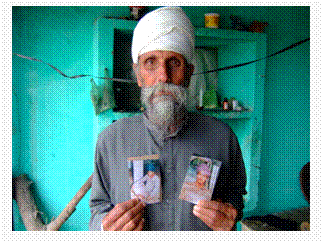
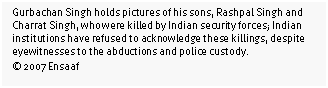
On November 17, 1988, Gurbachan Singh’s youngest son Rashpal Singh, about 15 or 16 years old, was traveling on a bus to visit his maternal family, when Punjab police stopped the bus and removed Rashpal and another youth. That same day, the newspapers reported that the police killed five persons in an alleged encounter. Gurbachan Singh learned that those five persons were cremated at Durgiana Mandir cremation ground in Amritsar—one of the cremation grounds investigated by the CBI. After speaking to employees there, Gurbachan Singh believes that his son was one of the individuals cremated because his son matched the physical description of a victim. His cremation, however, does not appear on the CBI list, and has thus been excluded from the Punjab mass cremations case by the NHRC’s limited mandate.
On June 18, 1989, between 4 and 5 p.m., approximately 100 security personnel from the Punjab police, Criminal Investigation Agency (CIA) Staff, and Central Reserve Police Force (CRPF) raided Gurbachan Singh’s village Johal Raju Singh in Tarn Taran, Punjab. Gurbachan Singh told Ensaaf:
The security forces proceeded to my residence and then my fields, where my son Charrat Singh and I were working. The Punjab police grabbed Charrat Singh and me, brought us to the small tube-well by the village, and began to savagely beat my son with their rifle butts. …They drove away with me and my son, but dropped me off on the way, and that was the last time I saw him. The security forces took my son to CIA Staff, Tarn Taran. Many folks from the village accompanied me to CIA Staff, where we asked to see my son and requested his release, but the police refused.140
On June 24, 1989, the Punjabi daily Ajit reported that unidentified persons had been killed in an encounter. A few days later, Gurbachan Singh and his family went to Police Station Tarn Taran (Sadar) to verify the news of the killing:
At the police station, we spoke with the clerk, who showed us a pile of clothes, and asked if we recognized any of them. Among the articles of clothing, we recognized the parna (small turban) worn by Charrat Singh on the day the security forces abducted him. We were allowed to view Charrat Singh’s parna, but the clerk did not allow us to take it with us.141
Gurbachan Singh did not receive the bodies of either of his “disappeared” sons, nor was he informed of their cremations, but he believes them both to have been killed by the Punjab police.
In response to the November 2006 notice issued by the Amritsar Commission of Inquiry, Gurbachan Singh submitted claims regarding both his sons. His claim for Rashpal Singh was never considered because Rashpal Singh’s cremation did not appear on the CBI list.
Justice Bhalla eventually allowed Gurbachan Singh to submit information on Charrat Singh’s death because Charrat Singh’s cremation matched an unidentified cremation on the CBI list of 814 remaining unidentified cremations. The Punjab police, however, rejected the identification of Charrat Singh.142 Justice Bhalla confirmed the police’s rejection of the identification, stating that Gurbachan Singh’s affidavit was not sufficient because Gurbachan Singh himself did not see Charrat Singh’s dead body. Justice Bhalla did not mention Gurbachan Singh’s identification of Charrat Singh’s belongings in police custody .143
The unlawful killings of Gurbachan Singh’s two sons highlight the disparate remedies available because of arbitrary distinctions resulting from the NHRC’s limited mandate and failure to investigate cases.
The case of Mehal Singh and Gurmail Singh, sons of Dara Singh
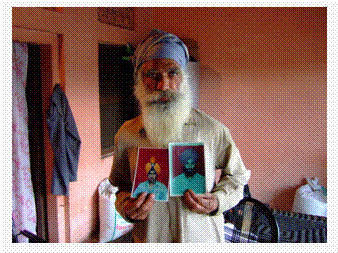
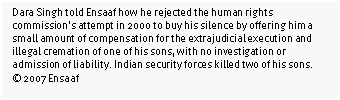
Dara Singh lost two of his four sons to extrajudicial killings: his youngest son Mehal Singh, aged 16, and his oldest son Gurmail Singh, aged 37.144 The NHRC did not acknowledge Dara Singh’s submission regarding Gurmail Singh because its limited mandate excluded cremations outside of Amritsar. In August 2000, the State of Punjab found 18 cases eligible for compensation with no admission of liability or wrongdoing, including that of Mehal Singh. Dara Singh rejected this compensation. Despite the fact that the individuals in these cases had been fully identified, the case of his son later reappeared on the unidentified list.145 The Punjab police now denies that Mehal Singh’s body was ever identified.146 The Bhalla Commission has also rejected the identification of Mehal Singh’s remains, because his father did not see his dead body and the doctor who conducted the post mortem and confirmed his son’s identity did not depose before the Commission.147
Dara Singh told Ensaaf:
My youngest son Mehal Singh was an apprentice at a tractor repair workshop in Tarn Taran. On the night of June 17 to 18, 1989, [names of police officers withheld] from Tarn Taran (Sadar) police station led a heavy police force …including the Punjab police and the CRPF, in raiding my house. It was after midnight when they came.
The security forces began beating me and my sons. They tied our hands behind our backs and lined us up facing a wall in the courtyard and threatened to execute us right then. The security forces thoroughly searched the house, and stole several valuable items, but did not recover anything incriminating….148
They then detained us at the police station for two hours and continued beating us, especially Mehal Singh. [Names of two police officers withheld] started torturing Mehal Singh. Around 5 a.m., they transferred all of us to the CIA Staff Interrogation Centre in Tarn Taran. There again, they segregated Mehal Singh and tortured him under the supervision of [name of third police officer withheld]. The rest of us were seated on the floor outside of the cell where they were torturing him, and we could hear his shrieks from the torture. Later that day, they transferred all of us, except Mehal Singh, to the Tarn Taran Sadar police station. They detained us for two days and interrogated us about weapons and threatened to kill us.149
The police officers released all of them, except Mehal Singh, on June 19, 1989. Dara Singh said he then immediately collected many respectable people from his area and went to CIA Staff Tarn Taran to inquire about Mehal Singh. Gurbachan Singh of village Johal Raju Singh, whose testimony is cited above, joined the delegation since his son Charrat Singh had also been abducted by the Tarn Taran police. But the station house officer denied custody of Mehal Singh and Charrat Singh. Dara Singh told Ensaaf:
Every day thereafter, I waited by the butcher shop [referring to CIA Staff Tarn Taran] to see if they would release my son. On June 24, by chance, I was by the entrance to the civil hospital where they conduct post mortems. There, I saw a tractor-trolley parked, and I guessed that there were bodies in the trolley. I went towards the trolley and attempted to climb in to see if my son was inside, but a policeman, who was sitting in the passenger’s seat, warned me not to get in. The trolley took off a few moments later. I followed the trolley, [walking] to the cremation ground by myself, which took about an hour.
At the cremation ground, I met one of the workers. He said that the police had just dropped off two bodies for cremation, and pointed to where they were being cremated. There were several other bodies being cremated in a line. I went to the cremations he indicated.
I wasn’t certain that the bodies were Mehal Singh and Charrat Singh, so I continued to try to find out what happened to them.150
About 8 to 10 days later, Dara Singh and a colleague who knew the doctor who performed post mortems at the civil hospital, went and spoke to the doctor. The doctor told him that he had conducted post mortems on two youth who fit the description of Mehal Singh and Gurbachan Singh’s son Charrat Singh. The doctor further described the clothes the boys were wearing. Dara Singh told Ensaaf:
We hired an attorney and obtained an order from a judge in Tarn Taran directing the police to show us the clothes in their possession. We took the order to Tarn Taran (Sadar) Police Station and spoke with the SHO. He said that we should perform our religious rites for the dead for Mehal Singh and Charrat Singh. We took this to mean that they were dead.151
The police continued to harass Dara Singh and his family, detaining them two to three more times. They wanted the family to produce Gurmail Singh, Dara Singh’s eldest son:
In the second week of June 1990, Gurmail Singh joined a Kar Sewa group renovating a gurdwara at village Gharam in Patiala district on the Punjab-Haryana border. Ten or 12 days later, a group of police officers from Ambala district in Haryana came to our village and made inquiries about the identity of Gurmail Singh, who, according to a newspaper report, had been killed in an encounter along with four other militants. The newspaper report did not mention my son’s name, but called him an unidentified militant. However, I recognized my son’s photograph that was published in the article. …Fearing further reprisals against my remaining sons, I didn’t pursue the matter. The families of the other encounter victims told us that the youth had been cremated in Ambala, the place of the encounter.152
In 1999, Dara Singh responded to the NHRC’s notice for claims regarding mass cremations. He submitted claims on behalf of Mehal Singh and Gurmail Singh. The NHRC decided that the family was eligible to receive compensation for the wrongful cremation of Mehal Singh, but Dara Singh rejected the compensation:153
Money is not justice. The police murdered both of my sons, and they won’t even admit that they did something wrong. They call my sons terrorists! The police are the terrorists.…. The government should also give us copies of their records relating to the murder of my sons, so we can figure out what really happened.154
In its October 9, 2006 order, which effectively closed all of the major issues dealing with the matter of police abductions leading to “disappearances” and secret cremations in Punjab, the NHRC appointed a commissioner of inquiry in Amritsar, retired High Court Judge K.S. Bhalla, to identify as many as possible of the remaining 814 cremation victims from the CBI list within eight months. The number of unidentified cremations was subsequently revised to 800.155
After its appointment, the Bhalla Commission and NHRC held ex parte meetings, excluding the petitioner CIIP.156 As a result, the NHRC issued an order on October 30, 2006, that limited participation in the Bhalla Commission proceedings to those families who were among the 1,857 families who had submitted claims in response to NHRC public notices issued in 1999 and 2004. The NHRC also restricted all 1,857 claimants from participating in the proceedings by requiring the claimants to resubmit their claims in response to a public notice issued in November 2006.157 The end result was that only 70 of 1,857 claimants were eligible to participate in the Bhalla Commission proceedings.158 In its October 30, 2006 order, the NHRC did not provide any rationale or legal justification for narrowing participation in the Bhalla Commission through such a procedure.
The NHRC limited Justice Bhalla’s mandate to identifying the remaining illegal cremations, but placed no further restrictions. However, Justice Bhalla demonstrated little interest in the underlying facts. In his February 3, 2007 order, he explicitly stated that human rights violations by the police did not fall within his scope of inquiry.159Further, at the April 10, 2007 hearing, Justice Bhalla stated:
Naturally, if the police had known the identity of the individuals, they would have turned over their bodies to the families. What interest would they have in keeping the bodies?160
This comment reflected Justice Bhalla’s dismissal of the contention that the police purposely covered up the identities of the individuals and destroyed their bodies in order to eliminate significant forensic evidence of torture and custodial death.
Justice Bhalla continued the NHRC practice of relying on the Punjab police for identifications or confirmations of victims of illegal cremations, instead of developing an independent methodology or conducting his own investigations.
While CIIP and other petitioners submitted identification information to Justice Bhalla, he waited for confirmation from the Punjab police. If the Punjab police rejected the identification, Justice Bhalla placed insurmountable evidentiary burdens on the petitioners, requiring them to produce evidence of the dead body or cremation.
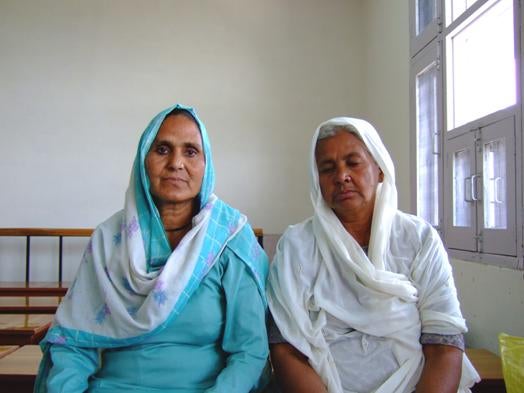
These women, whose family members were “disappeared” or extrajudicially executed by the Punjab police, regularly attended hearings of the Bhalla Commission in Amritsar but did not receive an opportunity to testify because they were excluded by the Commission’s arbitrary procedures.
© 2007 Ensaaf
At the initial hearings, through written and oral argument, the CIIP urged the Commission to adopt a rigorous methodology to resolve the unidentified cremations, and require the State to produce police records, post mortem reports, habeas corpus petitions, and news reports on abductions, “disappearances” and encounters. The CIIP also urged the Commission to solicit claims from throughout Punjab and allow all prior and new claimants to participate in the proceedings. The Bhalla Commission rejected these arguments at the February 3, 2007 hearing.161
Justice Bhalla further restricted the access of relatives to the commission, stating that victim families could not submit claims directly to the Commission, although they could provide information for the limited purpose of identification through CIIP or other petitioners. He did not explain how families excluded by the October 2006 NHRC order and November 2006 notice would know that they had this limited option. It was clear, however, that Justice Bhalla would not allow these families to testify.
The NHRC and Bhalla Commissions never acknowledged the possibility that the remaining 800 unidentified bodies could not be identified from the pool of 1,857 prior claims, and that a more inclusive process of participation was required if the Commissions were serious about establishing the identities of all 800 victims. At least 10 percent of the victims previously identified by the NHRC as having been secretly cremated in Amritsar lived outside of Amritsar district.162 The CIIP repeatedly suggested issuing a public notice throughout Punjab, inviting all victim families who believed their relatives may have been cremated in Amritsar to submit claims; these suggestions were rejected by the Bhalla Commission.163
The Bhalla Commission held its last hearing on June 29, 2007, and presumably submitted its final report to the NHRC. This report, according to the NHRC’s October 30, 2006 order, was due on June 30, 2007. The petitioners have not yet received a copy of the report. The NHRC initially scheduled a hearing for August 2007, but has postponed the hearing three times.164
B. CBI failure to investigate extrajudicial killings
The Supreme Court had entrusted the CBI with investigations into the culpability of police officials in the secret cremations case.165 The CBI was ordered to submit quarterly confidential progress reports.166Over 10 years later, the petitioners have no information regarding whether there have been any prosecutions.
In a July 1996 order, the Supreme Court ordered the CBI to register three cases—those which had specifically been mentioned in Jaswant Singh Khalra’s press release regarding his investigations: Pargat Singh “Bullet,” Piyara Singh, and Baghel Singh.167 The Punjab police responded that Baghel Singh was run over by a truck while being brought to Amritsar,168 Piyara Singh was killed by an ambush while being taken for recovery of weapons,169 and Pargat Singh was killed in an encounter.170
The case of two Pargat Singhs
The case of Pargat Singh “Bullet” illustrates the Punjab police’s practice of falsely identifying cremation victims, and the CBI’s collusion in that practice.
At the time of the July 1996 Supreme Court order mandating a CBI investigation into Pargat Singh’s death, the only information available was the date and place of cremation, the police station allegedly involved in the abduction and illegal cremation, and that Pargat Singh had allegedly been undergoing treatment at the Guru Nanak Dev hospital in Amritsar.171
But Pargat Singh has never properly been identified. One man, retired army officer Baldev Singh, claims he saw his son, named Pargat Singh, being cremated. However, the CBI and police have refused to respond to his pleas, and instead insist that the Pargat Singh that was cremated by Punjab police was the son of another man we can only identify as G. Singh at his son’s request. Both Pargat Singhs were nicknamed “Bullet.”
In the first year of the legal proceedings, Baldev Singh submitted an affidavit through CIIP regarding the extrajudicial execution and illegal cremation of his son, known as “Bullet,” after his detention by the Punjab police on September 19, 1992, from a movie theatre in Amritsar.172
The police started questioning Pargat Singh and his family in October 1988 and tortured Pargat Singh during six days of illegal detention. Later, when the police could not find Pargat Singh because he had gone underground, they illegally detained and tortured Pargat Singh’s father and older brother. Baldev Singh told Ensaaf:
[T]hey arrested me over 200 times during a period of two-and-a-half years and tortured me on many of those occasions. They would always ask me to turn over my son. But how could I? He was underground and never came home. During those days, the entire family stayed away from home. If I wasn’t home when the police came, they would take my wife and son and wouldn’t release them until I turned myself in.173
On September 20, 1992, Baldev Singh learned that Pargat Singh “Bullet” had been taken into police detention. He learned of the detention from his sister who met Pargat Singh in custody when she visited her son who had also been detained. (Her son was later released).
Baldev Singh immediately went to the police station to look for his son but was refused. He then began desperately to try to locate his son. One deputy superintendent of police (DSP) confirmed to a close police contact of Baldev Singh’s that Pargat Singh was in police detention, but refused to release him. Baldev Singh also learned that the police took Pargat Singh to B.R. Model School, an unofficial interrogation center, and tortured him.
Five days later, Baldev Singh asked another person who knew the district’s senior superintendent of police (SSP) to inquire after Pargat Singh. Baldev Singh said,
The SSP told him that Pargat Singh had been taken to the hospital for treatment. After that, I have no idea where they detained Pargat Singh or what they did to him, until I learned about his encounter.174
On the morning of November 5, Baldev Singh’s friend met with the SSP to ask about Pargat Singh. This time Baldev Singh heard that his son had been killed:
The SSP told him that yesterday they had killed Pargat Singh in an encounter and would cremate his body that day at Durgiana Mandir. The SSP further said that they would not turn over his body.175
The same day, Baldev Singh also read in the paper that Pargat Singh “Bullet” had been killed in an encounter. A former member of parliament (MP) from Amritsar, who had been helping the family locate Pargat Singh, called the SSP of Tarn Taran and asked for the body for cremation. The SSP told the MP they could attend the cremation at Durgiana Mandir cremation ground at 4 p.m. The MP advised Baldev Singh to go to the cremation ground immediately, since he could not trust the police. Baldev Singh recounted in his affidavit how he witnessed the cremation of his son:
I went to the cremation ground at Durgiana temple to ask whether the police had already cremated him [Pargat Singh]. He had not been. Then I went to the General Hospital [Guru Nanak Dev hospital] where his post mortem had been conducted. There I talked to an employee who had helped with the post mortem. He gave a detailed description of the body confirming that the person murdered in the faked encounter was indeed my son Pragat [sic]. He also told me that the police had taken the body away for the cremation. I rushed back to the cremation ground. The pyre had already been lit.176
Baldev Singh told Ensaaf:
Pargat Singh’s body had just started to burn from the head. His body was on a stack of firewood, and then more wood was stacked on top of his body. We rushed to the pyre and removed the wood on top. His body was wrapped in a blanket. We ripped it open with our fingers. The blanket was rotten so it came apart easily. I immediately recognized my son’s body. We saw bullet wounds on the left side of his body with exit wounds on the right. Once I was satisfied, we placed the wood back on top and allowed the pyre to burn.177
The police cremated Pargat Singh “Bullet,” son of Baldev Singh, on November 5, 1992; the next day the family collected his ashes.
The CBI visited Baldev Singh in the winter of 1996. He told them he wanted justice, but never heard from them again. Baldev Singh later learned that the CBI had refused to list his son as one of those identified as having been cremated by the Punjab police. He was instead identified as another Pargat Singh, a resident of M— village and son of G. Singh. Baldev Singh said he tried to convince the police that he had witnessed his son’s cremation, but to no avail. He was instead asked to produce his son.
In November 2006, an inspector from B-Division summoned me to the police station. He asked me to identify my son. I told him that my son was Pargat Singh and that he had been killed in a fake encounter. He started berating me saying that he didn’t believe me. He said that Pargat Singh belonged to a family from village M—. He told me that it was impossible for there to be two Pargat Singh’s from two different families, both killed in the same encounter, yet only one body. He then demanded that I turn over my son. I told him that he could say whatever he liked, but I saw my son’s body with my own eyes. He continued shouting at me, saying there couldn’t be two Pargat Singhs. I told him that was for him to explain, not me, but I saw him with my own eyes.
I returned about one week later to determine if they would acknowledge my son. The inspector said that he wouldn’t recognize my claim. He would recognize the family from M— village. According to his documentation, they were Pargat Singh’s family so he would decide in their favor. There was nothing else I could say, so I left.
The government should tell me what really happened. They should acknowledge my son’s death. I saw him with my own eyes. How can they tell me that it wasn’t my son?…They made my family suffer. Nobody was willing to marry my daughter. I’m not hungry for money, I’m hungry for justice.178
The CBI continues to identify the Pargat Singh who was cremated on November 5, 1992, as the son of G. Singh, not Baldev Singh.
The Pargat Singh that the CBI list acknowledges was the son of G.Singh and nicknamed “Mini Bullet.” Pargat Singh’s brothers told Ensaaf that he was a militant with the Khalistan Commando Force (KCF). The police regularly harassed his family. K. Singh, Pargat Singh’s brother, recounted to Ensaaf:
All in all, over the years, I was abducted and tortured 15 to 17 times. Chabal, Bhikiwind, Khalra, Harike were the main police stations involved. My father was abducted five to six times. In 1992, the police detained me continuously for seven months at various police stations, and beat me. When they transferred me between police stations, they would blindfold me, so I didn’t know where I was. I was released five to six days after they killed my brother Pargat Singh.179
According to the Punjab police, Pargat Singh of M—village was cremated on November 5, 1992, the same day that Baldev Singh witnessed the cremation of his son Pargat Singh. Only one Pargat Singh’s cremation is recorded on that day in the cremation ground records.180 The family of G.Singh read about the cremation at Durgiana Mandir cremation ground in the Ajit newspaper and went to collect the ashes; the cremation ground workers did not give the ashes to them.
As discussed above, in July 1996, the Supreme Court ordered the CBI to investigate the killing of Pargat Singh “Bullet.” One of his brothers, K. Singh, described the extent of investigation:
Many years later, the CBI visited our house to ask us about Pargat Singh’s death. They came a total of four times. The first two times the CBI came from Patiala. The first two times we were afraid to talk to the CBI and told them that we didn’t know anything. Then we spoke with Mrs. Khalra [Jaswant Singh Khalra’s widow] and she said that it was okay to speak with them—that they were investigating our case.
The CBI from Amritsar then visited us twice in the same year. We told them about our history of persecution and whatever we knew about Pargat Singh’s death. The CBI actually had more information than we did. They told us that the Raja Sansi police had faked the encounter of Pargat Singh. They said that some woman had admitted Pargat Singh to the hospital ten days earlier because of pain in his appendix. Then, on November 4, 1992, Raja Sansi police abducted Pargat Singh from the hospital and then cremated him at Durgiana Mandir the next day. They further said that Sub-Inspector[Name withheld]of Raja Sansi Police was the main accused.181
K. Singh described the lack of court proceedings:
In 2001, we received a letter from the CBI Patiala telling us to come to court to give testimony. About ten days later, I went to Patiala to the address indicated on the letter. I went to some government office. There, someone told me to go to an attorney’s office. I went to that attorney’s office and met a clerk. The clerk told me to return in about a month. I went back a month later to the clerk. The clerk told me that if we wanted to fight our case, we would have to give him 20,000 rupees—5,000 for him and 15,000 for the attorney. I told him that we had no ability to pay that amount and left. After that, the CBI never contacted us again. We have no idea if the CBI ever prosecuted anybody for Pargat Singh’s murder.182
Baldev Singh continues to dispute which Pargat Singh was killed and cremated on November 5, 1992. The CBI acknowledges the cremation of a Pargat Singh, but still insists he was the son of G. Singh.
The killing of Piyara Singh
In July 1996, the Supreme Court ordered the CBI to register a case regarding the killing of Piyara Singh.183 Piyara Singh’s son Balraj Singh, however, told Ensaaf that the CBI approached the family only twice during its investigation and the family has no knowledge of any criminal prosecution pursued in response to the Supreme Court order.
Balraj Singh said that a police team arrested his father in 1987 and tortured him for five to six days. In 1989, a police force arrested his father at his home and brutally tortured him, using a heavy roller, suspending him, tearing his legs, pulling his nails out of his feet, and impaling his legs with sharp, heated iron rods. In 1990, out of fear of the police, Piyara Singh moved to Uttar Pradesh to live with his sister.
In 1992, Balraj Singh was visiting his father in Uttar Pradesh when the police came to the village disguised as a group of doctors:
They approached my father’s neighbors, saying they wanted the presence of a prominent person to inaugurate a hospital. The neighbors mentioned my father, but said that he wasn’t home. The police said that they would wait nearby and asked the neighbors to signal them when my father returned.
When my father returned home and entered the house, about 10 to 12 policemen rushed in after him and tackled me and my father. They tied our arms behind our backs and took us away on a mini truck.184
The police took Balraj Singh and his father Piyara Singh to the B.R. Model School Interrogation Center, and placed them about three cells apart:
They started torturing my father. I could hear his screams into the morning. That night, around 9 p.m., they came for me and tortured me for about an hour. But they tortured my father continuously for three days. I could hear his screams the entire time. After the third day, I could no longer hear him, so I assumed they had tortured him to death.185
After his release over two weeks later, Balraj Singh learned that the police reported that his father had been killed in an encounter. He further learned from his family that his grandfather and Jaswant Singh Khalra had gone to Durgiana Mandir cremation ground and spoken with a cremation ground worker. Khalra knew Piyara Singh because they were both bank directors.
According to Balraj Singh, the family did not hear from the CBI again after 1996.
C. The murder of Jaswant Singh Khalra: Intimidation of witnesses and superior responsibility
In the early 1990s, human rights defender Jaswant Singh Khalra joined the Human Rights Wing of the political party Akali Dal.186 In 1994, while investigating the disappearance of a personal friend, Khalra discovered that the police had secretly cremated his body at Durgiana Mandir cremation ground in Amritsar district. Khalra launched a wider investigation into secret cremations.187
In January 1995, Jaswant Singh Khalra and his colleague Jaspal Singh Dhillon released a report on mass illegal cremations using government records. KPS Gill, the director general of police (DGP) in Punjab, responded to their evidence by accusing Pakistan’s Inter-Services Intelligence (ISI) of trying to destroy peace in Punjab and alleging that most of the “disappeared” persons were living abroad.188 Khalra discussed DGP Gill’s statements in April 1995:
KPS Gill said in a press conference in Amritsar, ‘These Human Rights Wing folks—they’re not doing anything on human rights. They have one motive, to prop up their agenda, so there is no peace in Punjab. They are ISI agents, and they are hatching a conspiracy to discourage the police machinery and re-incite militancy.’ KPS Gill went to the extent of saying, ‘I’ll tell you where those kids are.’ He said, ‘These kids are in Europe, in Canada, and in America, where they are earning their daily wages. And these human rights organizations are telling us that thousands of kids have disappeared.’ This was a challenge to us. This was a challenge to that truth which we sought to bring forward.189
Khalra challenged DGP Gill to an open debate on the evidence.190 In February 1995, at a press conference, Khalra publicly disclosed the death threats made to him because of his human rights work.191 He also discussed these death threats with various other individuals, especially threats made by the Tarn Taran police under the command of Senior Superintendent of Police (SSP) Ajit S. Sandhu, who had been transferred back to Tarn Taran district after Khalra released his investigative report.192 Sandhu allegedly threatened Khalra that he, too, would become an unidentified dead body.193 In March, the police tried to discredit Khalra by alleging that he had links with a militant group.194 Khalra continued to expose police officials, speaking throughout Punjab and North America on the issue.
On the morning of September 6, 1995, the Punjab police abducted Jaswant Singh Khalra. Rajiv Singh, a reporter who was present at the Khalra residence, witnessed the abduction and identified the police officers involved. Rajiv Singh saw three uniformed policemen and one policeman in civilian clothes exit a Maruti van. According to Rajiv Singh, two of the police officers, Station House Officer (SHO) Satnam Singh of Police Station Chabal and Head Constable (HC) Prithipal Singh of Police Post Manochahal, carried carbines, and Deputy Superintendent of Police (DSP) Jaspal Singh, also uniformed, had a walkie-talkie set. DSP Ashok Kumar sat in the front seat of the Maruti gypsy, or jeep, on the left side of the driver’s seat. Surinderpal Singh, SHO of Police Station Sarhali, sat in the front seat as well. Rajiv Singh further observed five to six uniformed policemen sitting in the back of the Maruti gypsy; one of them was Jasbir Singh, in-charge of Police Post Manochahal, another was Assistant Sub-Inspector (ASI) Amarjit Singh, and a third was Avtar Singh Sona, son of SSP Sandhu’s nephew Jagbir S. Sandhu.195
Rajiv Singh heard DSP Jaspal Singh tell Khalra that SSP Sandhu wanted to meet him. Khalra was forcibly placed between DSP Jaspal Singh and HC Prithipal Singh in the van. Rajiv Singh then heard DSP Jaspal Singh make a call on the walkie-talkie and state that the work was completed.196 Khalra was then taken away in the Maruti van, followed by the Maruti gypsy. Kirpal Singh Randhawa, a resident of the same neighborhood, also claimed to have seen the vehicles.197
After the abduction, Rajiv Singh called Paramjit Kaur, Khalra’s wife, and informed her of the abduction. She immediately came home from work and, accompanied by Rajiv Singh, went to Islamabad Police Station to make further inquiries. She then informed her family and husband’s colleagues, and also sent telegrams to the chief minister of Punjab, director general of police, chief justice of India, and chief justice of the Punjab and Haryana High Court, among others.198 A few days later, Paramjit Kaur filed a habeas petition in the Supreme Court. Khalra’s abduction by the police was never recorded in police records,199 and the police maintained that there was no criminal case against him and thus no reason to arrest him.200
As a court subsequently confirmed, the Punjab police illegally detained and tortured Khalra for almost two months before killing him in late October 1995 and, discarding his body in the Harike canal in Amritsar, Punjab.201 Several days prior to his murder, the police allegedly took Khalra to SSP Sandhu’s residence, where KPS Gill allegedly joined them and interrogated Khalra for half an hour. On the ride back to the police station, SHO Satnam Singh told Khalra that if he had listened to DGP Gill’s advice, he would have saved his life.202
In November 1995, the Supreme Court directed the CBI to investigate the kidnapping of Jaswant Singh Khalra.203 The CBI filed a charge sheet against nine police officers from Tarn Taran district on October 30, 1996, but did not arrest any of the accused.204 Initially, the CBI only charged the police officers with kidnapping and illegal confinement, and not torture or murder.205 After Paramjit Kaur Khalra’s attorney intervened in 1997,206 the court revised the charges to include murder charges against three of the officials.207
On November 18, 2005, over ten years after Paramjit Kaur Khalra filed a habeas corpus petition regarding her husband’s abduction, Additional Sessions Judge Bhupinder Singh convicted and sentenced six Punjab police officers for their roles in the abduction and murder of Khalra.208 Two other police officers—SSP Sandhu and DSP Ashok Kumar—died during the course of the trial, and one other police officer was not prosecuted and discharged.209 The convicted police officers have appealed the convictions.210 Paramjit Kaur Khalra has appealed the leniency of the sentences, arguing that all who gave orders or otherwise participated in the murder should receive life sentences.211 The CBI has not filed any appeal.212
While the convictions of lower-level officers more than a decade after the murder represent an exception to the impunity otherwise enjoyed by the security forces for serious abuses committed during the counterinsurgency, even in this case justice has not been done. The truth has not been established, the most responsible senior police officials have not been charged, and the proceedings that have taken place have been marred by inordinate delays and egregious intimidation and harassment of witnesses.
There is even evidence that some of the officers convicted in 2006 are receiving special treatment. Individuals have informed Khalra’s widow that they have seen some of the convicted police officers out during weekends at bars, clubs and hotels, suggesting that they are periodically released from jail.213 Mrs. Khalra’s attorney Rajvinder S. Bains informed Ensaaf that DSP Jaspal Singh has stayed at home in Hoshiarpur when he was supposedly transferred to a local Hoshiarpur jail for cases proceeding against him in a local court.214
Prior to the conviction, moreover, in part due to the slowness of the proceedings and the CBI’s failure to make arrests, the accused repeatedly intimidated and threatened witnesses.
Police have retaliated against activists by implicating five of the key witnesses—Khalra’s wife Paramjit Kaur, as well as Kulwant Singh, Kikar Singh, Rajiv Singh, and Kirpal Singh Randhawa—in false criminal cases, ranging from bribery, rape, and robbery, to establishing a terrorist organization.215 The police arrested Rajiv Singh, the witness to Khalra’s abduction, at least twice to prevent his appearing in court to testify, and implicated him in a total of four cases, including the forming of a terrorist organization.216 The Punjab State Human Rights Commission investigated the terrorism charge and concluded that the police falsely implicated him.217 In 2004, prior to his testimony in the Khalra case, the police falsely implicated another eyewitness to the abduction, Kirpal Singh Randhawa, in a rape case, and accused both him and Rajiv Singh of allegedly threatening a witness in the rape case.218
The police further threatened Kulwant Singh, who saw and spoke to Khalra in custody on September 6, 1995, the day of Khalra’s abduction. 219 Kulwant Singh said that he was brought to the office of SSP Sandhu and questioned about Khalra by Sandhu, Station House Officer (SHO) Satnam Singh and Deputy Superintendent of Police (DSP) Jaspal Singh, three of the accused police officers.220 Kulwant Singh stated in his trial testimony that police officers threatened and asked him not to meet CBI officials in connection with the Khalra case.221
Police harassment appears to have been the reason Kikar Singh turned hostile during trial. Kikar Singh initially told the CBI that he saw Khalra in police custody at Police Station Kang on October 24, 1995, witnessed signs of torture on his body, and helped him eat:
At the time the hair of his [Khalra’s] beard and head had been plucked and he had blue marks of bruises under his eyes. His fingernails were also blue. He had bruises on his body. He could not eat his food with his hands. I fed him food with my own hands. After eating the food he was taken out by the sentry and Jaswant Singh Khalra was not even able to walk properly. I helped him by supporting him with a shoulder along with another person in civilian clothes.222
After giving his statement to the CBI, Kikar Singh repeatedly asked for protection.223 The protection was ineffectual. In his affidavit of August 29, 1996, Kikar Singh stated that SSP Sandhu and DSP Jaspal Singh were pressuring him to turn hostile by implicating his father and relatives in false cases and by conducting raids on his house.224 They forcibly took possession of his house and farm on August 25, 1996 in connivance with Kikar Singh’s security guard.225 After spending time in judicial custody, Kikar Singh turned hostile in Khalra’s case, denying any knowledge of Khalra, that they had been in illegal detention together, or that he had made two previous statements to the CBI regarding his knowledge of abuses against Khalra.226
Police officers appear to have intimidated a key witness into filing a false bribery case against Paramjit Kaur Khalra and her supporters. In March 1998, officers implicated in Khalra’s abduction visited Special Police Officer (SPO) Kuldip Singh, who had witnessed Khalra’s illegal detention, torture, and the disposal of his body. The police officers intimidated SPO Kuldip Singh into filing false bribery charges against Paramjit Kaur Khalra, threatening him and his wife with disappearance.227 The charges against Paramjit Kaur Khalra were quashed after SPO Kuldip Singh’s family denied his statement and human rights groups drew attention to the case.228 In November 2004, SPO Kuldip Singh expressed no confidence in Punjab police security and requested that a Central Reserve Police Force (CRPF) vehicle replace the Punjab police vehicle that was bringing him to court.229
The CBI’s failure to charge Punjab Director General of Police (DGP) KPS Gill for his role in the abuses against Khalra highlights serious failures in the prosecuting authority of the CBI. To address the CBI’s failure to charge KPS Gill, Paramjit Kaur Khalra petitioned the court to allow her lawyers to intervene in the case. In a September 1997 order, the special judicial magistrate allowed her lawyers to argue, examine, and cross-examine witnesses, while acting under the directions of the public prosecutor.230
In 1997, after SSP Sandhu committed suicide, SPO Kuldip Singh approached the CBI with direct information on the abuses against Khalra. He said he had been too afraid to disclose this information while Sandhu was alive.231 SPO Kuldip Singh had served under SSP Sandhu since 1994, specifically as the bodyguard of SHO Satnam Singh, another accused in the Khalra case.232 In February 1995, when SSP Sandhu was transferred back to Tarn Taran after Khalra announced his discoveries, SPO Kuldip Singh and SHO Satnam Singh were also transferred with him.233 In his statement to the CBI, SPO Kuldip Singh described how he had been appointed to guard the room where Khalra was detained, and discussed the role of different officers, including the senior-most officer, DGP Gill, in the abuses against Khalra.234
The CBI appears to have actively worked to prevent the addition of Kuldip Singh as a witness in the trial. According to Kuldip Singh, SHO Satnam Singh told him on March 22, 1998, that the CBI officials who had recorded his statement had apologized to KPS Gill under pressure from the central government.235 On August 12, 1998, Paramjit Kaur filed an application in court for a direction to the CBI to present the supplementary charge sheet with the statement of Kuldip Singh.236 The CBI opposed this application, as did the accused; the court, however, ordered the CBI to present its supplementary report within a month.237 In its report, the CBI stated that they refused to add Kuldip Singh as a witness because his statement did not “inspire confidence” since it had been made two-and-a-half-years after Khalra’s abduction; they imputed his making the statement to his failure to secure a job in the Punjab police.238 According to the CBI, other police officers stated they had no knowledge of Khalra’s detention and KPS Gill also denied his role.239 Mrs. Khalra filed another application through her attorney in January 2000 arguing for Kuldip Singh to be added as a witness, which the CBI opposed.240 Only in October 2000, by order of the sessions judge, was Kuldip Singh added as a prosecution witness.241 The sessions judge found Kuldip Singh to be a material witness whose credibility could be assessed during cross-examination in trial.242
In February 2005, SPO Kuldip Singh gave his testimony in court and explained the sequence of events leading to Khalra’s custodial torture and murder, including the role of KPS Gill. He described how, in October 1995, he was handed the key of a room in Police Station Chabal by SHO Satnam Singh. SHO Satnam Singh told him that a man was being detained there and that he must serve him meals and keep his detention secret.243 SPO Kuldip Singh opened the door and saw Khalra there; his clothes were torn and there were bruises on his body.244 He described how he witnessed beatings of Khalra by the accused officers because Khalra had refused to stop his human rights work.245 One day, the police officers took Khalra to SSP Sandhu’s residence:
The condition of Sh. Jaswant Singh Khalra was not good as he had suffered beatings and was not able to walk and was brought to the car by me and Sh. Satnam Singh by holding him from arms. His wrist joints were swollen at that time and he was not able to even take his meals properly. He was also unable to go to answer the call of the nature. We had to support him for doing so.246
Thereafter, he said, KPS Gill visited SSP Sandhu’s house and interrogated Khalra for half an hour, and thus witnessed that Khalra could barely move from the torture he had experienced at the hands of Gill’s subordinate officers.247 SPO Kuldip Singh further testified that SHO Satnam Singh told Khalra to accept KPS Gill’s advice and save himself.248 SPO Kuldip Singh further described Khalra’s murder and the disposal of his dead body in Harike canal.249
SPO Kuldip Singh’s testimony established that DGP Gill defied Supreme Court orders regarding Khalra’s habeas petition. On September 6, 1995, Paramjit Kaur Khalra sent Gill a telegram informing him of her husband’s abduction.250 On September 11, 1995, five days after Punjab police abducted Khalra, the Supreme Court issued formal notice and service to DGP Gill of the habeas corpus petition filed by Khalra’s wife.251 Despite receiving this formal notice, DGP Gill failed to disclose Khalra’s whereabouts while Khalra was alive. On November 15, 1995, the Supreme Court ordered the CBI to inquire into Khalra’s “disappearance” because the police investigation had not yielded any results. The Court further directed DGP Gill to “render all assistance and help to the CBI.”252
According to the judge who passed the final order, Kuldip Singh “did respond properly to all the queries put forward to him by the defense counsel who could not shake his veracity despite detailed and lengthy cross-examination of this witness.”253 The judge found that the in-court statements made by Kuldip Singh were “fully consistent” with the statements he had given earlier to the CBI.254
Despite this detailed and consistent information, accepted now as findings of fact by a court of law, the CBI has failed to initiate an investigation of KPS Gill’s role in the abduction, torture, and murder of Khalra. After writing twice to the CBI requesting that it initiate an independent investigation and bring charges against former DGP Gill,255 with no reply,256 on September 6, 2006, Mrs. Khalra filed a petition in the High Court.257 Over a year later, this petition has yet to have a substantive hearing.258
One of the greatest obstacles to combating impunity is the failure to hold superior officials accountable. The international law doctrine of superior responsibility imposes liability on superiors for the unlawful acts of their subordinates, where the superior knew or had reason to know of the unlawful acts, and failed to take necessary and reasonable measures to prevent or punish those acts.259 Based on his acts and omissions, the Punjab Director General of Police, KPS Gill, could be liable under the doctrine for Khalra’s abduction, illegal detention, torture, and murder. The evidence suggests that Gill himself participated in crimes against Khalra, and failed to rescue or order Khalra’s release when he knew Khalra was being ill-treated.
A superior-subordinate relationship exists if the superior possesses “effective control” over a subordinate,260 which includes the ability to prevent or punish the commission of offenses.261 By his own admission, Gill exercised effective control over the Punjab police, and had intimate knowledge about the functioning of individual police stations.262 Gill wrote that he created an “active and accountable police leadership” and described how he worked to be a leader who led “from the front.”263 His de jure command, as evidenced by his own admissions and the high-level tasks he performed, creates a presumption of effective control.264 His de facto command over his subordinates also demonstrates his effective control, as evidenced by his ability to issue orders that were followed.265 Moreover, Gill was in a position to prevent and punish offenses with the power to initiate investigations and discipline subordinates.266 In September 1992, Gill himself said that his office was investigating more than 30 allegations of police wrongdoing and had fired more than fifty officers for misconduct.267 Furthermore, Gill thoroughly exercised his powers to reward and promote subordinates,268 and demanded regular communications and meetings with subordinates.269 All of these factors demonstrate that Gill had effective control over the subordinates who committed the crimes against Jaswant Singh Khalra.
KPS Gill appears to have had actual and constructive knowledge that his subordinates committed and/or were about to commit unlawful acts against Jaswant Singh Khalra because he witnessed Khalra’s illegal detention and tortured body.270 Further, his position in the chain of command, the timing of the abduction after Khalra exposed the mass cremations,271 the extensive use of police infrastructure and personnel to commit the crimes, also are strong evidence of his actual knowledge of the crimes. In this case, there were no fewer than nine police officers involved in the operation to abduct Khalra, including officers with the ranks of SSP, DSP, and inspector, who used police radios, weapons, and unmarked vehicles to abduct Khalra.272 Further, in May 1994, the Supreme Court heard a petition implicating the police abduction and disappearance of four Punjab human rights attorneys.273 At the time of Khalra’s abduction, one of the accused, SSP Sandhu, had at least 19 charges against him.274
KPS Gill had reason to know, or constructive knowledge, of his subordinates’ crimes against Khalra because of the number of complaints and court notices he received about Khalra’s abduction and threats to Khalra’s life, the information available in the public domain about the role of his subordinates in Khalra’s abduction, and general information on the violent history of his subordinates. Despite this actual and constructive knowledge that his subordinates had committed and were about to commit unlawful acts against Khalra, Gill failed to take necessary and reasonable measures to prevent his subordinates from committing unlawful acts against Khalra or to punish them afterwards. Gill could have prevented his subordinates’ crimes against Khalra with a simple release order and an order prohibiting further harm against Khalra. This measure was necessary because it was legally required by the Supreme Court and within his ability.
This case demonstrates the serious defects in the way the government has dealt with the abuses that accompanied the Punjab counterinsurgency operations. The lack of witness protection, the length of trials, duplicative investigations, the unwillingness to hold senior officials accountable, and government interference ensure that impunity for mass state crimes continues.
D. The killing of Jugraj Singh: Police intimidation and failure of due process
The lack of justice in India is like a cancer. It’s eating away at Indian society. But if you don’t tell people about it, then it will never get cured. You can’t be afraid to tell the truth.
-Mohinder Singh, father of Jugraj Singh
Unfortunately, the Khalra case is not an isolated example. The experience of Mohinder Singh in pursuing justice for the murder of his son Jugraj Singh also illustrates the role of the CBI in protecting the police, the intimidation of witnesses and petitioners, the failures of the judicial process, destruction of evidence by the police, and the lack of justice despite considerable efforts by affected families. It is further evidence that impunity continues to trump the rule of law in India.
On the morning of his abduction on January 14, 1995, Jugraj visited Mohinder Singh—they lived a few blocks apart in Mohali. Jugraj Singh told his father that he was going to the scooter market in Phase III B-2 to get his van fixed. When Mohinder Singh visited Jugraj Singh’s house around 8 or 9 p.m. that evening, his daughter-in-law told him that Jugraj had not returned. After speaking to neighbors, they learned that people at the market were saying that the police had arrested Jugraj. Mohinder Singh recounted:
A lot of people at the market knew Jugraj so it’s no surprise that they were talking about it. The day after the abduction the juice vendor, whose stall was in the market, told me that a blue Maruti car with license plate number PCO-42 parked at his stall around 7 a.m. and four plainclothes policemen stood around the car. When Jugraj passed the car in his van they jumped into the car and pulled out after him. The car overtook the van. Some of the men got out and signaled Jugraj. Jugraj stopped his van thinking they wanted a ride. They forced themselves into the van and took off towards Phase 8. Jugraj was a regular customer of the juice vendor’s and they knew each other well. A few days later, the juice vendor packed up and left.275
The next day, accompanied by two friends, Mohinder Singh went to the police station in Phase 8 to register a complaint:
I didn’t go to the police station immediately because it was late and I didn’t want to go alone.
At the police station we met with the clerk and told him that we wanted to register a complaint about the abduction. The SHO said that they would register our written complaint and find out in a few days where Jugraj was. We took a blank sheet of paper from the clerk and sat down and wrote-up the complaint. I wrote that police had abducted my son and I didn’t know where he was and wanted the police to locate him. I gave the complaint to the clerk in the presence of the SHO. They didn’t register the complaint in their Daily Diary Report or register a First Information Report (FIR).276
The following day, on Monday, January 16, Mohinder Singh went to the residence of Deputy Superintendent of Police (DSP) Gurpreet Singh Gill with a friend and an acquaintance of the DSP. He told Ensaaf:
The SP (Detective) was with the DSP at the time. I told the DSP about my son’s abduction. The DSP asked for the engine and chassis numbers to Jugraj’s Maruti van. He said that without it he couldn’t trace Jugraj, but with it he could find him quickly.
In the meantime the SHO showed up. The DSP asked him if he had registered our case in the Daily Diary Report or registered an FIR. The SHO lied and said that he had.277
Mohinder Singh procured a copy of the van’s registration certificate, which recorded the van’s engine and chassis numbers and gave that copy to the DSP.
That same day, Mohinder Singh sent a telegram to the chief justice of the Punjab and Haryana High Court, asking the court to intervene and save his son’s life.278 He also visited the market to verify the details of the arrest, and spoke to the owner of the shop next to the mechanic’s shop, whom his family knew well. This man confirmed that he had seen Jugraj in his vehicle with police on January 14, and that the police had also at that time arrested another man called Sukhdev Singh from his shop and driven away towards Phase 8. The owner recognized the SHO seated in the vehicle that was used in the arrest of Sukhdev Singh, which was followed by Jugraj’s vehicle.
The police did not register Mohinder Singh’s complaint until Monday evening; it never registered his FIR. After calling Mohinder Singh to the police station on Monday evening, the police accompanied him to the market, where he witnessed them arrest the owner of the shop who had seen Jugraj in police custody:
We reached the market at 6 p.m. and the SHO arrived separately at the same time. At the market I explained to the SHO what the owner of the shop had told me. The SHO then forcefully grabbed the owner by the arm and dragged him into the jeep and took him away.
The SHO repeatedly asked me in a threatening manner: ‘Was Sukhdev Singh your relative? Did he visit your house? Did you know he was a terrorist?’ I said that I didn’t know him so don’t keep asking me and threatening me. He really tried to intimidate me at the market. The shop owner’s father repeatedly asked the SHO why he was taking his son. The SHO also threatened him and said: ‘What’s it to you?’ The police left with the shop owner and we quietly came home.
Two to three days later the shop owner’s father told me that he had gotten his son released that same evening. The police had badly beaten him. The father was upset with me for naming his son and asked my why I had implicated him. I said that I simply repeated what his son had told me. The police told the shop owner’s father: ‘You better get your son out of here [India] otherwise we’re not going to let him go.’ Within a month the shop owner’s father had his son in Australia on a student visa.
I should never have told the police about any of the witnesses until the witnesses had a chance to record their statements in court. The police killed or intimidated all of them.279
On the morning of January 16, the newspapers carried statements from the SSP of Majitha, RS Khatra, that Majitha police had shot dead one Kashmiri Muslim militant and one Sikh militant in an encounter in Baba Bakala. (It was later established that the alleged Kashmri militant was actually Jugraj Singh). A white Maruti van was also shown in one of the photographs, and the reports stated that the license of Sukhdev Singh had been recovered from the Sikh.280 However, on January 20, DGP KPS Gill issued a statement saying that the Sikh militant was not Sukhhdev Singh Sukhi but Didar Singh.281
Following his son’s arrest, Mohinder Singh met over 60 individuals in an attempt to gather information about his son, including the senior-most Punjab police officers, chief ministers and governors of Punjab, MLAs, MPs, judges, lawyers, journalists, religious leaders, and many other individuals. None of them were able to help him resolve his son’s “disappearance”:
I was in a great deal of pain. I was deeply discouraged. Peace wouldn’t come to my mind. I ran in any direction suggested in the hope that it might lead me to my son. But my son was gone. How was he going to come back?282
On January 30, in response to Mohinder Singh’s telegram, the High Court issued notices to DSP Gurpreet Singh Gill and the superintendent of police of Ropar. Throughout the court proceedings, the police harassed Mohinder Singh, by coming to his home late at night and ringing the doorbell. After these incidents, Mohinder Singh would send complaints to senior police officers and members of the legislative assembly where he had worked.
Mohinder Singh described how he eventually recovered Jugraj’s van, and how investigations that followed prompted the High Court to order a CBI inquiry:
While the High Court case was pending I filed an application with the court stating that the white Maruti van was mine and that I be allowed to recover it from Beas Police Station. The judge passed an order on March 8, 1996, stating that I could repossess the car at my own expense and hand it over to the CRPF at the High Court.
The van was outside in the police grounds at the back of the main building. The police had completely finished it. They had removed the windows, the wheels, tires, the carburetor, everything was lying outside. They had welded the engine back in on one side instead of bolting it, probably because they had misplaced the bolts when they had removed it to destroy the engine number.283
The following day, Mohinder Singh arranged for a photographer to take pictures of the van so that its current state could be compared to earlier pictures of it. After reviewing the recent and old photos, the judge ordered the CBI investigation on April 23, 1996.284
The CBI DSP and two inspectors were appointed to investigate Jugraj Singh’s killing. Jugraj’s van remained at the High Court for two months before the CBI team took possession of it and transferred it to the Central Forensic Science Laboratory in Sector 36 in Chandigarh. The DSP asked Mohinder Singh to assist the forensic team, which included paying for services:
First, the forensic team wanted to see the engine number… I brought two mechanics on my scooter from the gas station in Sector 37 to the lab. It took them about an hour to remove the engine. After removing it we could see that the engine number had been welded over with metal. The lab wanted to remove the welded material but all they had were files. So they told me to make arrangements to have the welded-on material removed. I then got another mechanic from Sector 21 who had an electric grinder and brought him to the Forensic Lab. It took him about an hour to grind through the welded material. Then, the forensic team applied several different etching chemicals to remove the remaining material. Unfortunately, none of these efforts revealed the engine number. The police had completely obliterated it.
At this time, we also checked for the chassis number. When we got under the van to take a look, there was 2.5 inch hole where the chassis number used to be.
The forensic team then enlarged the photos from my negatives and compared all the photos with each other and with the van in their possession.285
Based on the earlier photographs, the forensic team noticed many similarities with the van in their possession. The same patterned covers were visible in the photos and in the recovered vehicle. Mohinder Singh described other similarities:
The old picture of the van also showed a fan bolted to the dashboard between the passenger and driver. There was a brown velvet cloth on the dashboard of the recovered vehicle and when the forensic investigators removed it they found three bolt holes exactly where the fan would have been. They also measured the location of the fan on the dashboard in the picture with the bolt holes in the dash of the recovered vehicle and concluded they were at the same spot.
Jugraj’s van also had red sticker striping on the sides of its doors which could be seen in the old pictures. There were no stickers on the recovered van but you could see that there was adhesive residue left on the same spot where the stickers would have been. I asked the forensic team to compare the measurements of the stickers on the van in the photos with the dimensions of the adhesive residue on the van. They did this and concluded that the stickers were the same size and had been peeled off.
Also, the driver’s side door of Jugraj’s van had been damaged in an accident. The handle got bent in and the door got scratched. The repair shop filled in the dent with powder and painted over it. When I mentioned this to the forensic team they scrapped at the area where I indicated the damage should be and powder came loose.286
The director of the forensic lab submitted its report to the CBI concluding that the van recovered from the Beas Police Station belonged to Jugraj. Despite this report, the DSP from the CBI challenged the ownership of the van. Mohinder Singh recounted:
The last piece of the puzzle was the vehicle registration number which the DSP insisted on. I had mentioned the registration number in the High Court petition. The DSP took the registration number to the Transport Department and asked them to check it with their records. They did and confirmed that the white Maruti van was registered with Jugraj Singh.287
While this was happening, Mohinder Singh described how the CBI attempted to dissuade him from pursuing this case:
On one occasion when [the officer] from the CBI came to my house, he told me that I wasn’t going to get anything out of this. Not justice and not even compensation. He further said that: ‘I see you running around pursuing your case. But you shouldn’t get into a confrontation with the police. You have to live here and they can pick you up at any time.’ He was indirectly threatening me.288
The CBI submitted its report to the High Court on August 16, 1996. The CBI confirmed the van as Jugraj Singh’s.289 The CBI, however, concluded that Jugraj’s being taken into police custody could not be established. The CBI report did state that one of the two encounter victims was Jugraj and clarified that he was the clean-shaven youth that had been killed.290 This also meant that the police had cut short the hair of Jugraj Singh, a devout Sikh who kept his hair uncut according to Sikh discipline. Based on photographs of the alleged encounter scene, Mohinder Singh disputes the CBI version, maintaining that Sukhdev Singh was the one whose hair and beard were cut.
The CBI report was accepted by the High Court judge on April 29, 1997.291 The judge denied Mohinder Singh’s request for further investigation by the CBI.
Mohinder Singh filed another application requesting the CBI to record the statement of Kesar Singh, who witnessed the police abduction.292 Mohinder Singh described the significance of Kesar Singh and how the judge failed to order the CBI to examine him as a witness:
Kesar Singh had gone to my attorney for his own reasons. He told the attorney that he witnessed the police abduction of Jugraj but didn’t know how to get in touch with Jugraj’s family. My attorney gave Kesar Singh my number. He came over and told me everything he had witnessed. He knew Sukhdev Singh Sukhi alias Didar Singh and Jugraj. Kesar Singh was walking from his office in Phase 7 to meet someone in Phase IIIA when he witnessed the police abduct Sukhi and saw Jugraj in the back of his van.
We filed Kesar Singh’s affidavit in the High Court along with an application asking the court to order the CBI to examine him as a witness. The CBI strongly opposed the application. They argued that it was too late to introduce a new witness.
The court rejected Mohinder Singh’s application:
In the beginning of the investigation the DSP said: “If you give me even one eyewitness to the abduction I’ll hang all of them [the police].” And when I produced an eyewitness the CBI refused to examine him. 293
Judge Srivastava denied this petition, but stated that Mohinder Singh would receive notice when the CBI filed its final report in the CBI Special Court.294 The High Court disposed of Mohinder Singh’s petition on November 21, 1997.295
The CBI filed its final report in the Court of the special judicial magistrate, CBI, in Patiala on February 27, 1998. After Mohinder Singh received notice from the court on March 18, 1998, he filed a petition against the CBI report which recommended closure of the case. Through another petition, Mohinder Singh requested copies of the documents attached in the CBI investigation file, but the petition was dismissed.296 He challenged that dismissal to the High Court.297 The High Court order stated that when the final report was presented in the Special CBI Court, “it is open to the petitioner to file a protest petition before the Special CBI Court and the Special Judge, CBI Court will examine the petitioner and other witnesses produced by him.”298
Mohinder Singh recounted:
I produced 10 of my witnesses within one to two months with the exception of DSP Gurpreet Singh Gill and Deputy Inspector General Chadda, who took a year. The DSP denied that I ever came to him and said he did not conduct an inquiry. But then I produced the affidavit he had submitted in the High Court describing his inquiry. Why would he have conducted an inquiry unless I had gone and complained to him?299
Mohinder Singh finished presenting his evidence in December 2000. In his order of April 9, 2003, the special CBI judge rejected the CBI report and ordered further investigation. The judge further ordered the CBI to complete its report within three months. The order stated:
The perusal of the closure report shows that the Investigating Officer has been toeing the line of the Punjab Police Officials…. The Investigating Officer had tried to justify the alleged encounter by the Punjab Police killing Jugraj Singh and Sukhdev Singh alias Didar Singh…. The perusal of the case diary reveals that Investigating Officer has kept his investigation confined to the recording of the statement of Police Officials involved in the encounter and also the Police Officials working in the Police Station Phase-8 Mohali or he has kept himself busy to establish the criminal record of Jagraj [sic] Singh and Sukhdev Singh alias Dari to prove that the encounter was genuine and both Jagraj [sic] Singh and Sukhdev Singh alias Dari are hardcore terrorist even though…this was not a point to be investigated.300
Meanwhile, another CBI officer had started intimidating witness Kesar Singh. On October 29, 2003, Mohinder Singh submitted a complaint to the director of the CBI regarding the conduct of the new investigating officer.301 He sent three reminders, with no reply.302
Mohinder Singh described the alleged actions of the inspector [name withheld]:
When the case was before the CBI Special Court in Patiala, the [investigating officer] visited Kesar Singh at work and tried to intimidate him into changing his statement. [He] told Kesar Singh that they would make his life difficult. Kesar Singh remained steadfast and said he wouldn’t contradict his High Court affidavit. [The inspector] then handed Kesar Singh a summons to appear in Delhi for a lie detector test. Kesar Singh told [the inspector] that he could summon him wherever he liked but he wasn’t going to change his statement. Two days before the test date the inspector called him and told him not to come to Delhi. The police and CBI tried to implicate Kesar Singh in false cases. He couldn’t attend work because of the harassment and got suspended. He only got reinstated after he filed an internal departmental appeal.
The next time [the inspector] visited me I told him that I had made a complaint against him. He said: ‘We get thousands of such complaints. Do you know what we do with them? We throw them in the trash.’303
After receiving several continuances, the CBI filed its final report in May 2004. In its closure report, the CBI stated that the professional and personal conduct of Kesar Singh was “tainted,” mentioning that he had been terminated from his job until 2000 and was an accused in three criminal cases.304 After receiving a protest petition by Mohinder Singh and a reply by the CBI, the CBI special judicial magistrate requested the CBI to investigate certain issues further.
Eventually, on February 9, 2006, the special judicial magistrate accepted the CBI’s final report and dismissed the case, discussing the unreliability of witnesses and the lack of corroboration of the events as stated to have occurred by Mohinder Singh.305
Eleven years after his son was executed, after filing countless petitions, pursuing investigations himself, and presenting numerous witnesses, Mohinder Singh was left with no remedy. Mohinder Singh continues to demand justice:
I should receive justice. My son won’t come back but the responsible police officers should be punished. But who will punish them? The judiciary? The judiciary arbitrarily closed my case. Where can I go? It’s not like I have so much money that I can keep litigating this case. That’s why I’ve given up. After all my running around and legal advocacy, I didn’t get anything. The facts were on my side but it didn’t matter.
Numerous sources told us that Jugraj was tortured to death. Different policemen approached my legal team in court and told them that Jugraj was tortured to death on the same night he was picked up. There’s no law if police can shoot and kill people at will. What kind of law is that? There are no human rights here. It’s all on paper. There’s no truth. It is the rule of the jungle here.306
E. Attacks on civilians: The killing of Charanjit Kaur
The case of Charanjit Kaur illustrates how high the stakes have been for many families. At least five other family members, including one son no more than 11 years old at the time, also allegedly were tortured by authorities.
In October 1992, officers in the Criminal Investigation Agency (CIA) office in Samana (an office hereafter referred to as “CIA Staff Samana,” following local practice) arrested Charanjit Kaur’s husband Kulwant Singh, suspected to be a militant, at a shop in Patran and detained him for 17 days at CIA Staff Samana and four days at CIA Staff Patiala. The police released him without charge, and then tried to abduct him again a few days later.307 According to his brother Jaswant Singh, Kulwant Singh then went underground and became a militant.308
After Kulwant Singh joined the militants, according to his brother Jaswant Singh, the police established a permanent check-point at their village and regularly harassed their relatives.
They also confiscated five acres of my mom’s farmland, and harvested and sold her crop for four to five years. The police beat up the family, ransacked the house, and then threw us out. After being thrown out, Kulwant Singh’s family and my mother moved in with me in Samana.309
The police continued to detain and torture members of the family, targeting Kulwant Singh’s two brothers, his parents, his wife Charanjit Kaur, and his young son. Recalls his brother:
Our torture typically included binding us in awkward positions for prolonged periods, drowning us in water, electrocution, ghotna [heavy roller], falanga [beating of soles of feet], and tearing our legs apart. Police detained and brutally tortured me over 10 times, and detained and tortured Charanjit Kaur over fifty times. During one episode, in 1993 or 1994, police detained Charanjit Kaur for six months and tortured her regularly. They also detained and tortured her son Baljit Singh alias Daler Singh, who was only 10 or 11 at the time. The police tried to use Baljit to identify other people. They would take him to public places, like gurdwaras [Sikh house of worship], in the hope that people would recognize and approach him, and then apprehend those people. They even detained and tortured my mother and my father numerous times. They practically detained and tortured everybody in my immediate and extended family. As a result of all this detention and torture, our extended family stopped associating with us.310
On November 20, 1995, police in Samana once again tortured several of Kulwant Singh’s relatives, and threatened them with extrajudicial execution:
[Names of two officers withheld] brutally tortured me and my brother and also brutally tortured Charanjit Kaur, including severe beatings, electric shocks, and other indescribable acts. [One of the officers] threatened my mother Pritam Kaur and Charanjit Kaur that if we did not produce my brother Kulwant Singh, they would kill someone from our family.311
On November 29, 1995, they executed that threat when around midnight, [name of officer withheld] and other police officers came in a Maruti van and entered the family’s house by scaling the walls. According to Jaswant Singh, they had their faces covered and were carrying assault rifles. In an affidavit, Pritam Kaur recounted the events of Charanjit Kaur’s killing:
The police dragged Charanjit Kaur outside and threw her in the van. I begged them to release her, but they did not listen…That same night, I went to CIA Staff Samana, and they told me to go to City Samana Police Station. When I went there, they told me to go to Sadar Police Station. When I went to Sadar Police Station, the police told me to go to sleep and they would find out in the morning.312
Jaswant Singh told Ensaaf:
At 7:30 in the morning, two policemen came to the neighbor’s house and told him to come along with them to identify a body lying at a tubewell [water well] in the fields of the neighboring village. Once they reached the tubewell, our neighbor identified Charanjit Kaur’s body….
The post mortem was conducted at Civil Hospital Samana, and Inspector [name withheld] who was present at the time, took into possession the bullets that were recovered from Charanjit Kaur’s body.
Later, we learned about the final moments of Charanjit Kaur’s murder. A farm worker was sleeping at the tubewell when the police murdered her. The person sleeping at the tubewell overheard the police say to Charanjit Kaur that ‘if we let you go, you won’t tell anybody, will you?’ Charanjit said, ‘No, I swear, I have a child and I wouldn’t do anything to jeopardize his life. I swear, if you let me go, I won’t tell anybody.’ The police said okay but then she only took two steps, looking over her shoulder at each step, before they shot her with a burst of bullets, and blew off half of her face.313
After repeated requests by Pritam Kaur, Kulwant Singh’s mother, the police registered a First Information Report (FIR) as FIR No. 247, dated November 30, 1995. However, she stated in an affidavit that the police did not transcribe her version of events as she recounted it. Instead, the police omitted all mention of the role of police officers and described Charanjit Kaur’s murder as an act perpetrated by unidentified individuals. They also omitted mention of Pritam Kaur’s visits to police stations after Charanjit Kaur was abducted.314 According to Pritam Kaur, [three officers, names withheld] at gunpoint forced Pritam Kaur and her granddaughter, who had accompanied her, to place their thumbprints on the FIR.315
In February 1997, the police returned Pritam Kaur’s land. The family submitted a case to the People’s Commission on Human Rights Violations, a private panel of three retired judges established by the Committee for Coordination on Disappearances in Punjab, but did not pursue further advocacy. Jaswant Singh told Ensaaf:
We did not pursue any advocacy at the time because we were afraid and could not afford an attorney and nobody was willing to stand with us. But we still want justice. The perpetrators should be punished. Charanjit was blameless; they shouldn’t have killed her…. [W]hat was the fault of [Kulwant Singh’s] wife, son, and the rest of the family? Her son should also receive employment so he can make something of his life. And we should receive compensation for the destruction of our property and the loss of our income due to the confiscation of our farming land for all those years.316
On August 21, 1999, the family heard on television that the police had killed Kulwant Singh in an encounter in Uttar Pradesh. The family does not believe he died in a genuine encounter, because the previous day’s news had reported the arrest of his associates and that Kulwant Singh had escaped.317
F. Harrassment of relatives: The case of Mohinderpal Singh alias Pali
The extrajudicial execution of Mohinderpal Singh provides further evidence of police fabrication of records, in this case post mortem reports, as well as abuses against other family members.
Mohinderpal Singh was active in leadership roles with the All India Sikh Students Federation (AISSF). In 1986, he served as the district vice-president of the AISSF, and was appointed president after the police killed the serving president. According to an unpublished biography written by his father Ajit Singh:
He had been president for about four months when, on September 26, 1986, comrade Darshan Singh Canadian was assassinated in Mahilpur. This opened the floodgates of government persecution of Mohinderpal Singh Pali because he was already under the government’s notice. His house was raided on September 27, but he had already left for Gardiwal college for a membership drive of the federation.318
Mohinderpal Singh went into hiding. The police then took his father Ajit Singh into detention instead, as well as several close relatives. Ajit Singh was detained for over one month until October 31, 1986. Meanwhile, the police charged Mohinderpal Singh with the assassination of Darshan Singh Canadian.
The police continued to detain and torture members of Mohinderpal Singh’s family until he was killed in November 1987. Ajit Singh told Ensaaf that he was detained from 15 to 20 times from 1984 to 1987. Two days before the death of Mohinderpal Singh, the senior superintendent of police (SSP) detained Ajit Singh. Ajit Singh told Ensaaf:
The SSP said, ‘We’re only going to leave you alone once you turn him in. We’ll pick up his mother and everybody else until we get him.’319
Ajit Singh, himself a victim of torture, holds a picture of his son who was tortured and extrajudicially executed by the police.
© 2007 Ensaaf
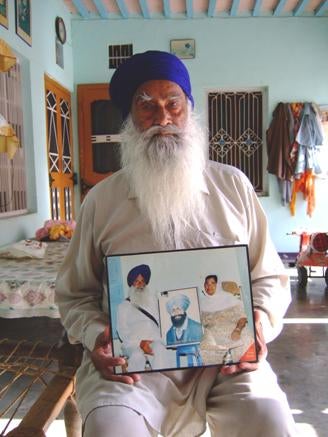
On November 3, 1987 Ajit Singh found that the police had killed his son:
On November 3, 1987 at 6:30 a.m., two Punjab police head constables came to my house on a private scooter and told me that their ‘Sahib’ (station house officer) wanted to see me. The policemen sat me on their scooter and took me to Mahilpur Police Station. At that time, only the clerk [name withheld] was present at the station and he directed me to wait in a room. About 20 minutes later, around 8:00 a.m., I was called out of the room. I saw that a large police force had assembled in the station’s courtyard. [Names of three officers, withheld], and a deputy inspector general (DIG) were among the policemen. These officers told me that they had killed two youths in an encounter at village Barian Kalan, and they asked me to see if my son was among them.320
Ajit Singh identified his son’s body; the identification was confirmed by the head of his village council. Ajit Singh accompanied the police to the hospital. He described his son’s body and apparent marks of torture, and recounted his conversation with the doctor who conducted the post mortem:
Around 1:30 p.m., the SHO ordered the sub inspector to take Pali’s body for post mortem at Garshankar Civil Hospital. They transferred Pali’s body to another truck and I sat in the back of the truck with the body and a constable, and SI [name withheld] and the driver sat in the front.
Before the post mortem, I bought a cloth from the market and covered the bodies. During the post mortem, I removed the clothes from my son’s body. There were marks of torture on his body. There were six to seven scars on his chest from electric shocks, and more on his genitals, neck, and hands. I also saw the bullet wounds; one in his head and several in his chest. His back was blown out from the bullet exit wounds.
At that time, [name of doctor withheld] was the senior medical officer at the civil hospital and personally knew me. I was also a government employee. The doctor told me that the gunshots had been fired at Mohinderpal from a very close range (four meters), but that he couldn’t write that in the post mortem report. He said that he would have to write that Pali was shot from 12 meters, and that if he didn’t, the police would tear up the post mortem report and get it done and signed by another doctor. He clearly told me that in encounter cases, the government doctors always wrote the post mortem reports so as not to incriminate the police. He said that in every police encounter, the gunshots were invariably fired from close range. However, in compliance with the ‘instructions,’ he always wrote that the shots were fired from a long distance. And that is what he would do in this case. As the doctor was telling me this, it was evident from his facial expressions that he was either scared of the police or he was carrying out secret government orders.321
Ajit Singh’s family cremated Mohinderpal Singh’s body at the village that evening. One of his alleged killers reportedly attended the funeral.322 The police had accused Mohinderpal Singh and another individual of killing innocent villagers in the area where the police killed them.323 Ajit Singh later went to the village and spoke to villagers:
At the village, I saw a grove of trees. That place is also known as ‘Babe da Bagh.’ There were many tubewells near there. The owners of those tubewells told me that on the night of the alleged encounter, they were irrigating their fields when they heard the sound of police vehicles and gunshots. Before the gunshots, they heard the voice of a youth who said: ‘Do not kill me blindfolded and bound. Do not shoot me in the back.’ According to the people around there, this youth was arguing with the police in a loud voice and then they heard the sound of gunshots for quite some time. They heard the shots at 3:45 a.m. According to the villagers, after sunrise, the police brought the villagers to the site and showed them the bodies. Later, the police also took the bodies to the village and showed them to the people.324
After his son’s death, Ajit Singh became an active worker of the Akali Dal (Mann) party, and also served as president of a committee of families of the “disappeared” and killed from Hoshiarpur district. For five years after Mohinderpal Singh’s killing, the police continued to raid his house and harass the family.
G. The “disappearance” of Ajmer Singh
Ajmer Singh was a 51-year-old primary school government teacher in village Lasohi. He had three children. According to his wife, Bhagwant Kaur, the family had no connections with militants. In February 1993, the Khanna police detained and tortured Ajmer Singh. Recalls his wife:
He told us about the torture he endured. The police took off his clothes, hung him from his arms tied behind his back, and beat him. They also applied the ghotna and stretched his legs apart. They tortured him every day. He also said that he spoke with another boy detained in the cell opposite his. They were able to see each other and talk to each other through the cracks in the cell doors. The boy said that he had been picked up from Amritsar, and his family had no idea where he was, and that if my husband got out, to please tell his family, because he was afraid that the police would kill him.325
After paying a bribe and exerting political pressure through a member of legislative assembly (MLA), the family was able to secure Ajmer Singh’s release after a week. The police never recorded his arrest.
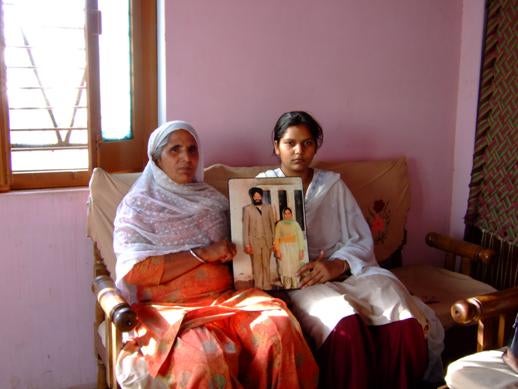
Bhagwant Kaur sits with her daughter, and holds a picture of her “disappeared” husband Ajmer Singh.
© 2007 Ensaaf
On March 4, 1994, Ajmer Singh left school for home at 3 p.m. When he did not return at 3:30 p.m., his wife, Bhagwant Kaur, contacted another teacher at the school who said that Ajmer Singh had been seen going towards his village. His relatives and other villagers fanned out in different directions to look for him. Bhagwant Kaur says that the police took her husband away.
Farm workers along the roadside told my father-in-law that they saw my husband coming on his scooter, but when my husband saw the police parked on the road, he turned around. The police jeep came after him and forced him off the road. Then, the police forcibly abducted him; they put him in the jeep and put his scooter in the tempo [three-wheeled van] and drove off. He was abducted around 3:15 p.m. My father-in-law then went home and told the rest of the family what he had learned. In the meantime, an acquaintance of my husband came to our house and also said that police had abducted my husband.326
The family contacted the MLA who agreed to help them locate Ajmer Singh. Bhagwant Kaur told Ensaaf how she saw Ajmer Singh in police custody:
We went to various police stations to locate my husband, but everybody denied having custody of him. Then, about two to three days later, around March 6, we saw him at CIA Staff Malerkotla. We asked some police officers to release him. They said: ‘Don’t worry. We’ll release him.’ We asked a police employee who those officers were, and he replied that they were [names of officers withheld] ….
We went to Malerkotla CIA Staff again the next day. We met the same officers, and they said again the second day that they would release him. By chance, on the way out, we saw Ajmer Singh in a room, but we were too afraid to speak out and say anything. He wasn’t wearing a turban and it looked as if he had been tortured.327
On both days, Bhagwant Kaur saw her husband’s scooter at the police station.328 The next day, when Bhagwant Kaur and her father-in-law returned to CIA Staff Malerkotla, the same police officers denied custody of her husband. His scooter was also not there.329 Her father-in-law continued to pursue leads, but they never saw Ajmer Singh again.
In April 1994, Bhagwant Kaur attended a meeting organized by Jaswant Singh Khalra and the Human Rights Wing of the Akali Dal, where she learned about his investigations into mass cremations and advocacy on behalf of families of the “disappeared” and killed. Bhagwant Kaur’s father-in-law Jagir Singh filed a complaint with the National Human Rights Commission. The Commission reviewed his complaint on October 24, 1994, and wrote to Jagir Singh on November 2, recording the Commission’s direction:
The petitioner alleged that on 4.3.1994 [March 4, 1994] his son Ajmer Singh had been taken away by the police and has since then not been found out. A notice was issued to the State Government on the complaint. It has been stated that no person by the name of Ajmer Singh had ever been arrested by the police and, therefore, the question of not accounting for the custody of the person does not arise. The SSP, Ropar, has also denied taking into possession of any Scooter and release thereof later on by the Police. In such circumstances, no further action is called for.330
Based merely on the police denial, the NHRC dismissed Jagir Singh’s complaint. It did not pursue any further investigation. In 1996, Ajmer Singh’s family filed a habeas corpus petition:
In 1996, we filed a Habeas Corpus Petition, Cr.W.P. No. 963/1996, in the Punjab and Haryana High Court Chandigarh through Advocate Ranjan Lakhanpal. The High Court ordered the sessions court to conduct an inquiry within three months. The sessions judge in Sangrur, Manmohan Singh Bedi, completed his inquiry within three months, and submitted a report favorable to our case to the High Court. The High Court then ordered the Malerkotla Police to register FIRs against the implicated officers.
During the inquiry process, the police would come to my home and try to persuade me to withdraw the case. I believe they even got me transferred from my job to make it difficult for me to attend the hearings.
We went to the police station and got the FIRs registered. A deputy superintendent of police (DSP) from Malerkotla conducted the investigation, which took three to four months. They would summon me to go to the police station to give my statement. I went about four times. In his final report, the DSP exonerated the police. The DSP had obtained statements from about 18 people from Lasohi village saying that no abduction had taken place. It’s no surprise that he exonerated his colleagues.331
Bhagwant Kaur performed her husband’s last rites in December 2006. After receiving no proof of what had happened to her husband, she resolved in her mind that he must be dead. She told Ensaaf how she lost the ability to pursue her husband’s case:
I don’t have the capacity to pursue the case anymore. My father-in-law is now deceased and I can’t do it without him, and I don’t believe that the witness will cooperate. Now, God will do the final accounting….
My husband was such a hard worker, doing both the school work and farming. He was Amrithdhari. He would help every person and every creature, even giving food and water to stray dogs. The perpetrators should have been punished and I should have been given justice.332
H. Dispiriting delays: The killing of Kulwinder Singh alias Kid
It has been 18 years since Tarlochan Singh first began pursuing a case against the police officers who allegedly killed his son, Kulwinder Singh alias Kid. During this time, key witnesses have died, others have been intimidated by police, and evidence has been destroyed. Further, senior officers have not been charged with their role in the killing, despite apparent superior responsibility for the crime.
Kulwinder Singh was 20years old at the time of his killing, and an active participant in the activities of the All India Sikh Students Federation (AISSF). The police first began to detain and torture Kulwinder in 1985, even detaining family members when they could not apprehend him. The police also filed two cases against him. Kulwinder Singh went into hiding to avoid the repeated police raids. In April 1987, the police implicated Kulwinder Singh in another estimated 25 cases after detaining and torturing him. By September 1987, Kulwinder Singh had been acquitted in these cases.
Kulwinder Singh disappeared on July 22, 1989, in Mohali. Tarlochan Singh, his father, told Ensaaf:
On that day, I received an anonymous call at the school where I worked as principal. The caller informed me that House Number 1752, Phase-V, had been cordoned off by police in civil clothes since 9:30 a.m. I received this call because I was serving as an active member on the Committee Against Police Excesses. The committee, which reported abuses to Ajit Singh Bains, chairman of the Punjab Human Rights Organisation, Chandigarh, was formed to highlight and protest against police abuses in Kharar. My active involvement in this committee had brought me into direct confrontation with the police several times. The committee used to meet daily at 2 p.m…. I informed the other members about the anonymous caller and we decided to proceed to Mohali in a jeep….
As we entered the street where the house was located, from a distance of about 30 yards, we saw Kulwinder Singh and another youth enter the specified house. We also saw three vehicles parked in the street, one of them a gypsy. We saw Kulwinder Singh open the wire-net door of the house, while the other youth stood in the courtyard of the house. Immediately, seven to eight men in civilian clothes came out of the garage and pounced on Kulwinder Singh. They overpowered him and threw him to the ground, covering him with a blanket. The other youth tried to escape by jumping over the wall of the house, but persons stationed on the rooftop shot and killed him. My colleagues and I heard three gunshots fired. Kulwinder Singh was taken to the garage where the landlady had been detained since morning. Kulwinder Singh was then bundled into the gypsy and all of the cars sped away, while three to four policemen in civilian clothes stayed behind with the dead body.333
Tarlochan Singh did not see Kulwinder Singh again.
Tarlochan Singh visited the Phase-I Police station with his colleagues, but they were not allowed to enter. After waiting two to three hours, they went to send telegrams to the chief justice of the Punjab and Haryana High Court, governor of Punjab, the SSP of Ropar, and the director general of police of Punjab. They next went to the office of the daily Punjabi Tribune, where a reporter informed them that the police had issued a press release stating that Palwinder Singh Pola had been killed in an encounter and Kulwinder Singh had escaped. He gave the reporter his version of events, and the Punjabi Tribune and Ajit published that as well.
Two days later, on July 24, human rights attorney Kulwant Singh and his wife visited Tarlochan Singh. Kulwant Singh had represented Kulwinder Singh in the cases against him, and told Tarlochan Singh that he had identified Kulwinder Singh’s dead body at the morgue at Ropar Civil Hospital. The doctor who conducted the post mortem also stated that one of the bodies of two unidentified youth killed the night of July 23, 1989, resembled Kulwinder Singh. The families did not receive the bodies. Justice Ajit S. Bains, Inderjeet Singh Jaijee, and Baljit Kaur tried to reclaim Kulwinder Singh’s body after receiving permission from the district commissioner, but when they reached the hospital, the bodies were gone. The police have continued to maintain that Kulwinder Singh escaped.
On September 22, 1989, Tarlochan Singh filed criminal writ petition No. 3342/89 before the Punjab and Haryana High Court. That began a process of multiple inquiries:
During court, the police admitted that ASI Amarjit Singh raided House No. 1752, Phase V Mohali, on July 22, 1989, and stated that Palwinder Singh Pola had been killed and Kulwinder Singh had escaped…The writ petition was initially heard by Justice SS Grewal and he directed the chief judicial magistrate (CJM) at Ropar to hold an enquiry.
On June 18, 1990, Justice R.S. Mongia of the High Court directed the CJM Ropar to submit an inquiry report in three months on the issue of whether Kid was abducted by police. Inspector Surjit Singh and ASI Amarjit Singh petitioned the High Court to transfer the case to Chandigarh, alleging that no advocate was willing to take up their case because of militant threats.
I learned of the stay request from the CJM Ropar at the second hearing. The CJM told me that I’d have to go to the High Court to challenge the stay petition. He further told me that the police were pressuring him to do things in their favor. He refused to give into their pressure, however, and told the police that he would do justice.
My lawyers were not present to argue against the stay petition, but I told the High Court judge that I could speak for myself. I told the judge about my conversation with the Ropar CJM: the police were seeking a transfer because the CJM Ropar refused to succumb to their pressure. Hari Singh Mann was the counsel for the police. I said I had no objection to the case being transferred to Chandigarh. However, the case should not be transfered to a CJM requested by the police, but some other judge. The High Court agreed with me, and said that the inquiry would be conducted by Tara Singh Cheema, a sessions judge in Chandigarh.334
The sessions judge began the inquiry but was transferred. The second judge was promoted to the High Court. The third judge gave continuances every two to three months, failing to develop the inquiry any further. A year later, he was also promoted to the High Court. The fourth judge M.S. Lobhana completed the inquiry. Tarlochan Singh recounted:
The inquiry report was dated April 29, 1995, and the sessions judge accepted my version of events. He said that my version was fully corroborated by the landlady Dr. Amarjit Kaur, whose presence at the house was not disputed by the police….
The High Court accepted the inquiry report of Justice Lobhana in total and ordered the CBI to conduct an inquiry and then, if appropriate, register cases. The CBI took about three years to complete its inquiry, starting in 1996. The CBI, after completing its investigation, registered cases against 37 officials. Seven were in the first column—the main accused…
After analyzing fingerprints taken from Kid’s previous detentions and prints from the post mortem report, the CBI report concluded that police had killed Kid.335
After receiving the sessions judge's report, Tarlochan Singh had filed criminal petition No. 329/1995 asking for murder cases to be registered against Inspector Surjit Singh Grewal and ASI Amarjit Singh, with a CBI investigation, as well as compensation of 500,000 Indian rupees to the immediate family. The High Court justice directed the CBI to file the necessary charge sheet after investigation and ordered 300,000 Indian rupees as compensation.
Seven years after he had filed the writ petition, charges had not yet been filed. Tarlochan Singh described the police abuse he suffered during those years:
While the case was proceeding, I used to receive threatening phone calls. The caller would say that they had killed thousands of boys and thrown them into canals, and they would also do that to Kulwinder Singh’s wife, Kid, or me and my wife. I would tell the callers that they knew where I lived and they could come and get me.336
The High Court asked the central government for approval to bring a case against state officials. After some delay, the sanction was ultimately granted. The police challenged the sanction, but the High Court dismissed their petition. Tarlochan Singh described the trial, and how the police officers remain free:
The officers were never arrested or suspended. They filed bail applications, and the sessions judge initially denied their applications. They appealed to the High Court and the High Court directed the police to go back to the Sessions Court within 15 days. This time, for reasons known only to the sessions judge, he granted bail.
The trial has been proceeding since 2002, with very little evidence being recorded at each hearing, and with two to three months between hearings. During this time, key witnesses have died. All were members of the committee which conducted inquiries into the police excesses and witnessed the abduction.
In this time, the police have also tried to bribe Dr. Amarjit Kaur, but she still won’t say that Kid escaped from her residence. Surjit Singh Grewal has been promoted to superintendent of police. Earlier, he was an inspector at CIA Staff Patiala. Many of the other guilty policemen have retired. They should receive life imprisonment. When they come to court, they touch my knees and ask me to withdraw my case. This is a mockery of justice. Justice has been murdered by Justice.337
Eighteen years after Kulwinder Singh’s murder, the case continues with little headway.
82 Writ Petition (Crl.) No. 447 of 1995, Committee for Information and Initiative on Punjab v. State of Punjab and Others, April 3, 1995 (Writ Petition (Crl.) No. 447 of 1995). Copy on file with Ensaaf.
83 Order of the Supreme Court dated November 15, 1995, Writ Petition (Crl.) No. 497 of 1995, Paramjit Kaur v. State of Punjab & Others, with Writ Petition (Crl.) No. 447 of 1995. Copy on file with Ensaaf.
84 Order of the Supreme Court dated December 11, 1996, Writ Petitions (Crl.) Nos. 497 and 447 of 1995. Copy on file with Ensaaf.
85 Order of the Supreme Court dated December 12, 1996, Writ Petitions (Crl.) Nos. 497 and 447 of 1995. Copy on file with Ensaaf.
86 Ensaaf, “Sardar Jaswant Singh Khalra,” video report, 2006, http://www.ensaaf.org/docs/khalravideo.php (accessed April 13, 2007).
87 Writ Petition (Crl.) No. 447 of 1995, para. 5x-5xii.
88 Order of the Supreme Court dated December 12, 1996.
89 See Bandhua Mukti Morcha v. Union of India and others, (1984) 3 SCC 161; M.C. Mehta v. Union of India, AIR 1987 SC 1086.
90 Order of the Supreme Court dated November 15, 1995, Writ Petition (Crl.) No. 497 of 1995, Paramjit Kaur v. State of Punjab & Others, with Writ Petition (Crl.) No. 447 of 1995. Copy on file with Ensaaf.
91 Order of the Supreme Court dated December 12, 1996.
92 See e.g., “NHRC to send team to Assam to look into the living conditions in refugee camps,” http://nhrc.nic.in/dispArchive.asp?fno=1478 (accessed October 3, 2007); “Nithari: NHRC awaits govt report,” Tribune (Chandigarh), Jan. 16, 2007. W.P. (Crl.) No. 109 or 2003, National Human Rights Commission v. State of Gujarat & Ors.; W.P. (Crl.) No. 194-202 or 2003 & 326-329 of 2003, National Human Rights Commission v. State of Gujarat & Ors., “India: Gujarat -- Denial of Justice for Victims,” Amnesty International press release, Feb. 26, 2004, available at http://web.amnesty.org/library/index/ENGASA200032004.
93 NHRC Order dated October 9, 2006, Reference Case No. 1/97/NHRC, http://nhrc.nic.in/Punjab.htm#9th%20October,%202006 (accessed April 20 2007). The Bhalla Commission held its last hearing on June 29, 2007 and presumably submitted its final report to the NHRC. According to the NHRC’s October 30, 2006 order, its final report was due June 30, 2007. NHRC Order dated October 30, 2006, Reference Case No. 1/97/NHRC, para. 14. Copy on file with Ensaaf. Throughout its proceedings, it identified duplicate records and reduced the number of cases in its mandate to 800 unidentified cremations. Bhalla Commission order dated May 12, 2007, Reference Case No. 1/97/NHRC and CI/NHRC/2006.
94 NHRC Order dated January 28, 1997, Reference Case No. 1/97/NHRC. Copy on file with Ensaaf.
95 Protection of Human Rights Act, 1993, http://nhrc.nic.in/HRAct.htm (accessed April 20, 2007), Rules 18, 19, 36(2).
96 NHRC Order dated August 4, 1997, Reference Case No. 1/97/NHRC, quoting Bandhua Mukti Morcha v. Union of India & Others, 1984(3) SCC 16. Copy on file with Ensaaf.
97 NHRC Order on Proceedings dated August 4, 1997, Reference Case No. 1/97/NHRC. Copy on file with Ensaaf.
98 A Petition for Clarification/Directions filed on behalf of Applicant-Union of India, Writ Petitions (Crl.) Nos. 497 and 447 of 1995. Copy on file with Ensaaf. The Union of India wanted the PHRA’s one-year statute of limitation to apply, which would have closed the NHRC inquiry.
99 Order of the Supreme Court dated September 10, 1998, Criminal Misc. Petition Nos. 6674 of 1997 and 4808 of 1998, Writ Petitions (Crl.) Nos. 497 and 447 of 1995. Copy on file with Ensaaf.
100 A cremation is “identified” if the name of the decedent, his father’s name, and his residence are known. A cremation is “partially identified” if two out of the three above pieces of information are known. If none of these fields are known, the cremation is “unidentified.” The NHRC based its understanding of its mandate on technicalities, stating that the CIIP’s petition only attached records regarding secret cremations at two cremation grounds in Amritsar district, and not other districts, and that the Supreme Court intended it only to investigate those 2,097 cremations. NHRC order dated January 13, 1999, Reference Case No. 1/97/NHRC. Copy on file with Ensaaf.
101 Application to NHRC by Petitioners in Writ Petition 447 of 1995 Seeking Review of Order dated January 13, 1999 (Received January 28, 1999); Application by Petitioners in Writ Petition No. 447 of 1995 Seeking Clarification and Directions with Reference to Orders dated August 4, 1998 [sic], January 13, 1999 and March 24,1999 (Received February 1, 2001); Application for Clarification of Scope of the Reference Made by this Hon’ble Court to the National Human Rights Commission in the above Writ Petition vide Order dated December 12, 1996, Writ Petition Nos. 497 of 1995 and 447 of 1995 (Dated August 23, 1999). Copies on file with Ensaaf.
102NHRC order dated March 24, 1999, Reference Case No. 1/97/NHRC; Supreme Court order dated October 11, 1999, Review Petition No. 447 of 1995. Copies on file with Ensaaf.
103 NHRC Order dated August 4, 1997, Reference Case No. 1/97/NHRC, para. 9, quoting M.C. Mehta v. Union of India, AIR 1987 SC 1086. In its August 1997 order, the NHRC had quoted from another key case defining the Supreme Court’s Article 32 powers in which the Court stated: “[O]ur approach must be guided not by any verbal or formalistic canons of construction but by the paramount object and purpose for which this article has been enacted as a fundamental right in the Constitution.” NHRC order dated August 4, 1997, para. 9, quoting Bandhua Mukti Morcha v. Union of India & Others, AIR 1984 SC 802. Copy on file with Ensaaf.
104 In its first order on preliminary issues in August 1997, the NHRC discussed setting up commissioners who would “record and process the evidence” and conduct inquiries in order to resolve “the large number of claims that are likely to arise for determination.” NHRC Order dated August 4, 1997, para. 19. Neither the commissioners nor the inquiries ever materialized.
105 See NHRC order dated October 9, 2006, Reference Case No. 1/97/NHRC: “Learned counsel for CIIP during the course of inquiry filed a further list of 163 persons….The State of Punjab, after verification accepted...[the] identity of 111 persons….On March 3, 2005, CIIP filed yet another list of 12 persons….the State of Punjab accepted the identity of 10 persons out of the list of 12 persons. Thus, it was admitted case of the parties that total number of identified bodies now stood as 703 (582 [identified by the CBI] + 111 + 10),” http://nhrc.nic.in/Punjab.htm#9th%20October,%202006 (accessed April 20, 2007).
106 See discussion of case of Paramjit Singh (Sl. No. 67 in CBI list). The dispute was over whether he was in police custody at time of death. NHRC Order dated October 4, 2005 order, Reference Case No. 1/97/NHRC, http://nhrc.nic.in/Punjab.htm#Date:%204th%20October,%202005 (accessed April 20, 2007). The NHRC also changed the classification of the case of Gurbachan Singh, son of Karnail Singh, to admitted custody after CIIP revealed that police records established that he was in police custody at the time of his death, and the State of Punjab did not dispute this position. NHRC order dated October 9, 2006.
107 NHRC Order dated November 11, 2004, Reference Case No. 1/97/NHRC. http://nhrc.nic.in/Punjab.htm#Reference%20made%20by%20the%20Supreme%20Court (accessed April 20, 2007).
108 See, e.g., police affidavits submitted in response to 582 cases identified by CBI, such as Affidavit of Makhan Singh, SP(Detective), Amritsar in CBI No. 285/43 (victim was a robber and killed during attempted robbery); Affidavit of Dilbagh Singh, SP(D), Majitha in CBI No. 281/41 (victim was killed by fellow terrorists). Copies on file with Ensaaf.
109 NHRC Order dated October 9, 2006, Reference Case No. 1/97/NHRC, http://nhrc.nic.in/Punjab.htm#9th%20October,%202006 (accessed April 20, 2007).
110 Ibid.
111 “In so far as other Rules, as noticed above, are concerned, the learned Solicitor General fairly conceded that appropriate steps under the Punjab Police Rules were not taken before cremation of identified dead bodies and that steps were also not taken to identify the unclaimed dead bodies, where identity of the deceased was not known. It is also admitted that even bare minimal steps…were not undertaken by the Punjab Police before getting the bodies cremated in the three crematoria of Amritsar, Majitha and Tarn Taran.” Ibid.
112 The original number of 2,097 was revised to 2,059 after the Punjab Police identified duplicate records in the CBI list. Ibid.
113 During its proceedings, the Bhalla Commission identified duplicate records and reduced the number of cases in its mandate from 814 to 800. Bhalla Commission order dated May 12, 2007, Reference Case No. 1/97/NHRC and CI/NHRC/2006.
114 At a hearing in February 2007, the NHRC heard CIIP’s arguments in response to 54 new identifications made by the Punjab Police after the NHRC had established the Amritsar Commission of Inquiry. The police claimed that the cremation victims had not been in police custody at the time of their deaths. The NHRC placed the entire burden on the CIIP to dispute the police assertions. In the ten days given by the NHRC, Ensaaf investigated five out of the 54 cases, and in four out of the five cases the families denied the police version of events and maintained the police had custody prior to the unlawful killing. In the remaining case, the police suppressed the identity of the true victim and his survivors, and colluded with another family to put forward a fraudulent claim in order to collect compensation. The NHRC did not invite survivor testimony or respond to these arguments, or in any way challenge the police identifications. The police later tried to explain away the fraudulent claim as a case of mistaken identity.
115 “The fact that during the course of inquiry before the Commission as many as 663 more bodies have been identified…shows that they were capable of being identified but apparently sincere efforts do not appear to have been made by the Punjab Police to identify the deceased before they were cremated….We find that there has been a serious lapse on the part of the State Police in this behalf.” NHRC Order dated October 9, 2006.
116 “DGP Fears Threat to Sukhi’s Life,” Tribune (Chandigarh), February 20, 2006, http://www.tribuneindia.com/2006/20060220/main4.htm (accessed April 20, 2007).
117 The CIIP stressed that this information was necessary to ensure that the compensation was granted to the true victim families in submissions to the NHRC and later to the Bhalla Commission but received no response from the NHRC. Copies on file with Ensaaf. In May 2007, after three such cases of forged cremations came to light, an inquiry was ordered by the Punjab DGP. Media reported that in at least one case, police claimed a reward after an innocent individual was killed and cremated in the place of a militant. Ajay Banerjee, “Fake Encounters: Trouble in Store for Erring Cops,” Tribune (Chandigarh), July 26, 2007, http://www.tribuneindia.com/2007/20070726/punjab1.htm#8 (accessed August 1, 2007); Jyoti Kamal, “Punjab digs up a ‘fake encounter,’” CNN-IBN, May 8, 2007, http://www.ibnlive.com/news/Punjab-cops-too-staged-encounters/39960-3.html (accessed May 9, 2007). In early September 2007, former DGP S.S. Virk was arrested for providing one former militant with a faked identity, after the militant was shown to have been killed by the police. Ajay Banerjee, “Virk case: Real issue ‘cats,’ not just assets,” Tribune (Chandigarh), September 10, 2007, http://www.tribuneindia.com/2007/20070910/main2.htm (accessed September 10, 2007).
118 Ensaaf interview with Joginder Singh, Amritsar, February 14, 2007.
119 Conversations between Trideep Pais, Junior Counsel to CIIP, and Sukhman Dhami, February 15, 17, and 27, 2007.
120 Submission to the NHRC by Surinderjit Singh Mand, SP (D), Tarn Taran, Reference Case No. 1/97/NHRC. March 3, 2007. Copy on file with Ensaaf.
121 NHRC Order dated October 9, 2006. See also, NHRC Order dated November 11, 2004, Reference Case No. 1/97/NHRC, http://nhrc.nic.in/Punjab.htm#Reference%20made%20by%20the%20Supreme%20Court (accessed April 20, 2007).
122 Ibid.
123 NHRC Order dated August 4, 1997, Reference Case No. 1/97/NHRC. Copy on file with Ensaaf.
124 NHRC Order dated August 18, 2000, Reference Case No. 1/97/NHRC. Copy on file with Ensaaf.
125 Application by Petitioners in Writ Petition No. 447 of 1995 Seeking Clarification and Directions with Reference to Orders dated August 4, 1998 [sic], January 13, 1999 and March 24,1999 (Received February 1, 2001). Copy on file with Ensaaf.
126 NHRC Order dated October 9, 2006.
127 Application by Petitioners in Writ Petition No. 447 of 1995 Seeking Clarification and Directions with Reference to Orders dated August 4, 1998 [sic], January 13, 1999 and March 24,1999 (Received February 1, 2001). Includes 17 affidavits by survivor families. Copy on file with Ensaaf.
128 NHRC Order dated November 11, 2004, quoting DK Basu v. State of West Bengal, (1997) 1 SCC 416.
129 NHRC Order dated August 4, 1997, Reference Case No. 1/97/NHRC. Copy on file with Ensaaf.
130 NHRC Order dated November 11, 2004, quoting DK Basu v. State of West Bengal, (1997) 1 SCC 416.
131 NHRC order dated November 11, 2005, Reference Case No. 1/97/NHRC, http://nhrc.nic.in/Punjab.htm#Punjab%20Mass%20Cremation%20Order%20dated%2011%20November%202005 (accessed April 29, 2007).
132 “Rates of depression, posttraumatic stress disorder, and global psychological distress were extremely high, with nearly 80% of the individuals interviewed reporting a past or present major depressive disorder and more than half reporting symptoms indicative of posttraumatic stress disorder.” Physicians for Human Rights (PHR) and the Bellevue/NYU Program for Survivors of Torture (Bellevue), “Evaluation of Litigants Pertaining to Writ Petition (Crl.) No. 447/95 Committee for Information and Initiative on Punjab v. State of Punjab,” October 24, 2005, http://www.ensaaf.org/pdf/reports/PHR-Bellevue.pdf (accessed April 29, 2007), pp. 19-20.
133 Application by the Petitioner, October 24, 2005, Writ Petition (Criminal) No. 447 of 1995, Committee for Information and Initiative on Punjab v. State of Punjab and Others.
134 NHRC Order dated October 10, 2006, Misc. Petition No. A-1 dated 24.10.2005 in Reference Case No. 1/97/NHRC. Copy on file with Ensaaf.
135 Open letter from Physicians for Human Rights and the Bellevue/NYU Program for Survivors of Torture to Honorable Dr. Justice Shivaraj V. Patil, Acting Chairperson, National Human Rights Commission, December 8, 2006, http://www.ensaaf.org/pdf/legal/PHRLetter.pdf (accessed April 20, 2007).
136 NHRC Order dated October 9, 2006.
137 Ensaaf interviews with Mohinder Singh, Ropar, March 13 to April 1, 2007.
138 Ibid.
139 Report of Investigation in Crim. Misc. Pet. No. 92 of 1995 & Cr. W.P. No. 87 of 1995, Punjab and Haryana High Court. CBI Case No. RC.4(S)/96-SIU.I/SIC.I/New Delhi. S. Prasad, DSP CBI SIC.I. New Delhi, 16 August 1996, paras. 16 (cremation), 20-21, 28 (establishing identity of unidentified body as Jugraj Singh son of Mohinder Singh). Copy on file with Ensaaf.
140 Ensaaf interview with Gurbachan Singh, Tarn Taran, February 27 to 28, 2007.
141 Ibid.
142 “Comments regarding the list of four cases submitted by CIIP on 03.03.07,” by Sudhir Walia, Adv. for Punjab Police. Submitted March 24, 2007. Copy on file with Ensaaf.
143 Bhalla Commission order dated April 10, 2007. Reference Case No. 1/97/NHRC and CI/NHRC/2006. Copy on file with Ensaaf. Bhalla Commission order dated April 28, 2007. Reference Case No. 1/97/NHRC and CI/NHRC/2006 (insufficiency of Gurbachan Singh’s affidavit). Copy on file with Ensaaf. Bhalla Commission order dated June 8, 2007. Reference Case No. 1/97/NHRC and CI/NHRC/2006 (final rejection of identification). Copy on file with Ensaaf.
144 Ensaaf interview with Dara Singh, Tarn Taran, April 8, 2007. See also, Affidavit of Dara Singh, in Application by Petitioners in Writ Petition No. 447 of 1995 Seeking Clarification and Directions with Reference to Orders dated August 4, 1998, January 13, 1999 and March 24,1999 (received February 1, 2001). Copy on file with Ensaaf.
145 CIIP Submission to Bhalla Commission, March 2, 2007, para. 2 (submitted with April 10, 2007 application). Copy on file with Ensaaf. See also, Bhalla Commission order dated February 3, 2007. Reference Case No. 1/97/NHRC and CI/NHRC/2006 (referencing CIIP submission on three previously identified cases now marked as unidentified).
146 “Comments regarding the list of four cases submitted by CIIP on 03.03.07,” by Sudhir Walia, Adv. for Punjab Police. Submitted March 24, 2007. Copy on file with Ensaaf.
147 Bhalla Commission order dated April 28, 2007. Reference Case No. 1/97/NHRC and CI/NHRC/2006. Copy on file with Ensaaf.
148 Ensaaf interview with Dara Singh, Tarn Taran, April 8, 2007.
149 Ibid.
150 Ibid.
151 Ibid.
152 Ibid.
153 Affidavit of Dara Singh, in Application by Petitioners in Writ Petition No. 447 of 1995.
154 Ensaaf interview with Dara Singh, Tarn Taran, April 8, 2007.
155 The Bhalla Commission subsequently revised the number of unidentified cremations from 814 to 800 because of alleged clerical errors by the CBI. Bhalla Commission order dated May 12, 2007. Reference Case No. 1/97/NHRC and CI/NHRC/2006. Copy on file with Ensaaf.
156 This includes one meeting between the NHRC, Bhalla Commission, and Punjab Police in October 2006, and a private meeting at the January 2nd Bhalla Commission hearing, when Justice Bhalla left the courtroom to hold private discussions with representatives of the Punjab Police, before returning to start the hearing. Neither the Commission nor the Punjab Police have informed the CIIP of what transpired in Justice Bhalla’s chambers. Ensaaf attended the January 2, 2007 hearing.
157NHRC Order dated October 30, 2006, Reference Case No. 1/97/NHRC, para. 16. Copy on file with Ensaaf.
158 Bhalla Commission order dated January 2, 2007. Reference Case No. 1/97/NHRC and CI/NHRC/2006. Copy on file with Ensaaf. Out of the 1,857 claims, those that were not matched to a cremation were not processed further by any agency.
159 Bhalla Commission order dated February 3, 2007. Reference Case No. 1/97/NHRC and CI/NHRC/2006. Copy on file with Ensaaf. See also, Bhalla Commission order dated April 28, 2007. Reference Case No. 1/97/NHRC and CI/NHRC/2006 (stating that it is not the scope of the Commission to determine the fate of the survivor’s son and what happened to the victim’s dead body). Copy on file with Ensaaf.
160 Ensaaf attended the hearing.
161 Ensaaf attended all hearings for the Bhalla Commission of Inquiry from January 2, 2007 to April 10, 2007.
162 NHRC Order dated October 9, 2006, Reference Case No. 1/97/NHRC, Annexure A. Copy on file with Ensaaf. Ensaaf analysis of cremations listed in Annexure A.
163 Submissions of the Petitioner Committee for CIIP in WP No. 447 of 1995 on the issues of Evidence and Inquiry to Fix the Identity of the Remaining 814 Cremations, Bhalla Commission, January 2, 2007. Bhalla Commission order dated February 3, 2007. Reference Case No. 1/97/NHRC and CI/NHRC/2006. Copy on file with Ensaaf.
164 At time of writing, the next NHRC hearing was scheduled for October 18, 2007.
165 Order of the Supreme Court dated December 11, 1996.
166 Ibid.
167 Order dated July 22, 1996. Writ Petitions (Crl.) Nos. 497 and 447 of 1995. Copy on file with Ensaaf.
168 Affidavit on behalf of Respondents No. 4 to 6, Writ Petitions (Crl.) Nos. 497 and 447 of 1995 (Received August 14, 1998), Annexure A/4: Affidavit by Sukhdev Singh Chhina, SP(City) Amritsar, Writ Petitions (Crl.) Nos. 497 and 447 of 1995, Submission on Merit, para. 5vi (Submission on Merit). Copy on file with Ensaaf.
169 Submission on Merit, para. 5vii.
170 Submission on Merit, para. 5viii.
171Writ Petition (Crl.) No. 447 of 1995, Committee for Information and Initiative on Punjab v. State of Punjab and Others, April 3, 1995, para. 5viiii.
172 Affidavit of Baldev Singh, submitted September 27, 1995 to Supreme Court in Civil Writ Pet. No. 447 of 1995, Committee for Information and Initiative on Punjab v. State of Punjab and Others, para. 4. Copy on file with Ensaaf.
173 Ensaaf interview with Baldev Singh, Amritsar, March 29, 2007.
174 Ibid.
175 Ibid.
176 Affidavit of Baldev Singh, para. 5.
177 Ensaaf interview with Baldev Singh, Amritsar, Marcy 29, 2007.
178 Ibid.
179 Ensaaf interview with K. Singh, Amritsar, April 8, 2007.
180 Annexure A of Writ Petition (Crl.) No. 447 of 1995, Committee for Information and Initiative on Punjab v. State of Punjab and Others, April 3, 1995.
181 Ensaaf interview with K. Singh, Amritsar, April 8, 2007.
182Ibid.
183 Order dated July 22, 1996. Writ Petitions (Crl.) Nos. 497 and 447 of 1995. Copy on file with Ensaaf.
184 Ensaaf interview with Balraj Singh, Amritsar, April 9, 2007.
185 Ibid.
186 Ram Narayan Kumar et al., Reduced to Ashes, p. 53.
187 Ibid., p. 54.
188 Writ Petition (Civil) No. 16777 of 2006, Paramjit Kaur Khalra v. State of Punjab and Others (Gill Petition), (Admitted on October 23, 2006), List of dates and events. See also Gill Petition, Annexure P-2, “‘Missing Persons’ not killed: Gill,” Tribune (Chandigarh), January 19, 2005.
189 Ensaaf, “Sardar Jaswant Singh Khalra,” video report, 2006, http://www.ensaaf.org/docs/khalravideo.php (accessed April 13, 2007).See also Gill Petition, Annexure P-2, “’Missing persons’ not killed: Gill,” Tribune (Chandigarh), Jan. 19, 2005 (reporting that Gill stated that missing persons had gone abroad and the ISI was trying to revive the militancy in Punjab).
190 Gill Petition, List of dates and events: January 20, 1995. See also Gill Petition, Annexure P-3/T.
191 Gill Petition, List of dates and events: February 27, 1995.
192 State (CBI) v. Ajit Singh Sandhu & Others, Additional Sessions Judge Bhupinder Singh, Patiala, Session No. 49-T of 9.5.1998/30.11.2001, Judgment, November 18, 2005 (State v. Ajit Singh Sandhu & Others judgment), paras. 14, 17.
193 State v. Ajit Singh Sandhu & Others judgment, paras. 13, 14. Copy on file with Ensaaf.
194 Gill Petition, List of dates and events, March 23, 1995. See also, Counter-Affidavit by Sukhdev S. Chhina, SP (City) Amritsar, on Behalf of Respondents 1, 2, and 5, dated September 25, 1995, Paramjit Kaur v. State of Punjab, Writ Petition (Crl.) No. 497 of 1995, para. 8. Copy on file with Ensaaf.
195 State v. Ajit Singh Sandhu & Others judgment, para. 15.
196 Ibid., para. 15.
197 Ibid., para. 16.
198 Ibid., para. 15.
199 Charge Sheet against police officers with brief report submitted by AS Joshi DSP CBI (New Delhi), pg 6. Case No. RC.14/S/95/DLI. Oct. 30, 1996. Copy on file with Ensaaf.
200 Counter-Affidavit by Sukhdev S. Chhina, para. 1.
201 State v. Ajit Singh Sandhu & Others judgment, paras. 28, 31.
202 Ibid., para. 17.
203 Order of the Supreme Court dated November 15, 1995, Paramjit Kaur v. State of Punjab, Writ Petition (Crl.) No. 497 of 1995. Copy on file with Ensaaf.
204 Gill Petition, List of dates and events.
205 Charge Sheet, Oct. 30, 1996—all charges u/s 120-B read with 365, 220 IPC.
206 Order of Special Judicial Magistrate dated September 3, 1997, State (CBI) v. Ajit S. Sandhu & Others, para.13. The order allowed Paramjit Kaur Khalra’s attorney to participate under the directions of the Public prosecutor. Copy on file with Ensaaf.
207 Order of Sessions Judge K.S. Garewal, Patiala, dated July 25, 1998, State v. Ajit Singh Sandhu & Others, para. 12: “[P]rima facie cases are made out against the accused as under: 1. Under S.120-B IPC against all of the accused. 2. Under S. 364/34 IPC against Ashok Kumar, Surinder Pal Singh, Satnam Singh, Jasbir Singh and Prithipal Singh accused. 3. Under S.302/34 IPC and 201 IPC against Jaspal Singh, Amarjit Singh and Rachhpal Singh.” Copy on file with Ensaaf.
208 State v. Ajit Singh Sandhu & Others judgment.
209 A revision petition is pending against the acquittal of Rachhpal Singh. Crim. Revision Petition No. 1814 of 2005. Paramjit Kaur Khalra v. State of Punjab, July 30, 2005.
210 See, for example, Criminal Appeal No. 865-DB of 2005, Jaspal Singh v. State of Punjab, admitted on December 8, 2005. Copy on file with Ensaaf.
211 Criminal Revision No. 323 of 2006, Paramjit Kaur Khalra v. State of Punjab and Others, admitted on December 12, 2006.
212 Gill Petition, para.12.
213 Ensaaf interview with Paramjit Kaur Khalra, Amritsar, March 27, 2007. See also, “Khalra Panel Cries Foul,” Tribune (Chandigarh), Dec. 1, 2005 at http://www.tribuneindia.com/2005/20051201/punjab1.htm#14 (accessed May 1, 2005).
214 Ensaaf telephone interview with Rajvinder S. Bains, September 10, 2007. The next hearing in this case of Jaspal Singh’s jailbreaks will be on November 23, 2007.
215 Written Arguments of R.S. Bains in the matter of RC-IV/S/95-SCB-1, State v. Ajit Singh Sandhu & Others, filed November 8, 2005, para. 8.
216 Amnesty International, “Break the Cycle of Impunity and Torture in Punjab,” January 2003, http://web.amnesty.org/library/Index/engASA200022003?OpenDocument&of=COUNTRIES%5CINDIA (accessed May 4, 2007), p. 9. Written Arguments of R.S. Bains, para. 8.
217 Written Arguments of R.S. Bains, para. 8. Statement of Rajiv Singh s/o Parkash Singh in court, Prosecution Witness 15, State v. Ajit Singh Sandhu & Others, February 2, 2005. Copy on file with Ensaaf.
218 Written Arguments of R.S. Bains, para. 8.
219 Statement of Kulwant Singh s/o Udham Singh, Prosecution Witness 14, State v. Ajit Singh Sandhu & Others, January 6, 2004. Copy on file with Ensaaf. See also, Written Arguments, para. 8, citing Kulwant Singh’s acquittal and judgment, 1998(1) RCR 846.
220 State v. Ajit Singh Sandhu & Others judgment, para. 17.
221Statement of Kulwant Singh s/o Udham Singh, Prosecution Witness 14, State v. Ajit Singh Sandhu & Others, January 6, 2004. Copy on file with Ensaaf.
222 Statement of Kikar Singh, s/o Harbans Singh, recorded by P. L. Meena, deputy superintendent of the CBI on May 29, 1996 in case RC 14(S)95/S.C.B. DLI (translated from Hindi original). Copy on file with Ensaaf.
223 Order of the Supreme Court dated July 30, 1996, Paramjit Kaur v. State of Punjab, Writ Petition (Crl.) No. 497 of 1995. Copy on file with Ensaaf. The Court ordered protection for Kikar Singh and other witnesses. See also, Affidavit of Kikar Singh s/o Harbans Singh, (Paramjit Kaur v. State of Punjab, Writ Petition (Crl.) No. 497 of 1995) Supreme Court of India, August 29, 1996, para. 1. Copy on file with Ensaaf.
224 Affidavit of Kikar Singh s/o Harbans Singh, para. 3.
225 Affidavit of Kikar Singh s/o Harbans Singh, paras. 3-5.
226 Statement of Kikar Singh s/o Harbans Singh, Prosecution Witness 1, State v. Ajit Singh Sandhu & Others, 2002. Copy on file with Ensaaf. The owner of the vehicle used by the police in the abduction also turned hostile, warranting further investigation.
227 State v. Ajit Singh Sandhu & Others judgment, para. 30.
228 Ibid.
229 “Khalra witness wants CRPF vehicle,” Tribune (Chandigarh), Nov. 4, 2004, http://www.tribuneindia.com/2004/20041104/punjab1.htm#7 (accessed May 4, 2007).
230 Order of Special Judicial Magistrate, CBI, Patiala, September. 3, 1997. Copy on file with Ensaaf.
231 Statement of Kuldip Singh s/o Harbans Singh, Prosecution Witness 16, State v. Ajit Singh Sandhu & Others, February 16, 2005. Copy on file with Ensaaf.
232 State v. Ajit Singh Sandhu & Others judgment, para. 17.
233Ibid.
234 Closure report in the matter of RC 14/S/95-SCB-1-New Delhi regarding report u/s 173 (VIII) Criminal Procedure Code (“Closure report”), Court of Special Magistrate, Patiala, para. 4. submitted September 22, 1999 by investigating officer, DSP, CBI/SIC-IV New Delhi. Copy on file with Ensaaf.
235 Statement of Kuldip Singh s/o Harbans Singh, Prosecution Witness 16, State v. Ajit Singh Sandhu & Others, February 16, 2005. Copy on file with Ensaaf.
236 Order of Sessions Judge dated October 9, 2000, State v. Ajit Singh Sandhu & Others, para. 6.
237 Order of Sessions Judge dated April 9, 1999, State v. Ajit Singh Sandhu & Others, paras. 1, 4.
238 Closure report, para. 13. See also, Statement of K.S. Joshi, Superintendent, CBI, Prosecution Witness 19, March 23, 2005; Order of Sessions Judge dated October 9, 2000, State v. Ajit Singh Sandhu & Others, para. 8. Copies on file with Ensaaf.
239 Closure report, paras. 9-10.
240 Gill Petition, Annexure P-8 (CBI Reply to Petition, filed September 29, 2000 by Public Prosecutor H. Qureshi, CBI SCB-1: New Delhi).
241 Order of Sessions Judge dated October 9, 2000, State v. Ajit Singh Sandhu & Others.
242 Order of Sessions Judge dated October 9, 2000, State v. Ajit Singh Sandhu & Others, para. 15.
243 State v. Ajit Singh Sandhu & Others judgment, para. 17. See also Statement of Kuldip Singh s/o Harbans Singh, Prosecution Witness 16, State v. Ajit Singh Sandhu & Others, February 16, 2005. Copies on file with Ensaaf.
244State v. Ajit Singh Sandhu & Others judgment, para. 17.
245 Ibid.
246 Statement of Kuldip Singh s/o Harbans Singh, Prosecution Witness 16, State v. Ajit Singh Sandhu & Others, February 16, 2005.
247 State v. Ajit Singh Sandhu & Others judgment, para. 17.
248Ibid.
249Ibid., para. 28.
250Statement of Paramjit Kaur, Prosecution Witness 2, State v. Ajit Singh Sandhu & Others, September 4, 2002. See also, Paramjit Kaur v. State of Punjab, Writ Petition (Criminal) No. 497 of 1995, List of Dates and Events (C). Copy on file with Ensaaf.
251Paramjit Kaur v. State of Punjab, 1996 SC (7) 20, November 15, 1995. Copy on file with Ensaaf.
252 Ibid.
253 State v. Ajit Singh Sandhu & Others judgment, para. 26.
254 Ibid.
255 Gill Petition, Annexures P-13, P-14, Representations to CBI, December 5, 2005 (For further investigation in case no. RC No. 14(S)/95/Dellhi, under Sections 120-B, 364, 302, 201 read with Section 34 IPC) and January 15, 2006.
256 Gill Petition, para. 11.
257 Gill Petition.
258 Ensaaf interview with Rajvinder S Bains, Chandigarh, September 15, 2007.
259 Prosecutor v. Kordic and Cerkez, International Criminal Tribunal for the former Yugoslavia, Case No. IT-95-14/2-T, Judgment (Appeals Chamber), December 17, 2004, para. 449 (“Kordic Appeals Chamber”); Prosecutor v. Blaskic, ICTY, Case No. IT-95-14-T, Judgment (Trial Chambers), March 3, 2000, para. 294; see also Prosecutor v. Bagilishema, International Criminal Tribunal for Rwanda, Case No. ICTR-95-1A-T, Judgment, 7 June 2001, para. 38 (“Bagilishema Trial Chambers”).
260 Prosecutor v. Kayishema, ICTR, Case No. 95-1-T, Judgment (Trial Chambers), May 21, 1999, para. 229 (“Kayishema Trial Chambers”). See also Kordic Appeals Chamber, para. 462; Prosecutor v. Blagojevic and Jokic, ICTY, Case No. IT-02-60-T, Judgment (Trial Chambers), January 17, 2005, para. 791 (“Blagojevic Trial Chambers”).
261 Blagojevic Trial Chambers, para. 791. The power to prevent or punish the commission of offenses is also demonstrated by: the power to initiate investigations and discipline subordinates, rewarding subordinates, meeting subordinates and receiving communications rendered through the chain of command. Bagilishema Trial Chambers, paras. 172-173; Kayishema Trial Chambers, paras. 501, 483.
262 KPS Gill, “Endgame in Punjab: 1988-1993,” 2001, South Asia Terrorism Portal, http://www.satp.org/satporgtp/publication/faultlines/volume1/Fault1-kpstext.htm (accessed May 4, 2007).
263Ibid.
264 Prosecutor v. Zejnil Delalic, Zdravko Mucic, Hazim Delic and Esad Landzo, ICTY, Case No. IT-96-21-T, Judgment (Appeals Chamber), February 29, 2001, para. 197 (“Delalic Appeals Chamber”). In cases of de jure command, “a court may presume that possession of such power prima facie results in effective control unless proof to the contrary is produced.”
265 Giving orders which are followed is a substantial indication that a superior posses effective control over his subordinates. See Prosecutor v. Serushago, ICTR, Case No. ICTR-98-39-S, Judgment (Trial Chambers), February 15, 1999, para. 29; Prosecutor v. Blaskic, Case No. IT-95-14-A, Judgment (Appeals Chambers), July 29, 2004, para. 69.
266 In 1989, Gill stated that he took “internal action” after investigating allegations of “excesses” committed by a senior superintendent of [olice (SSP), and took action against those involved in corruption. Amit Buruah, “‘We Have Done A Good Job’—Interview With KPS Gill, DGP,” Frontline, April 29, 1989, 116. In early 1990, Gill told a visiting delegation of members of the European Parliament that, in the first two months of 1990, seven police officers had been suspended and one dismissed for “crimes against the populous.” Amnesty International, “Human Rights Violations in Punjab: Use and Abuse of the Law,” May 1991, http://www.amnestyusa.org/countries/india/document.do?id=8D63FE02A44B98C8802569A600600B91.
267 John Ward Anderson, “Punjab’s Cycle of Violence: Villagers Suffer as Sikh Gunmen and Police Trade Attacks,” Washington Post, September 2, 1992, p. A23.
268 Gill describes how he developed “a radical policy of postings and promotions.” KPS Gill, “Endgame in Punjab: 1988-1993”. See also, Shekhar Gupta and Kanwar Sandhu, “KPS Gill: True Grit,” India Today (April 15, 1993), p.64 (DGP Gill promoted the best officers).
269 By his own description, Gill said that he made it his “practice to move constantly across the state” to meet with his subordinates. He identified the police stations most affected by the insurgency, catalogued their weaknesses, and then addressed them. Gill also received written reports from his subordinates. KPS Gill, “Endgame in Punjab: 1988-1993.”
270 A superior’s actual knowledge can be demonstrated through direct or circumstantial evidence. Delalic Trial Chambers, para. 383; see also Kordic Trial Chambers, para. 427 (same). A superior’s actual knowledge is “easier to prove” if he is “part of an organized structure with established reporting and monitoring systems.” Kordic Trial Chambers, para. 428. Additionally, the number and type of subordinates involved, type of illegal acts, and the identity and character traits of the individuals involved must be considered in establishing the superior’s actual knowledge. Delalic Trial Chambers, para. 386. See also Delalic Appeals Chamber, para. 238.
271 Based on the content of his findings and the timing after Khalra released his investigative report and publicly spoke of the police threats against him, Judge Bhupinder Singh found that SSP Sandhu and his subordinates had a motive to kill Khalra. State v. Ajit Singh Sandhu & Others judgment, paras. 13-14.
272 State v. Ajit Singh Sandhu & Others judgment, paras. 15-18. Further, the Sessions Court, in convicting six officers for their roles in the abduction and murder of Khalra, specifically cited the use of at least two police stations to illegally detain Khalra: Chabal, where two individuals witnessed Khalra’s detention, and Kang. State v. Ajit Singh Sandhu & Others judgment, paras. 17, 28.
273 Sukhwinder Singh Bhatti, abducted May 12, 1994; Kulwant Singh, his wife, and his baby, abducted in January 1993; Ranbir Singh Mansahia, abducted on September 12, 1991; and Jagwinder Singh, abducted on September 25, 1992. Navkiran Singh & Ors. v. State of Punjab, Writ Petition (Crl.) No. 242-258 of 1994, Supreme Court, July 2, 1995. Copy on file with Ensaaf.
274 Praveen Swami, “Forgotten War: Treatment of A.S. Sandhu Raises New Questions,” Frontline, June 27, 1997, p.114.
275 Ensaaf interviews with Mohinder Singh, Ropar, March 13 to April 1, 2007.
276 Ibid.
277 Ibid.
278 Copy of telegram on file with Ensaaf.
279 Ensaaf interviews with Mohinder Singh, Ropar, March 13 to April 1, 2007. The shop owner’s father refused to give a statement to the CBI during its investigation, and told the CBI that his son had not left out of fear. Naresh Talwar, Inspector, CBI/SIC.I/New Delhi, Final Report under Section 173, Criminal Procedure Code, RC.4(S)/96-SIU.I.SIC.I/New Delhi, May 19, 2004. Copy on file with Ensaaf.
280 “Two Terrorists Killed in Majitha Police District,” Tribune (Chandigarh), January 16, 1995. Copy on file with Ensaaf.
281 “Claim that Identification of the Militant Killed in the Encounter is Didar Singh Dari,” Tribune (Chandigarh), January 20, 1995. Copy on file with Ensaaf.
282 Ensaaf interviews with Mohinder Singh, Ropar, March 13 to April 1, 2007.
283 Ibid. See also, Crim. Misc. No. 92 of 1995 in Writ Petition (Crl.) No. 87 of 1995, Mohinder Singh v. State of Punjab, Order of the High Court, March 8, 1996. Copy on file with Ensaaf.
284Ensaaf interviews with Mohinder Singh, Ropar, March 13 to April 1, 2007.
285 Ibid.
286 Ibid.
287 Ibid.
288 Ibid.
289Report of Investigation in Crim. Misc. Pet. No. 92 of 1995 & Cr. W. P. No. 87 of 1995, Punjab and Haryana High Court, CBI Case No. RC.4(S)/96-SIU.I/SIC.I/New Delhi, S. Prasad, DSP CBI SIC.I, New Delhi, August 16, 1996, paras. 20-23. Copy on file with Ensaaf.
290 Ibid., paras. 16 (establishing cremation of bodies in Amritsar), 20-21, 28 (establishing identity of one of the two unidentified bodies as Jugraj Singh, son of Mohinder Singh). See also Crim. Misc. No. 730 of 1996 in Writ Petition (Crl.) No. 87 of 1995, Mohinder Singh v. State of Punjab, Punjab and Haryana High Court, July 17, 1997. Copy on file with Ensaaf.
291 Crim. Misc. No. 730 of 1996 in Writ Petition (Crl.) No. 87 of 1995, Mohinder Singh v. State of Punjab, Order of the Punjab and Haryana High Court, April 29, 1997. Copy on file with Ensaaf.
292 Crim. Misc. No. 608 of 1997 in Writ Petition (Crl.) 87 of 1995, Mohinder Singh v. State of Punjab, Punjab and Haryana High Court, July 17, 1997. Copy on file with Ensaaf.
293 Ensaaf interviews with Mohinder Singh, Ropar, March 13 to April 1, 2007.
294 Crim. Misc. No. 608 of 1997 in Writ Petition (Crl.) 87 of 1995, Mohinder Singh v. State of Punjab, Order of the Punjab and Haryana High Court, August 8, 1997. Copy on file with Ensaaf.
295 Writ Petition (Crl.) 87 of 1995, Mohinder Singh v. State of Punjab, Order of the Punjab and Haryana High Court, November 11, 1997. Copy on file with Ensaaf.
296 Application for directing CBI i.e. Investigation Agency to submit all the documents relating to investigation, No. RC.4(S)/96/SIU.I/SIC.I.CBI/New Delhi, April 16, 1998. Order of Special Judicial Magistrate, CBI, Patiala, RC.4(S)/96/SIU.I/SIC.I.CBI/New Delhi, July 30, 1998. Copies on file with Ensaaf.
297 Crim. Misc. No. 21986-M-1998, Mohinder Singh v. Central Bureau of Investigation, August 26, 1998. Copy on file with Ensaaf.
298 Crim. Misc. No. 21986-M-1998, Mohinder Singh v. CBI, Order of the Punjab and Haryana High Court, June 2, 1999. Copy on file with Ensaaf.
299Ensaaf interviews with Mohinder Singh, Ropar, March 13 to April 1, 2007. See also, Order of Special Judicial Magistrate, CBI, CBI v. Unknown, RC No.4(s)96/10/5/96/SIU.1.SIC.1.CBI.New Delhi, April 9, 2003, para. 11. Copy on file with Ensaaf.
300 Order of Special Judicial Magistrate, CBI, CBI v. Unknown, RC No.4(s)96/10/5/96/SIU.1.SIC.1.CBI.New Delhi, April 9, 2003, para. 11. Copy on file with Ensaaf.
301 Letter from Mohinder Singh to Director, CBI, Subject: Complaint of mis-conduct against Inspector Naresh Talwar, CBI-SIC-I, New Delhi, October 29, 2003. Copy on file with Ensaaf.
302Letter from Mohinder Singh to Director, CBI, November 24, 2003. Copy on file with Ensaaf. Letter from Mohinder Singh to Director, CBI, January 7, 2004. Copy on file with Ensaaf. Letter from Mohinder Singh to Director, CBI, February 12, 2004. Copy on file with Ensaaf.
303 Ensaaf interviews with Mohinder Singh, Ropar, March 13 to April 1, 2007.
304 Naresh Talwar, inspector, CBI/SIC.I/New Delhi, Final Report under Section 173, Criminal Procedure Code, RC.4(S)/96-SIU.I.SIC.I/New Delhi, May 19, 2004, p. 16. Copy on file with Ensaaf.
305 Order of Special Judicial Magistrate, CBI, Punjab, CBI vs. Unknown, RC No. 4(S)/96/SIU.I.SIC-I, New Delhi, February 9, 2006. Copy on file with Ensaaf.
306 Ensaaf interviews with Mohinder Singh, Ropar, March 13 to April 1, 2007.
307 Affidavit of Pritam Kaur, mother of Kulwant Singh, to People’s Commission on Human Rights Violations, para. 1, August 5, 1998. Copy on file with Ensaaf.
308 Ensaaf interview with Jaswant Singh, brother of Kulwant Singh, Patiala, April 16, 2007.
309 Ensaaf interview with Jaswant Singh, Patiala, April 16, 2007. See also, Affidavit by Balkar Singh (father of Kulwant Singh) to Sub-Divisional Officer, Punjab State Electricity Board, Patran, March 31, 1997, para. 3 (regarding reconnecting his motor, which was disconnected while the police occupied their land starting March 1993. The SSP Sangrur had just ordered return of the land). Copy on file with Ensaaf.
310 Ensaaf interview with Jaswant Singh, Patiala, April 16, 2007.
311Ibid.
312 Affidavit of Pritam Kaur, para. 5.
313 Ensaaf interview with Jaswant Singh, Patiala, April 16, 2007.
314First Information Report No. 247 of 1995, Police Station Samana, District Patiala, November 30, 1995. Copy on file with Ensaaf.
315 Affidavit of Pritam Kaur, para. 6.
316 Ensaaf interview with Jaswant Singh, Patiala, April 16, 2007.
317 Ibid.
318Ajit Singh Gill, Biography of Martyr Mohinderpal Singh Pali (unpublished). Copy on file with Ensaaf.
319Ensaaf interview with Ajit Singh, Hoshiarpur, April 11, 2007.
320 Ibid.
321 Ibid.; see also Affidavit by Ajit Singh, submitted to Supreme Court Justice Kuldip Singh (August 6, 1998), para. 6. Copy on file with Ensaaf.
322 Ensaaf interview with Ajit Singh, Hoshiarpur, April 11, 2007.
323 “Seven suspicious individuals among ten killed—Attack on police post,” Ajit (Jalandhar), November 4, 1987, p. 1. Copy on file with Ensaaf.
324 Ensaaf interview with Ajit Singh, Hoshiarpur, April 11, 2007.
325 Ensaaf interview with Bhagwant Kaur, Ludhiana, April 6, 2007.
326 Ibid.
327 Ibid.
328 “The residents of Sihora still are startled when they see police,” Ajit (Jalandhar), May 26, 1997. Copy on file with Ensaaf.
329 Ibid.
330 Letter from NHRC, Law Division, Registrar to Jagir Singh, son of Gurdir Singh, village Sihora, District Ludhiana, No. 19/250/94-LD/NHRC, November 2, 1994. Copy on file with Ensaaf.
331 Ensaaf interview with Bhagwant Kaur, Ludhiana, April 6, 2007.
332 Ibid.
333Ensaaf interview with Tarlochan Singh, Ropar, April 2, 2007.
334 Ibid.
335 Ibid.
336 Ibid.
337 Ibid. The last hearings were on September 28 and 29, 2007 in the CBI special court in Chandigarh.